
Snake plant care fits in one sentence: give it decent light, plant it in fast-draining soil, and water only when the soil has dried out completely, roughly every 2 to 3 weeks in summer and as little as once a month in winter.
That is genuinely the whole job, and here is the twist that makes snake plants different from every other houseplant: almost nobody kills one through neglect. People kill them with kindness. A snake plant can shrug off a month of forgetting, dim corners, dry air, and total indifference. What it cannot survive is a loving owner with a watering can on a weekly schedule, because soggy soil rots its roots, and root rot is responsible for nearly every dead snake plant on earth.
So this guide is mostly about restraint, plus the good stuff nobody tells you: the ten-second test that ends all watering guesswork, the reason this is the single best plant to keep in a bedroom (it does something at night that most plants cannot), how to turn one leaf into a windowsill full of free plants, and the strange catch where a propagated cutting comes back the wrong color.
There is also a rescue procedure for a snake plant that is already mushy and yellowing, because caught early, root rot is survivable. Cheat sheet at the bottom. Start with the one rule that decides everything.
The One Rule: Water Like a Desert, Not a Jungle
Snake plants evolved in the arid rocky regions of West Africa, storing water in those thick, waxy leaves. They are built for drought and defenseless against swamp. Every care decision follows from that.
So how often should you water a snake plant? Water thoroughly, then do not water again until the soil is bone dry all the way down. In practice that lands around every 2 to 3 weeks through spring and summer, stretching to every 4 to 6 weeks in winter, when the plant is barely growing and barely drinking.
But do not trust the calendar. Trust the test. Push a finger, a chopstick, or a wooden skewer deep into the soil. Comes out clean and dry? Water today. Comes out with damp soil clinging to it? Walk away and check again in a week. Ten seconds, zero guesswork, and it automatically adjusts for your light, your pot, and your climate.
When you do water, do it properly: soak the soil until water runs out the drainage hole, let it drain fully, and empty the saucer. A snake plant sitting in a saucer of water is a snake plant filing for root rot. Shallow sips, meanwhile, keep the top damp and the roots dry, the worst of both worlds.
Two small refinements: water the soil, not the center of the leaf rosette, where trapped water invites rot. And if your tap water is heavily treated, letting it sit out overnight helps, since snake plants can get brown leaf tips from fluoride-heavy water.
Master that one rule and the plant is nearly immortal. Everything else in this guide is fine-tuning, starting with where to put it.
Light: It Tolerates Everything, It Prefers One Thing
Snake plants are famous as low-light plants, and the reputation is earned, but there is a difference between what a plant tolerates and where it thrives.
The sweet spot is bright, indirect light: near a window without hot midday sun beating directly on it. In that light a snake plant grows noticeably faster, stands tall and rigid, and keeps its patterns and edges vivid.
In a dim corner, it survives politely. Growth slows to a crawl, new leaves come in thinner, and the bold striping and yellow edging on variegated types fade. It will not die there. It just stops performing.
In direct sun, most types adapt fine, especially with a gradual introduction, though harsh all-day summer sun through glass can scorch leaves.
Two placement tips: rotate the pot a quarter turn each time you water so the plant grows straight instead of leaning toward the window, and know that a snake plant moved from dark to bright will drink faster, so the finger test matters after every move.
Light sorted. The next decision is the one people skip, and it quietly determines the plant’s whole future.
Soil and Pot: Where Root Rot Is Won or Lost
You can have perfect watering discipline and still rot a snake plant if the soil holds water like a sponge. The setup below makes the plant nearly foolproof.
The soil: a cactus and succulent mix, straight from the bag, is exactly right. Upgrading regular potting soil works too: mix in roughly one part perlite or coarse sand for every two parts soil, so water races through instead of pooling.
The pot: a drainage hole is non-negotiable. No hole, no deal, no matter how beautiful the pot (keep the pretty pot as an outer sleeve and grow the plant in a plain nursery pot inside it). Terracotta earns a special mention here: the clay breathes and wicks moisture out of the soil, which gives you an extra margin of error against overwatering.
The size: snug. Snake plants genuinely prefer being a little rootbound, and a pot only 1 to 2 inches wider than the root mass dries out faster and keeps the plant happy. An oversized pot holds a huge volume of wet soil around a small root ball, which is the root rot recipe in ceramic form.
Get the container right and your watering mistakes get forgiven. Now the conditions around the plant, which is the shortest section in this guide for a reason.
Temperature, Humidity, and Food (The Easy Part)
Temperature: anything comfortable for you is comfortable for it. The happy range runs about 60 to 85°F. The only real limits are cold ones: below 50°F growth stops and damage starts, and frost is fatal. Keep it off freezing windowsills in winter and away from blasting AC vents in summer, and that is the whole chapter.
Humidity: irrelevant. Dry winter air that crisps a fern does not register to a snake plant. No misting, no pebble trays, nothing.
Feeding: light and rare. A balanced houseplant fertilizer at half strength, once or twice across spring and summer, is plenty, and none at all in fall and winter while the plant rests. Overfeeding does more harm than skipping a year entirely. If the plant is growing and the leaves stand firm, it is fed.
Which brings us to the section for the plant that is not standing firm, because a snake plant in trouble sends very readable signals.
Troubleshooting: What the Leaves Are Telling You
Yellowing, mushy leaves, soft at the base: overwatering, and possibly root rot in progress. This is the emergency. Skip to the rescue procedure below, today, not next week.
Wrinkled, curling, or slightly leaning leaves with dry soil: genuine thirst, which is rare and wonderful news, because it is the easy problem. One deep soak and the leaves plump back up within days.
Brown, crispy tips: usually inconsistent watering (long droughts followed by floods), sometimes fluoride-rich tap water. The brown tips never turn green again, so trim them with clean scissors following the leaf’s natural shape, and smooth out the watering rhythm going forward.
Leaves flopping outward instead of standing tall: most often too little light, sometimes early overwatering. Move it brighter and let the soil dry hard before the next drink.
Sticky residue, fine webbing, or tiny white fuzz: pests, which are rare on snake plants but possible. Spider mites leave the webbing, mealybugs the white fluff. Wipe the leaves down with a cloth and treat with neem oil or insecticidal soap until clear.
No growth for months: in winter, completely normal, snake plants effectively hibernate. In summer, it usually means very low light or a plant so rootbound it has paused, both easy fixes.
Now the procedure that saves the overwatered ones.
The Root Rot Rescue (Caught Early, They Survive)
A yellowing, mushy snake plant is not necessarily a dead one. Move fast and the odds are good.
- Unpot it. Slide the whole plant out and shake or rinse the soil off the roots.
- Assess. Healthy roots are firm and pale. Rotten ones are brown, mushy, and smell swampy.
- Cut. With clean scissors, remove every soft root and any leaf that is mushy at the base. Be ruthless; anything soft stays behind.
- Dry. Let the trimmed plant sit out of soil for a day or two so the cuts callous over.
- Repot in fresh, dry cactus mix in a clean pot with drainage. Do not water for about a week, then resume with the finger test and a new philosophy.
Even a plant reduced to a few firm leaves can rebuild, because those leaves carry everything needed to start over, which is exactly what the next section is about.
Free Plants: Propagating Your Snake Plant
Snake plants multiply so willingly that one healthy plant can stock a shelf, and there are two ways to do it.
Division (the fast, faithful way): a mature snake plant spreads underground through rhizomes, sending up new pups beside the original. At repotting time, slide the plant out, find a natural cluster with its own roots, and cut it free with a clean knife. Pot it up and it carries on as if nothing happened. Division gives you a full plant instantly and preserves everything about the parent.
Leaf cuttings (the slow, fascinating way): cut a healthy leaf into 3 to 4 inch segments, keeping track of which end pointed down, because segments only root from their original downward end. Stand them in water or lightly moist soil, then wait. And wait. Roots take weeks, new pups take months, but a single leaf can become several plants.
Now the catch promised in the intro: propagate a yellow-edged variety like Laurentii from a leaf cutting, and the babies come back plain green. The golden edge is a chimera, a genetic layer that leaf cuttings cannot carry forward, so only division preserves the variegation. Plain-green types propagate true either way.
Speaking of varieties, if you are choosing a snake plant rather than saving one, the family is bigger than most people know.
A Quick Tour of the Best Varieties
All of them follow the exact care in this guide. The differences are pure style.
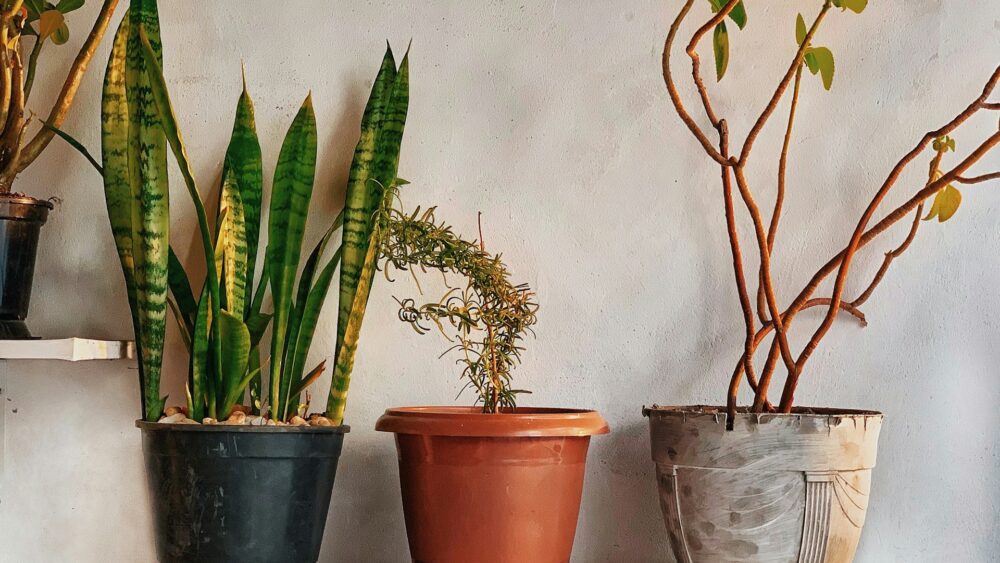
Laurentii: the icon. Tall sword leaves, dark green banding, golden yellow edges.
Zeylanica: the classic without the gold trim, wavy silver-green banding, arguably tougher than tough.
Moonshine: broad leaves in pale silvery green, almost ghostly, and a designer favorite.
Hahnii (Bird’s Nest): a compact rosette under a foot tall, perfect for desks and shelves.
Cylindrica: round, spear-like leaves, sometimes braided by growers.
Whale Fin: one enormous paddle-shaped leaf per pot, slow, sculptural, and wildly popular.
One label note if you go shopping: botanists reclassified the whole group from Sansevieria into the Dracaena genus, so tags may read either name. Same plant, same care.
Two Things Worth Knowing Before Bedroom Placement
The night oxygen trick is real. Most plants breathe in carbon dioxide by day and release a little of it back at night. Snake plants run a different metabolism (CAM photosynthesis, a water-saving adaptation from their desert origins) that lets them keep releasing oxygen after dark. It is why the snake plant tops every list of bedroom plants, and unlike most plant folklore, this one holds up.
The pet warning is also real. Snake plant leaves contain saponins, which are mildly toxic to cats and dogs, typically causing drooling, nausea, or an upset stomach if chewed. It is rarely serious, and the bitter taste means most pets take one bite and quit, but with a dedicated leaf-chewer in the house, keep the plant up high or pick a pet-safe species instead.
And one happy rarity: a mature, rootbound, slightly stressed snake plant occasionally throws up a tall spike of small white flowers, sweetly fragrant at night. It is uncommon indoors, harms nothing, and is the plant’s version of a standing ovation. If it happens, you have earned it.
Repotting: Every Few Years, Reluctantly
Snake plants like their pots the way they like their watering: minimal.
Repot every 2 to 3 years, or when you see the real signals: roots circling out of the drainage hole, water running straight through without soaking in, growth fully stalled in summer, or the plant literally bulging or cracking a plastic pot, which vigorous rhizomes genuinely do.
The job: go up just one pot size, use fresh cactus mix, spring is the ideal timing, and treat it as your propagation appointment, since the plant is already out and any pups practically fall off into your hand.
The Cheat Sheet (Save This)
Screenshot this and relax. The plant has it handled.
Water: only when soil is completely dry, verified by the finger or skewer test. Roughly every 2 to 3 weeks in summer, every 4 to 6 in winter. Soak, drain, empty the saucer.
Light: bright and indirect is ideal, low light is survivable, hot direct sun with a gradual introduction.
Soil and pot: cactus mix, drainage hole mandatory, snug fit, terracotta for extra forgiveness.
Food: half-strength balanced fertilizer once or twice in spring and summer. Nothing in winter.
Yellow and mushy: stop watering, do the root rot rescue today. Wrinkled: just thirsty, soak it. Brown tips: trim, steady the watering.
Free plants: divide at repotting (keeps the gold edges), or leaf cuttings for the slow magic (green babies only).
Pets: mildly toxic to cats and dogs. Keep it out of reach of chewers.
The Bottom Line
Snake plant care is a lesson in doing less. One honest watering rule, a pot that drains, reasonable light, and the plant handles the rest for a decade or more, cleaning up dim corners, breathing at night, and quietly making free copies of itself while every needier plant in the house comes and goes.
Kill the schedule, trust the finger test, and this becomes the plant you own for so long you forget when you got it.