
The best way to grow strawberries comes down to five decisions: full sun (8 hours minimum), slightly acidic well-drained soil, crowns planted exactly at the soil line, an inch of water a week, and the patience to pinch off the first flowers, which is the counterintuitive move that separates a handful of berries from a harvest.
That crown-depth rule deserves its bold up front, because it is the make-or-break detail of the whole crop: plant a strawberry a half inch too deep and the crown rots; a half inch too shallow and the roots dry out and die. No other common garden plant is this picky about one measurement, and it is the quiet reason so many first strawberry beds fail while the tomatoes next to them thrive.
Get the five decisions right and strawberries repay you like almost nothing else in the garden: each plant produces for years, manufactures its own free replacements on runners, and fits anywhere from a farm row to a balcony pot.
All of it is below: choosing between the three strawberry types (this decides your entire harvest calendar), the full planting method, a dedicated section on growing strawberries in pots, the runner trick that turns one plant into a dozen, the companion plants that measurably help your berries and the neighbors that quietly sabotage them, and the honest answer on growing strawberries from seed, including from a store-bought strawberry.
Cheat sheet at the bottom. First, the decision that everything else hangs on.
Pick Your Type First: June-Bearing, Everbearing, or Day-Neutral
Strawberry plants come in three types, and the type decides when your berries arrive, how you prune, even how you plant. Choose before you buy.
June-bearing strawberries produce one massive crop over 2 to 3 weeks in late spring or early summer. Biggest berries, biggest single harvest, and the right call for jam-makers and freezers who want volume all at once. They also produce runners most aggressively, which matters later.
Everbearing strawberries deliver two to three smaller flushes: one in spring, one or two in late summer and fall. Steadier supply, more modest peaks.
Day-neutral strawberries ignore day length entirely and just keep flowering, producing a steady trickle of berries from spring until frost whenever temperatures stay moderate. The best pick for containers and for anyone who wants a bowl of berries most weeks rather than a flood in June.
The quick rule: one big harvest for preserving, choose June-bearing. Berries all season for snacking, choose day-neutral or everbearing. Most garden centers sell all three as young plants or dormant bare-root crowns in spring, and either form works.
Type chosen. Now the ground rules.
Where and When to Plant Strawberries
Sun is non-negotiable. Strawberries convert sunlight into sugar with unusual directness: 8 or more hours of full sun grows sweet, abundant fruit, 6 hours grows a decent crop, and real shade grows lovely leaves and disappointment.
Soil: rich, well-drained, and slightly acidic, ideally pH 5.5 to 6.8. Strawberries have shallow roots and hate wet feet, so heavy clay is better solved with a raised bed or mounded rows than with amendment heroics. Work in a couple of inches of compost before planting, and skip any bed that recently grew tomatoes, peppers, potatoes, or eggplant, for a disease reason covered in the companion section below.
Timing: early spring, as soon as the soil can be worked, is planting season for most climates. Gardeners in mild-winter regions get a second window, planting in fall or even winter for an earlier first crop, since the plants establish roots through the cool months and hit spring running.
Spacing: 12 to 18 inches between plants, in rows 2 to 3 feet apart. That sounds generous for such small plants, and by midsummer, once runners start flying, it will look exactly right.
Now the planting itself, and the one measurement to obsess over.
Planting: The Crown Rule
The crown is the short, thick knot of tissue where the leaves emerge, sitting between the roots below and the foliage above. It is the plant’s engine room, and it must sit exactly at the soil surface: roots fully buried, crown fully exposed, right at the line.
Planting a potted strawberry: dig a hole the size of the root ball, set the plant so the crown sits level with the surrounding soil, backfill, firm gently, and water in. Check after watering, since settling soil can pull a crown low; lift and re-firm if it sank.
Planting bare-root strawberries (the dormant, soil-less bundles sold cheaply in early spring): soak the roots in water for 20 to 30 minutes first, trim any longer than 6 inches, then dig a hole with a small cone of soil in the center. Drape the roots down over the cone like a skirt, hold the crown at the soil line, and backfill. Bare-root plants look alarmingly dead on arrival and wake up within weeks; they are the budget path to a big bed.
Then mulch immediately: 1 to 2 inches of clean straw around (never over) the plants. Straw holds moisture for those shallow roots, blocks weeds, and, most importantly, keeps ripening berries off the wet soil where rot and slugs wait. The name straw-berry is a lesson in itself.
The in-ground method handled, here is the version for everyone without a garden bed.
Growing Strawberries in Pots (They Might Prefer It)
Strawberries are one of the best container crops in existence, and not as a compromise: their shallow roots fit pots perfectly, containers lift the fruit away from slugs and soil rot, and a pot on a sunny balcony often outproduces a shaded garden bed.
The setup:
- Any container at least 8 to 12 inches deep and wide, with drainage holes. Classic strawberry jars, hanging baskets, fabric grow bags, window boxes, and stacked towers all work. One plant per 10 to 12 inches of surface.
- Quality potting mix, not garden soil, which compacts in pots. Mix in a slow-release balanced fertilizer at planting.
- Same crown rule as the ground: roots buried, crown at the surface.
- Day-neutral or everbearing varieties are the container champions, producing all season on compact plants. June-bearers work but deliver everything in one short window.
The two container habits that matter:
- Water more often than feels reasonable. Pots dry out far faster than beds, and in summer heat a strawberry pot often needs water daily. The finger check settles it: dry an inch down means water now. Inconsistent watering is the number one cause of small, sparse container berries.
- Feed lightly but regularly, since frequent watering rinses nutrients out of the pot. A half-strength balanced liquid feed every 2 to 3 weeks through the growing season replaces what drains away.
Winter in pots: roots in containers face colder temperatures than roots in the ground. In cold-winter regions, move pots against a sheltered wall, into an unheated garage or shed, or sink them into a garden bed for the season. The plants are dormant and need only occasional light watering until spring.
Whether bed or pot, the next section is where new strawberry growers earn their stripes.
The First-Year Sacrifice (Pinch the Flowers)
Here is the move nobody wants to make and every experienced grower swears by: in the first year, pick off the flowers.
A newly planted strawberry wants to fruit immediately, but every berry it makes in year one is energy stolen from root building. Pinch the blossoms off, and the plant invests everything in roots and crowns instead, and repays you the following spring with a harvest often double what an unpinched plant produces, on a plant that keeps producing for years.
The protocol by type: June-bearing plants, remove all flowers the entire first season, and take the payout in year two. Everbearing and day-neutral plants, remove flowers only until about the start of July of year one, then let them fruit, which surrenders only the early crop and still banks most of the root growth.
It stings for exactly one season. The plants spend years paying it back. And speaking of the plants paying you back, here comes the free-plant machine.
Strawberry Runners: One Plant Becomes Twelve
By midsummer, your strawberries will start sending out runners: long horizontal stems that skate across the soil, land a few inches away, and grow a complete baby plant (a “daughter”) at the tip, roots and all. This is strawberries offering you free stock, and managing it well is half of long-term strawberry success.
To multiply your patch: choose the strongest runners from your best plants, let each daughter land where you want it (or pin it down with a bit of bent wire or a stone), and keep the spot moist. Once the daughter is rooted and growing, usually 4 to 6 weeks, snip the connecting stem, and it is an independent plant.
The pot trick, and it is the best version: sink a small pot of potting mix into the soil beside the mother, pin the runner’s tip into the pot, and let the daughter root directly into it. When you cut the cord, you are holding a ready-to-transplant potted strawberry: movable to a new bed, a container, or a friend, with zero digging and zero root disturbance.
But do not keep them all. Runners are also a tax: every one the plant feeds is energy not going into fruit. Keep the two or three daughters you actually want per plant and trim the rest, especially on everbearing and day-neutral types, where heavy runner production directly shrinks the berry supply.
The renewal cycle this enables: strawberry plants peak in years two and three, then decline. The runner habit means your bed replaces itself for free: root a wave of daughters each summer, retire the mothers after their third or fourth season, and the patch stays permanently young without another trip to the garden center.
Now the neighbors, and this is a bigger deal for strawberries than for almost any other crop.
Strawberry Companion Plants (Helpers and Saboteurs)
Companion planting has a folkloric reputation, but for strawberries several pairings rest on solid, practical mechanics: pest confusion, pollinator traffic, ground cover, and shared space. Just as practically, a few common neighbors carry real risk.
The helpers:
Borage is the celebrity companion, and it earns the status twice over: its blue flowers are a pollinator magnet, pulling bees through your strawberry bloom, and it draws predatory insects that eat strawberry pests. Old garden lore claims it improves the flavor of berries nearby; the pollination boost, at least, is very real.
Garlic, onions, and chives run scent interference. Their sulfur smell confuses and repels aphids, spider mites, and other soft-bodied pests hunting for your plants, and their skinny vertical footprint fits between strawberries without competing.
Thyme creeps into a fragrant living mulch around the plants, suppresses weeds, and is reputed to deter worms and some crawling pests, while its flowers feed pollinators.
Marigolds deter root-attacking nematodes and various beetles, and are the cheapest insurance in the bed.
Lettuce and spinach make ideal space-sharers: shallow, quick, cool-season crops that fit between young strawberry plants in spring and are harvested before the strawberries need the room. The leafy canopy even helps hide ripening berries from birds.
Bush beans and clover quietly enrich the bed, fixing nitrogen in the soil that the strawberries’ shallow roots appreciate.
The saboteurs:
Tomatoes, peppers, potatoes, and eggplant, the whole nightshade family, are the neighbors to refuse. They host and spread verticillium wilt, a soil fungus that devastates strawberries, and the risk extends through time as well as space: avoid planting strawberries in soil where nightshades grew within the past 3 to 4 years, because the fungus waits.
The cabbage family (broccoli, cauliflower, cabbage, kale) competes hard for the same nutrients and root zone, and both crops sulk when paired.
Fennel is the garden’s famous bad neighbor, releasing compounds that suppress the growth of most plants around it. Fennel gets a corner to itself, far from the berries.
Neighbors sorted. Two more topics before harvest: the from-seed question, and playing defense.
Growing Strawberries From Seed (And From a Store-Bought Strawberry)
Strawberries can absolutely be grown from seed, and it is the slow, scenic route, worth choosing deliberately rather than by default.
The method: strawberry seeds need cold stratification, so seal the seed packet in a bag in the refrigerator for 3 to 4 weeks before sowing. Then surface-sow onto damp seed-starting mix, pressing the seeds in without covering them, because strawberry seeds need light to germinate. Warmth, moisture, and patience: germination takes 1 to 6 weeks, and the seedlings grow slowly. Started indoors in late winter, seed-grown plants typically fruit lightly in their first fall or properly in year two.
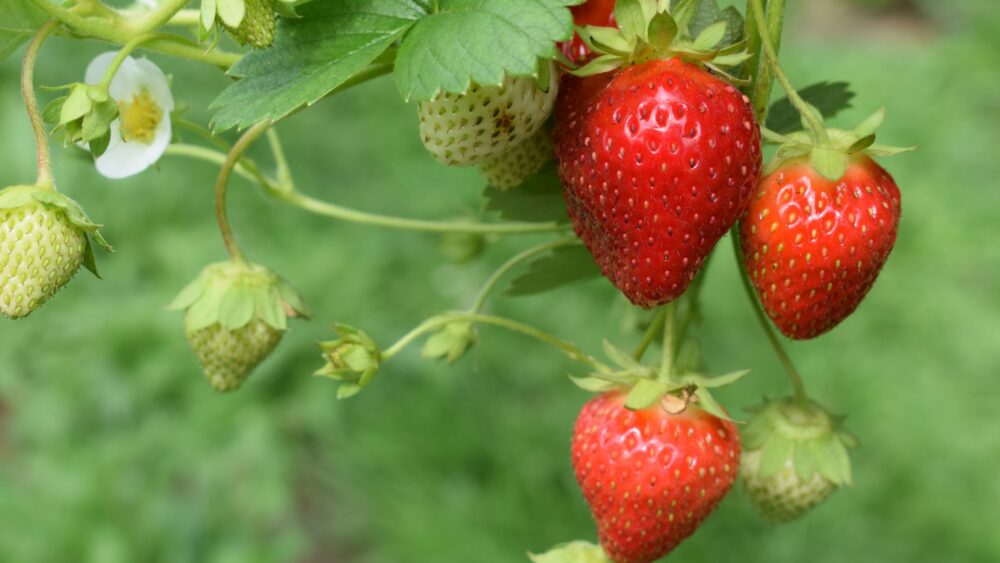
Those dots on every strawberry are the seeds, which raises the inevitable question: can you grow strawberries from a strawberry? Yes, mechanically: dry the flesh or blend a berry briefly with water and strain, collect the tiny seeds, stratify, and sow as above. The honest footnote is that grocery strawberries are hybrids, and their seedlings do not come true, so the plants you raise will be a genetic grab bag: some decent, some feeble, few matching the berry you ate. A fun experiment, not a production plan.
The exception that proves the rule: alpine strawberries, the tiny, intensely aromatic woodland type, come true from seed and are genuinely best started that way, since they produce almost no runners.
The practical bottom line: for eating-sized harvests on a schedule, buy plants or bare-root crowns, or take free daughters from a friend’s runners. Grow from seed for alpines, for curiosity, or for the pleasure of raising a fruit plant from a dot.
Water, Feeding, and Defense
Water: about 1 to 1.5 inches per week, at the soil rather than over the foliage, since wet leaves and fruit invite rot. Those shallow roots mean strawberries feel drought early, especially while fruit is swelling, which is when water stress translates directly into small berries.
Feeding: compost at planting carries the first months. In-ground beds appreciate a balanced fertilizer (a 10-10-10) after the first-year establishment, applied for June-bearers after harvest (fueling next year’s buds) and for everbearing and day-neutral types lightly through the season. Go easy on nitrogen everywhere: overfed strawberries grow magnificent leaves and shy fruit.
Defense wins the harvest:
- Birds are the top thief, and netting draped over hoops or stakes just before berries blush is the only reliable answer. Tuck the edges; birds are professionals.
- Slugs take the ground-level fruit, and the straw mulch, beer traps, and evening patrols hold the line. Container growing largely sidesteps them entirely.
- Gray, fuzzy berries are botrytis rot, the wet-fruit disease: straw under the fruit, watering at soil level, and prompt picking prevent most of it.
Pick at full color: strawberries stop ripening the moment they leave the plant, so harvest only fully red berries, pinching or snipping the stem rather than tugging the fruit. In season, pick every other day, and the plants respond by ripening more.
Winter: after the first real freeze, blanket in-ground beds with 3 to 4 inches of straw, and pull it back in early spring. (Pots follow the sheltered-spot routine from the container section.)
Quick Troubleshooting
Lots of leaves, no flowers: usually a first-year plant doing its job, too much shade, or too much nitrogen. Patience, sun, and a lighter hand with fertilizer, in that order.
Flowers but no berries: a late frost that killed the blossoms’ centers (frosted flowers show a telltale black eye) or poor pollination. Cover plants when frost threatens bloom, and let the borage recruit more bees.
Small or sparse berries: overcrowding from unmanaged runners, plants past their prime (year four and up), or water stress during fruiting. Thin, renew from daughters, and steady the watering.
Plants wilting and dying in patches: if nightshades grew there recently, suspect verticillium, and start fresh stock in a new bed or containers.
The Cheat Sheet (Save This)
Screenshot this before planting weekend.
Choose: June-bearing for one big preserving crop, everbearing or day-neutral for berries all season (and for pots).
Plant: full sun 8+ hours, pH 5.5 to 6.8, 12 to 18 inches apart, and the crown exactly at the soil line: roots buried, crown exposed. Straw mulch immediately.
Year one: pinch all flowers (June-bearers all season; others until early July). It doubles year two.
Pots: 8 to 12 inches deep, potting mix, day-neutral varieties, water daily in heat, half-strength feed every 2 to 3 weeks, shelter pots in winter.
Runners: keep 2 to 3 daughters per plant, root them into sunken pots for free transplants, trim the rest, retire mother plants after year 3 to 4.
Companions: yes to borage, garlic, chives, thyme, marigolds, lettuce. No to tomatoes, peppers, potatoes, eggplant (verticillium), cabbage family, and fennel.
Defend: bird netting at first blush, straw under fruit, water at soil level, pick fully red every other day.
The Bottom Line
Growing strawberries is a short list of disciplines: sun, the crown at the line, one patient flowerless year, and runners managed like the free nursery they are. Do those, keep the tomatoes at a respectful distance, and a single spring planting becomes a self-renewing berry patch that hands you fruit, and new plants, for years.
The supermarket sells strawberries. The garden sells the version they were always supposed to taste like.