
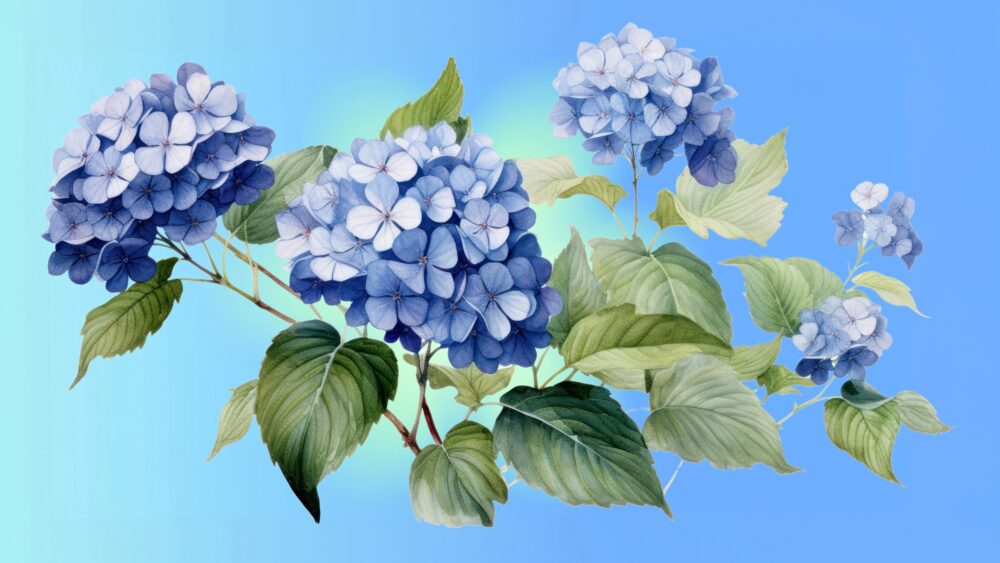
Hydrangea care comes down to five habits: morning sun with afternoon shade, deep watering whenever the top of the soil dries, a 2 to 3 inch blanket of mulch, one feeding in early spring, and pruning at the right moment for your specific type.
That last one is where most hydrangeas go wrong. The number one reason a healthy, leafy hydrangea refuses to bloom is pruning at the wrong time of year, and here is the trap: the “wrong time” is completely different depending on which hydrangea you own. Prune a bigleaf in fall and you have cut off next summer’s flowers. Prune a panicle in summer and you have done the same. Same shears, same good intentions, opposite calendars.
So this guide starts with a sixty-second identification, because every care decision downstream, pruning, sun, winter protection, even the option to change the flower color, depends on knowing your type. After that: the watering signals hydrangeas give you (including the afternoon wilt that looks like an emergency and usually is not), the soil trick that turns blooms blue or pink, a troubleshooting section for the dreaded all-leaves-no-flowers plant, and a season-by-season care calendar you can screenshot.
Let’s figure out what you are growing.
First: Which Hydrangea Do You Have?
Six types cover nearly every hydrangea in home gardens, and they split into two care families based on one question: does it bloom on old wood (stems grown last year) or new wood (stems grown this spring)?
Bigleaf (Hydrangea macrophylla): the classic. Big mophead or lacecap blooms in blue, purple, or pink, glossy rounded leaves. Blooms on OLD wood. This is the one whose color you can change.
Mountain (Hydrangea serrata): like a daintier bigleaf, mostly delicate lacecap flowers, also color-changeable. OLD wood.
Oakleaf (Hydrangea quercifolia): unmistakable oak-shaped leaves, cone-shaped white blooms that age pink, brilliant fall foliage. OLD wood.
Panicle (Hydrangea paniculata): cone-shaped white blooms in mid to late summer, the toughest and most sun-tolerant of the family. NEW wood.
Smooth (Hydrangea arborescens): giant white snowball blooms in early summer (‘Annabelle’ is the famous one). NEW wood, and the most forgiving hydrangea alive.
Climbing (Hydrangea anomala petiolaris): a vine that scales walls on aerial roots, white lacecap flowers. Prune only to control size.
Remember your family: bigleaf, mountain, and oakleaf are the old-wood group. Panicle and smooth are the new-wood group. That single fact drives the pruning section below and the winter section after it.
Type known. Now give it the light it actually wants, because the shade advice you have heard is half wrong.
Light: The Shade Myth That Costs You Blooms
“Hydrangeas need shade” is one of gardening’s most repeated half-truths, and too much shade is a top cause of a bloomless plant.
The sweet spot for most types is morning sun and dappled afternoon shade. Morning light fuels flower production; afternoon shade protects the plant through the hottest hours.
By type: panicle hydrangeas take full sun happily, and smooth hydrangeas tolerate it in cooler regions. Bigleaf and mountain types want that morning-sun arrangement, especially in hot climates. Oakleaf is the most shade-tolerant, though it blooms better with more light. Climbing hydrangeas like sun in the north and shade in the south.
One more siting factor nobody mentions: airflow. A hydrangea crammed against a wall or crowded by other shrubs traps humid air, and humid still air is exactly what powdery mildew waits for. Space matters: roughly 3 to 4 feet around a bigleaf, 6 to 10 for a full-size panicle.
If your plant is already in deep shade and refusing to bloom, moving it in fall or early spring is a real fix, not a last resort. Light sorted. Water is next, and hydrangeas make it easy by telling you exactly what they need.
Watering: Read the Plant, Not a Schedule
The name starts with “hydra” for a reason: hydrangeas are thirsty, especially in their first two years while roots establish. But there is no universal gallons-per-week rule, because sun, soil, climate, and plant age change everything. Instead, learn the two signals.
Thirsty hydrangea: crispy brown leaf edges, and wilting. But here is the nuance that saves you from overwatering: on a hot afternoon, a hydrangea can wilt dramatically and recover completely by evening on its own. That is heat management, not drought. The real test is the evening check: still wilted after the temperature drops? Water now. Wilted at 2 p.m. but perky at 7? It was fine all along.
Drowning hydrangea: yellowing leaves that go soft and droopy rather than crisp, and soil that stays soggy around the base. Overwatering suffocates roots, and it looks deceptively like thirst, which is why the soil check matters before the hose comes out.
The habits that make watering easy:
- Water deeply and less often. Deep soakings push roots downward where moisture holds; daily sprinkles keep roots shallow and fragile.
- Water at the base, never overhead. Wet leaves invite fungus, and water on white blooms browns the petals.
- Morning is the best hour, giving leaves the day to dry.
- Containers and full-sun plants dry out far faster and may need daily checks in summer heat.
And the single biggest watering upgrade is not water at all. It is the next section.
Mulch: The Two-Minute Job That Does Four Jobs
A 2 to 3 inch layer of organic mulch, shredded bark, pine straw, leaf mold, is the highest-return two minutes in hydrangea care.
It slows evaporation so your watering lasts, keeps shallow roots cool in summer and warmer in fall, and smothers weeds, which matters more than it sounds: hydrangea roots run shallow, and yanking established weeds out from above them tears feeder roots.
The rules: start the mulch ring about 2 inches out from the crown (mulch piled against stems invites rot), spread it to the drip line, use natural undyed mulch, and skip any product containing weed pre-emergent, which stunts those same shallow roots. Refresh the layer each spring once the soil has warmed.
Fed, watered, and blanketed. Now the section that decides whether next summer has flowers.
Feeding: Less Than You Think, Earlier Than You Think
Hydrangeas are light feeders, and the classic mistake is loving them to death with nitrogen, which buys you a huge, lush, green plant with no flowers on it.
The routine: one application of a balanced slow-release fertilizer (a 10-10-10 works well, as do hydrangea-specific bloom formulas) in early spring as new growth emerges. Container plants get a second light feeding six to eight weeks later, since watering flushes their nutrients out faster.
The two don’ts: never feed after midsummer, because late-season fertilizer pushes soft new growth that winter kills before it hardens. And keep lawn fertilizer well away from the bed, because high-nitrogen lawn runoff is the classic cause of a giant leafy hydrangea that has not bloomed in years.
Speaking of blooming, here is the part to read twice.
Pruning: The Make-or-Break Skill (By Type)
Everything in this section flows from the old wood vs new wood split in the ID section, because the two families keep opposite calendars.
Old-wood types (bigleaf, mountain, oakleaf): these set next year’s flower buds in late summer and fall on this year’s stems. Those buds ride through winter and open next season. Which means a fall or spring haircut removes the flowers you have not seen yet.
- Prune immediately after they finish blooming in summer. That is the only safe window.
- Deadhead spent blooms anytime by cutting just below the flower head, above the nearest healthy pair of leaves.
- Remove dead, damaged, or crossing stems whenever you see them.
- In cold climates, leave frost-damaged stems until spring, when you can see what is truly dead, then cut just above the highest swollen bud.
New-wood types (panicle and smooth): these grow their flowering stems fresh each spring, which makes them nearly impossible to prune wrong on timing.
- Prune in late winter to early spring, before growth starts.
- Cut smooth hydrangeas down to 12 to 24 inches; they respond with vigor.
- Cut panicle types back by about a third, just above outward-facing buds, and never to the ground, which produces floppy stems too weak to hold the flower heads.
- Harder pruning gives fewer, bigger blooms; lighter pruning gives more, smaller ones. Dried flower heads can stay all winter for looks and come off in the late-winter cut.
Not sure if a stem is dead? The scratch test: scrape the bark lightly with a fingernail. Green underneath means alive. Dry brown or hollow means dead: remove it cleanly at the base.
And the golden rule when you are not sure what type you own: only deadhead. Removing spent flower heads is safe on every hydrangea in every season. Real pruning can wait until you have identified the plant.
Which brings us to the question this whole guide has been building toward.
Why Isn’t My Hydrangea Blooming?
A green, healthy, flowerless hydrangea is the most common complaint in the hydrangea world. Run this list top to bottom and you will almost always find your answer.
1. It was pruned at the wrong time. The number one cause. An old-wood type cut in fall, winter, or spring lost its buds to the shears. The fix costs nothing but patience: prune only right after flowering from now on, and blooms return next year.
2. Winter or a late frost killed the buds. Old-wood buds sit exposed all winter. A hard freeze, or a warm spell followed by a late spring frost, kills them silently: the plant leafs out fine and simply never flowers. The winter protection section below is the fix.
3. Too much shade. Enough light to grow leaves is not enough light to make flowers. If it sits in deep shade, relocate it.
4. Too much nitrogen. Lawn fertilizer drift or heavy feeding equals foliage instead of flowers. Feed once, lightly, in spring, and check what the lawn service is spreading nearby.
5. Deer ate the buds. Deer treat bigleaf hydrangeas as a salad bar, and a winter of browsing removes the buds before you ever see them. Netting or repellent through the dormant season protects old-wood types.
6. It is simply young. A newly planted hydrangea often spends a season or two building roots before it blooms in earnest. Give a new plant two full years before you diagnose a problem.
Blooms secured. Now, if yours is a bigleaf or mountain type, you get to play with what color they are.
The Color Trick: Turning Blooms Blue or Pink
This is the hydrangea party trick, and it only works on bigleaf and mountain types. Panicle, smooth, and oakleaf blooms ignore soil chemistry entirely.
The color comes from aluminum. In acidic soil (pH 5.5 and below), aluminum is available to the roots and the flowers come out blue. In alkaline soil (pH 6.5 and up), aluminum is chemically locked away and the flowers come out pink. The zone in between produces purples and mauves.
For blue: work aluminum sulfate into the soil in early spring. A drench can shift color within weeks. For pink: apply garden lime to raise the pH. Lime is slower; expect a season. The kitchen shortcut: used coffee grounds are mildly acidic. A thin scattering around the base a few times a year nudges soil toward blue while feeding the soil life.
Two footnotes: only future buds change, never flowers already open, and a soil test (worth doing every couple of years anyway) tells you your starting point instead of guessing.
Pests, Spots, and Mildew
Hydrangeas are tough, and most problems trace back to two habits worth breaking: overhead watering and crowded plants.
Aphids and spider mites attack soft new growth. Aphids cluster on stems and leaf undersides; mites leave fine webbing and dusty, stippled leaves. Blast both off with a strong jet of water, and escalate to neem oil only if they persist.
Cercospora leaf spot shows as small spots with reddish-purple borders and tan centers. It weakens rather than kills; remove affected leaves and keep foliage dry.
Powdery mildew, the white-gray dusting, thrives on warm days, cool nights, and stale air. Water at the base, prune for airflow, and pull infected leaves promptly. Do those three things and you will likely never need a fungicide.
Deer deserve their own line: they browse hydrangeas hard, and on old-wood types a winter of nibbling is a summer without flowers. Repellents or netting from fall through spring where deer roam.
Winter Care (Only Two Types Need It)
Here is a relief: panicle and smooth hydrangeas need zero winter protection. Their buds do not exist yet in winter.
Bigleaf and mountain types are the vulnerable ones, because their exposed buds ride out the cold. Where winters regularly dip below 14°F, protect them:
- Wait until the ground has frozen. Wrapping too early traps warmth and moisture.
- Pile straw, dry leaves, or pine needles loosely 8 to 12 inches deep around the base.
- For serious cold, ring the plant with a wire cage (a tomato cage works) filled loosely with straw, or wrap loosely in burlap.
- Remove it gradually in early spring once nights stay above freezing.
Ten minutes in December buys the June flowers a frost cannot take.
Container Hydrangeas: The Extra 10 Percent
Pots work beautifully for bigleaf, compact panicle, and some mountain types (oakleaf and climbing outgrow them). The tradeoff is attention: confined roots run drier, hotter in summer, and colder in winter than garden soil.
The container routine: a pot at least 12 to 18 inches wide with real drainage holes, quality potting mix that holds moisture but drains, daily water checks in summer heat, that second light spring feeding, a sheltered unheated spot (garage, shed) for winter, and a repot one size up every 2 to 3 years.
One more habit for the big-bloomed types anywhere: mophead flowers get heavy enough that one rainstorm lays them flat. A grow-through ring or tomato cage installed in spring, before the stems reach height, keeps them standing. And on smooth hydrangeas, correct late-winter pruning (not too low) is itself the anti-flop measure.
Your Hydrangea Care Calendar
The whole year on one screen.
Early spring: feed once (slow-release, balanced). Prune panicle and smooth types. Cut winter-killed wood on old-wood types above the highest live bud. Refresh mulch once soil warms. Apply aluminum sulfate or lime if you are steering color.
Late spring: remove winter protection gradually. Water as heat arrives. Set support rings before stems get tall.
Summer: deep water through heat, checking containers daily. Do the evening wilt check before panic-watering. Prune old-wood types (bigleaf, mountain, oakleaf) right after their flowers fade, and only then. Deadhead anything, anytime.
Fall: stop feeding entirely. Water until the ground freezes. Do not prune old-wood types, no matter how untidy they look.
Winter: after ground freeze, protect bigleaf and mountain types where winters drop below 14°F. Leave panicle and smooth dried blooms standing for winter interest. Guard against deer.
The Bottom Line
Taking care of hydrangeas is not hard. It is specific. Identify your type once, and every decision answers itself: when to prune, how much sun, whether winter needs you, whether the color trick is on the table.
Water deeply, feed lightly, mulch generously, prune on your plant’s calendar instead of yours, and a hydrangea does not just survive, it gets bigger and more ridiculous with bloom every single year. The plant is patient. It is just waiting for you to learn its name.