
Two moves tonight end most fruit fly problems: set out a small bowl of apple cider vinegar with two or three drops of dish soap, and get every piece of exposed produce into the fridge or the outdoor trash. The trap drowns the adults overnight, and clearing the fruit cuts off the next generation.
Speed matters more with fruit flies than with any other household pest, and here is the math that explains why. A female fruit fly lays up to 500 eggs, those eggs hatch in about a day, and the whole cycle from egg to breeding adult takes roughly 8 to 10 days at room temperature. Which means the two flies hovering over your bananas on Tuesday are a full airborne colony by the weekend. You are not fighting the flies you see. You are racing the clock behind them.
Win the race and the kitchen is yours again in days. This guide covers the whole campaign: where the flies actually came from (it is not “out of nowhere,” and the real answer changes how you shop), the sixty-second trap that outperforms anything at the store, the five breeding spots hiding well away from the fruit bowl, a trap recipe from the 1800s that still works, and the honest timeline for when the last fly disappears.
Cheat sheet at the bottom. First, the mystery of how a sealed, clean kitchen grows fruit flies at all.
Where Fruit Flies Actually Come From
A kitchen with no open windows suddenly has fruit flies, and it feels like they generated out of thin air. For centuries people genuinely believed rotting fruit spontaneously created them. The real answer is more useful:
They rode in on your groceries. Fruit flies lay their eggs on the skin of ripening fruit at the farm, in the warehouse, and in the store’s display. The eggs are far too small to see. You carry the bananas home, the fruit ripens on the counter, the eggs hatch, and a few days later you have flies that “appeared from nowhere.” They came from aisle four.
A few also drift in through open doors, window screens, and gaps, following the smell of ripening fruit from remarkable distances. But the grocery route is the main highway, which is why one prevention habit near the end of this guide, washing produce the moment it comes home, quietly prevents most infestations before they start.
For the infestation already in progress, though, the order of operations is: trap the adults, then destroy the breeding sites. Trap first, because it takes sixty seconds.
The 60-Second Trap That Beats the Store-Bought Ones
Apple cider vinegar plus dish soap. It is the most recommended fruit fly trap on the internet because it is the best one, and understanding why makes you better at using it.
Why vinegar and not sugar: fruit flies are not actually chasing sweetness. They are chasing fermentation, the yeasty, slightly alcoholic smell of fruit past its prime, because fermenting fruit is where they feed and breed. Apple cider vinegar is essentially that exact smell in a bottle, which makes it irresistible in a way plain sugar water never is.
Why the dish soap: water and vinegar have surface tension, a thin elastic skin a nearly weightless fly can stand on. A few drops of soap collapse that skin, and the surface becomes a trapdoor. The fly lands to drink, breaks through, and sinks.
The build:
- Pour an inch of apple cider vinegar into a small bowl, jar, or glass.
- Add 2 to 3 drops of dish soap. Do not stir into foam.
- Place it wherever the flies gather, and make more than one for more than one hot spot.
- Refresh every couple of days as it fills or fades.
The lid question, settled: some people cover the container with plastic wrap and poke pencil-lead holes, which lets flies in and confuses their exit. Others roll a paper cone into a funnel, tape it, and set it point-down into a jar, wide entrance, tiny exit, a one-way door. Both upgrades beat an open bowl on escape rate; the open bowl wins on simplicity and catches plenty. The genuinely optimal move is to run an open bowl and a funnel jar side by side for a night and keep whichever fills faster in your kitchen, because it varies with the crowd.
No apple cider vinegar in the house? The pantry has understudies.
Four More Traps From Things You Already Own
The wine bottle. A finger of leftover wine in the bottom of its own bottle is a self-contained trap: the neck is a natural funnel, the wine is pure fermentation perfume. Add a drop of soap and stand it on the counter.
The beer can. Same principle, same result. An almost-empty beer can standing by the sink quietly collects flies all day. Soap drop optional but helpful.
The bait-fruit jar. Drop a chunk of very ripe banana or peach into a jar, top it with the paper funnel, and you have built a better mousetrap out of the mouse’s favorite cheese. Every day or two, take the jar outside and shake the catch into soapy water before rebaiting.
The 1850s farmhouse trap. From old household manuals, and it still works: simmer a cup of milk with a quarter cup of sugar and a couple of tablespoons of ground black pepper for a few minutes, then pour it into shallow dishes. Fruit flies find the mixture irresistible and drown in it. Nobody fully agrees on why the pepper matters, but the recipe has been catching flies since before window screens existed, and it is a genuinely fun party trick of a trap.
Traps handle the adults on the wing. For the ones in front of you right now, two instant options: a spray bottle of water with a squeeze of dish soap knocks flies out of the air on contact, and a vacuum hose (no attachment) makes shockingly quick work of a swarm hovering over the sink.
But remember the math from the top. Adults are the visible fraction. Somewhere, eggs are hatching on schedule, and the next section is where the war is actually won.
Destroy the Breeding Sites (The Fruit Bowl Is Only the First)
Every day the breeding continues, the traps are bailing a boat with the drain open. Fruit flies need moist, fermenting organic matter to lay in, and your kitchen offers more of it than you think. Work this list top to bottom.
1. The produce, obviously, but thoroughly. Everything ripe or past it goes into the fridge, a sealed container, or the outdoor bin. Then check the places produce hides: the pantry’s potato and onion bin, where one forgotten spud liquefying in the dark can fuel an entire infestation by itself, the back of the banana hook, the bottom layer of the fruit bowl.
2. The trash and compost. The bin does not need visible food to breed flies; the film and drips coating the liner and the can itself are enough. Take trash out nightly during the fight, rinse the empty can with hot soapy water, and keep any countertop compost caddy sealed tight or in the freezer until the war ends.
3. The recycling. Unrinsed beer bottles, wine bottles, soda cans, and juice cartons are a fermentation library. Rinse everything before it goes in the bin, and rinse the bin.
4. The drain and garbage disposal. Fruit flies happily breed in the wet food sludge coating a kitchen drain, and a disposal is a buffet. Scrub the drain opening and as far down as a bottle brush reaches, run the disposal with a tray of ice cubes and a lemon wedge to scour the blades, and finish with a kettle of hot water. (A sink drain is metal and PVC, so hot water is fine here.)
5. The damp and the forgotten. A sour sponge, a wet mop head, a dishrag balled up behind the faucet, spill residue under the fridge or toaster, a drip tray under a coffee machine, and the seal of a rarely emptied dishwasher filter. Anything perpetually damp with a food trace on it qualifies. Wash it, dry it, or bin it.
Not sure if the drain is a nursery? Prove it before you scrub. Dry the sink at night and stretch a strip of tape sticky-side-down across the drain opening. Flies stuck to the underside by morning are your confession, and the drain gets the full treatment above.
Sources gone, traps running. Now the question of when you get your kitchen back.
How Long Until They Are Gone?
Set expectations correctly and you will not abandon a winning strategy on day four.
Day 1 to 2: the traps fill fast and the visible cloud thins. These are the adults dying off.
Day 3 to 6: a trickle of new flies keeps appearing, and this is where people wrongly conclude the traps failed. They did not. Eggs and pupae laid before your cleanup are still maturing on their 8-to-10-day schedule, and no trap on earth reaches them. Keep the traps fresh, keep the fruit locked up, and hold the line.
Day 7 to 10: the pipeline of already-laid eggs runs dry. With no new eggs possible, the trickle stops.
A straggler after two weeks means a breeding site survived the purge. Re-run the five-spot list above, and check the drain with the tape strip. Something damp and sweet is still hiding.
One more accuracy check is worth thirty seconds before you commit to any of this, because a surprising number of “fruit fly” problems are not fruit flies at all.
Make Sure They Are Actually Fruit Flies
Three small flies invade kitchens and bathrooms, and each one dies differently.
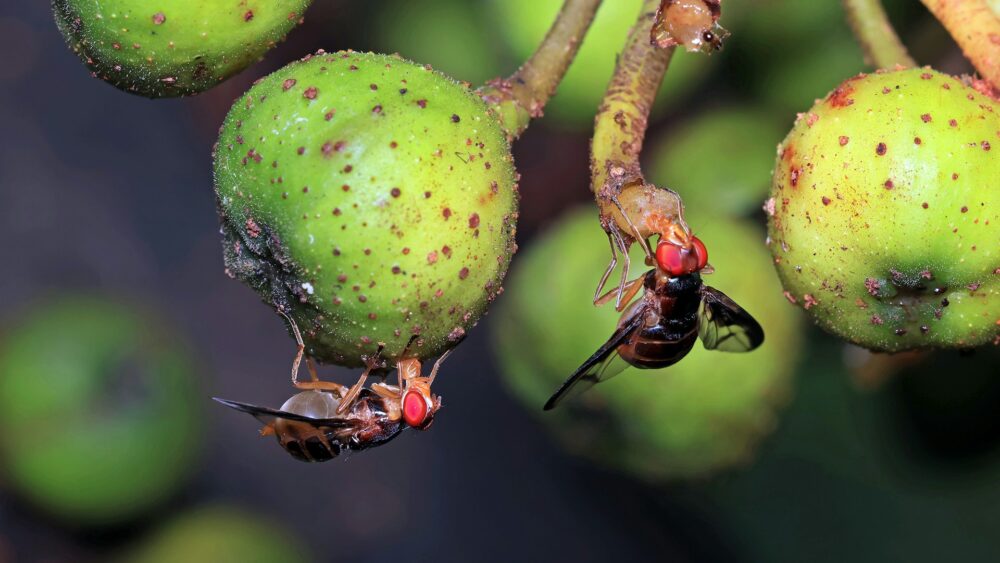
Round tan-to-brown body, red eyes up close, orbiting fruit, trash, or the sink: fruit fly. This guide is your plan.
Skinny, dark, long-legged, hovering around potted plants: fungus gnat. It breeds in damp potting soil, not food, and the fix is drying out the plants and treating the soil, not vinegar bowls.
Fuzzy, moth-shaped wings, parked on the bathroom wall: drain fly. It breeds in the slime inside drains, and the fix is scrubbing the pipe, not the fruit bowl.
Fighting the wrong species with the right method is the most common reason “nothing works.” Thirty seconds of squinting saves two weeks of frustration.
Keep Them From Ever Coming Back
Four habits make your kitchen a place fruit flies cannot get started, and the first one intercepts them at the source.
Wash produce the moment it comes home. Remember, the eggs arrive on the fruit’s skin. A rinse under running water (a quick vinegar-water soak for berries) removes most of them before they ever hatch, which stops the infestation at the front door. This is the single highest-value habit on this page.
Refrigerate the ripe stuff. Fruit flies cannot breed in the cold. The counter is for fruit you will eat this week; the fridge is for everything at peak ripeness.
Run a dry-sink policy. Wring the sponge, hang the dishrag, empty the strainer, and give the drain a weekly hot-water flush. No standing dampness, no nursery.
Rinse before you recycle, and lid the trash. Ten seconds per bottle removes the fermentation library, and a sealed bin removes the maternity ward.
Quick Answers
Are fruit flies harmful? They do not bite or sting, but they walk from trash to your food and can ferry bacteria along the way. A reason to act, not a reason to panic.
Do store-bought traps work? Yes, the liquid-lure ones are essentially your vinegar bowl in a decorative shell. Fine to buy, unnecessary to buy.
Why do I get them every summer? Warmth accelerates their breeding cycle and summer means more fresh produce on counters. The wash-and-refrigerate habits above are seasonal armor.
Can they live in winter? Outdoors, populations crash. Indoors, a heated kitchen with a fruit bowl is endless summer, which is why a January infestation is always an indoor breeding site.
The Cheat Sheet (Save This)
Screenshot this and start tonight.
Tonight: bowls of apple cider vinegar + 2-3 drops of dish soap at every hot spot. All ripe produce into the fridge or outdoor trash.
Tomorrow: purge the five hidden nurseries: pantry potatoes and onions, trash can film, unrinsed recycling, the drain and disposal (scrub, ice cubes, hot water), and anything damp: sponges, mops, drip trays.
Drain check: tape sticky-side-down over the dry drain overnight. Flies on the tape = scrub the drain.
Timeline: big die-off in 2 days, stragglers from old eggs through day 10. Keep traps running the whole way.
Forever: wash produce when it comes home, refrigerate the ripe, dry the sink, rinse the recycling.
The Bottom Line
Fruit flies are a math problem wearing wings: 500 eggs, eight days, repeat. Every guide that only hands you a trap recipe is losing that race politely.
Trap the adults tonight, wipe out the breeding sites tomorrow, and hold for one full life cycle. Ten days from now the kitchen is quiet, and the wash-your-produce habit means it stays that way through every grocery run to come.