
Getting rid of carpet beetles comes down to three moves: vacuum every edge and crevice they hide in, hot-wash and dry infested fabrics at 120°F or higher, and lay down a targeted killer like food-grade diatomaceous earth where they crawl. Do those three and most infestations collapse within weeks.
But before you touch a vacuum, one fact changes your whole strategy, and it is the fact most people fighting carpet bugs never learn: the adult beetles are not eating your carpet. Adults eat pollen and nectar. Every hole in your wool rug, every bald patch on the sofa, every ruined sweater is the work of their larvae, small, hairy, bristled grubs feeding quietly in the dark for months.
Which means killing the beetles you can see barely dents the problem. Win the war and you have to kill what you cannot see.
This guide is built for exactly that. What kills carpet beetles at every life stage, the natural methods that work without a drop of pesticide, the dedicated plan for the larvae doing the actual damage, the growing black carpet beetle problem, what to do when they show up in your bed, and the sealing routine that gets rid of them permanently instead of until next spring.
Cheat sheet at the bottom. First, know your enemy for thirty seconds, because two of these bugs get misidentified constantly and the mix-ups cost people months.
First: Confirm It Is Actually Carpet Beetles
Carpet beetles go by many names, carpet bugs, carpet weevils, fabric beetles, and they get confused with two other pests. A quick ID saves you from fighting the wrong war.
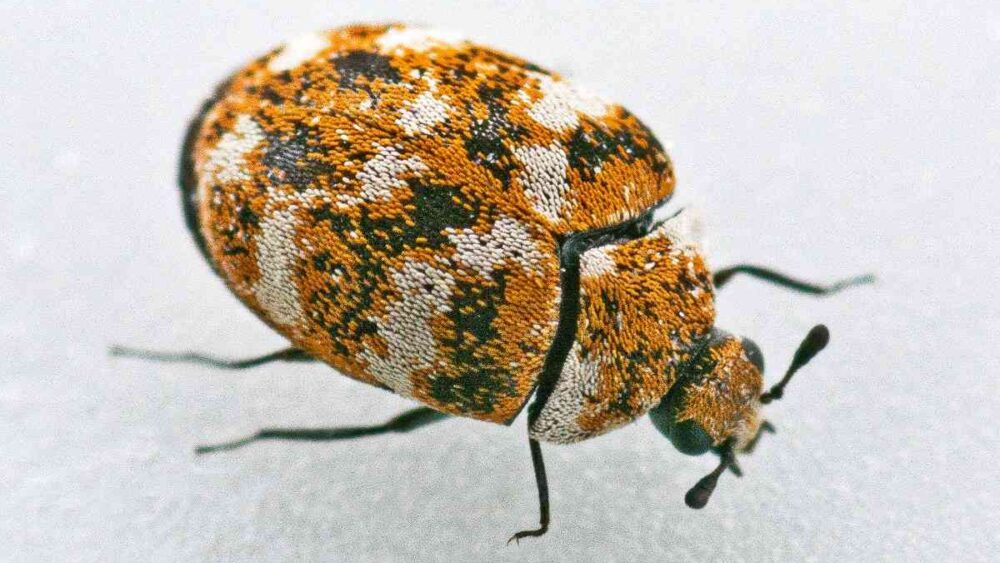
The adult: small, oval, about the size of a sesame seed. The varied carpet beetle is mottled white, brown, and yellow. The black carpet beetle, the one on the rise in many areas, is solid dark brown to black and slightly longer. Adults fly, love light, and you will often find them on windowsills trying to get out.
The larva: the real villain. Short, fat, hairy, brown or striped, with bristles at the tail. Found in dark, quiet places: closet floors, under furniture, along baseboards, in air vents, inside stored boxes.
The two signs that confirm them: shed larval skins, which look like tiny hollow bristly husks, and clean, surgical-looking holes or threadbare patches in natural fabrics: wool, silk, fur, feathers, leather.
Not sure if it is bed bugs instead? Big difference, and it matters: carpet beetles do not bite. If you wake up with welts in lines or clusters, think bed bugs. If you wake up with an itchy rash and find bristly little larvae or husks nearby, that is an allergic reaction to carpet beetle larval hairs, not bites. Different pest, completely different treatment.
ID confirmed? Then start where the pros start, because the first step is not a product. It is a flashlight.
Step 1: Find the Breeding Spot (The Step That Decides Everything)
Somewhere in your house is a spot where the eggs are being laid and the larvae are feeding. Miss it and every other treatment is a delay. Find it and you cut the infestation off at the root.
Where to hunt: dark, undisturbed places near natural fibers. The attic, the basement, closet corners, under heavy furniture that never moves, inside air vents and ducts, wall voids, stored boxes of clothes or fabric, and around old bird nests or dead insects in the eaves, which are gourmet meals for larvae.
What you are looking for: live larvae, those bristly shed skins, sand-like fecal pellets, and clusters of adults. A room where adults keep appearing usually has a breeding spot within a few feet.
When you find it: bag the infested material in a sealed plastic bag and get it out of the house immediately. Vacuum the whole area, then treat anything salvageable with heat, steam, or the freezer using the methods below.
Eggs hatch in one to three weeks and larvae feed for months, so this one discovery shortcuts an enormous amount of fighting. With the source found, strip their numbers with the most underrated weapon in the house.
Step 2: Vacuum Like You Mean It
Vacuuming is the foundation every other treatment stands on, because it physically removes eggs, larvae, adults, and the hair, lint, and debris they feed on, all at once.
But surface passes do nothing. Larvae hug edges and hide in cracks, so the crevice attachment is the real weapon.
Hit these zones: carpet edges along every baseboard, under and behind furniture, closet floors and corners, furniture seams and under cushions, inside heating vents, under area rugs, and anywhere pet hair collects, since pet hair is larva food.
During an active infestation, vacuum every 2 to 3 days, and empty the canister or bag outside in a sealed bag every time. Larvae can crawl right back out of an indoor bin.
Vacuuming knocks the population down hard. The next two steps kill what it cannot reach: the ones living inside your fabrics.
Step 3: Hot Wash and Dry (Kills Every Stage)
Heat is the most reliable carpet beetle killer there is, and your laundry machines deliver it.
The magic number is 120°F. A wash at or above that temperature kills adults, larvae, and eggs together. Run every washable fabric from the infested area, clothes, bedding, curtains, cushion covers, pet bedding, through the hottest cycle the fabric allows, then a high-heat dryer cycle, which finishes any eggs that survived the wash.
For delicates that cannot take hot water, a long, high-heat dryer cycle alone still does most of the killing.
So yes, to answer one of the most-asked questions on this topic: washing clothes absolutely kills carpet beetles, but only if the water or the dryer gets genuinely hot. A cold wash mostly gives them a bath.
The washer handles what fits in it. For the carpet itself and the furniture, bring the heat to them.
Step 4: Steam Clean the Carpets and Furniture
A steam cleaner pushes lethal heat deep into carpet fibers and upholstery seams, killing larvae and eggs on contact in the exact places they hide.
How to do it right:
- Vacuum first, always, so the steam reaches beetles instead of debris.
- Work slowly. Hold the nozzle an inch or two from the surface for 10 to 30 seconds per spot so heat penetrates the fibers.
- Spend extra time on the room’s edges. Larvae live along baseboards where dust and pet hair drift, not in the open middle of the carpet.
- Do not soak anything. Controlled steam, then fans or open windows so everything is fully dry within 24 hours, or you trade beetles for mold.
- Repeat every 3 to 7 days for two or three rounds in a heavy infestation.
Heat kills fast. But some things can never meet heat, and for those, the freezer is the assassin.
Step 5: Freeze the Delicates
Wool sweaters, silk, vintage fabrics, stuffed animals, fur: anything too precious for hot water dies happily in the freezer.
How to do it:
- Seal the item in an airtight plastic bag first, which stops condensation from soaking it.
- Freeze at 0°F or colder for at least 7 to 14 days. Two to three weeks is the guaranteed kill. The cold crystallizes the water inside larvae and eggs and destroys them from within.
- Thaw fully, inspect, and return to a clean, sealed storage area.
Slow, silent, and completely fabric-safe. Now for the section this entire war actually hinges on.
How to Get Rid of Carpet Beetle Larvae (The Real Fight)
Everything above weakens the infestation. This is the section that ends it, because the larvae are the ones eating your home.
Weapon 1: Food-grade diatomaceous earth (DE). A powder of fossilized algae that is harmless to humans and lethal to crawling insects. It scrapes and absorbs the waxy coating off a larva’s body, and the larva dehydrates and dies over a few days.
How to use it:
- Buy food-grade DE only. Pool-grade DE is a lung hazard indoors.
- Vacuum the area first, and make sure it is bone dry. Wet DE is useless.
- Dust a thin, barely visible layer along carpet edges, baseboards, closet floors, cracks, and under furniture. A soft brush or hand duster spreads it well.
- Thin is the whole trick. Pile it up and larvae simply walk around it.
- Leave it 5 to 7 days, vacuum it up, and reapply in any still-active areas.
No DE available? A fine dusting of boric acid works the same way in the same places. Keep either one away from where kids and pets play, and avoid breathing the dust while applying.
Weapon 2: Insect growth regulators (IGRs). Products like NyGuard, Gentrol, and Tekko do not kill on contact. They break the life cycle itself, stopping larvae from ever molting into egg-laying adults. Spray them into cracks, seams, and fiber-rich hiding zones, pair them with your vacuuming routine, and the population quietly ages out over several weeks. Low toxicity when used per the label, and devastating over a month.
Weapon 3: Residual insecticide, precisely aimed. For a stubborn infestation, a spray containing a pyrethroid (look for bifenthrin, deltamethrin, or permethrin on the label, with beetles listed as a target) keeps killing larvae that cross treated surfaces for weeks.
The targeting rules matter: crack-and-crevice only. Baseboards, carpet edges, closet cracks, under furniture. Never broadcast it across open carpet, never on clothing or bedding, never near food surfaces. Vacuum first, apply lightly, ventilate, and let it dry undisturbed.
Larvae handled. If you would rather run this entire war without a single chemical, you can, and it works.
How to Get Rid of Carpet Beetles Naturally
Every load-bearing method in this guide is already natural, which makes carpet beetles one of the few pests you can genuinely beat without pesticides.
The natural kill stack:
- Heat: the 120°F wash-and-dry and slow steam cleaning kill every life stage on contact.
- Cold: the freezer wipes out anything heat cannot touch.
- Diatomaceous earth: a mechanical killer, not a chemical one. It shreds and dehydrates rather than poisons.
- The vacuum: removal is the most natural method of all, and done every 2 to 3 days it breaks the breeding cycle by itself.
- White vinegar wipe-downs: vinegar does not kill beetles outright, but wiping shelves, drawers, closet floors, and windowsills with a 1:1 vinegar and water mix strips away the dust, lint, and food traces that attract egg-laying females.
Run that stack diligently for three to four weeks and most households never need to open a spray bottle. Two special situations deserve their own answers first, though, because they generate the most panic.
Carpet Beetles in Your Bed (Do This Tonight)
Finding larvae or shed skins in the bed feels like a bed bug emergency. The fix is faster than you fear.
- Strip everything. Sheets, pillowcases, duvet cover, mattress protector, into a hot wash and high-heat dry today.
- Vacuum the mattress slowly with the crevice tool: every seam, every fold, the box spring, the bed frame, and the floor and baseboards under and around the bed.
- Steam the mattress seams if you have a steamer, and let it dry fully.
- Find the why. Beetles in a bed are almost always feeding on something: pet hair in the bedding, a wool blanket, feather pillows, or a breeding spot in the closet three feet away. Check the closet.
- Wash bedding hot weekly until you have seen nothing for a month.
They do not bite you in your sleep, and unlike bed bugs they do not want to live on you. Clear their food and they leave the bed on their own.
The Black Carpet Beetle (The Tougher Cousin)
If your beetles are solid black or dark brown rather than mottled, you have black carpet beetles, and infestations of these are climbing sharply in many regions.
Same playbook applies, with two adjustments. Black carpet beetle larvae are longer, more golden-brown, and even more drawn to stored products, so extend your hunt to the pantry: pet food bags, dry goods, grains, and pet hair around feeding areas. And they are notorious in air ducts and wall voids, so vacuum vents thoroughly and consider having ducts inspected in a stubborn case.
Kill methods stay identical: heat, cold, DE, IGRs. It is the hiding spots that shift.
Get Rid of Them Permanently: Seal and Starve
Everything so far kills the beetles you have. Permanence means no next generation, and that takes two habits.
Seal the ways in. Adult carpet beetles fly, and they come in through window screens with tears, gaps around window and door frames, unscreened vents, and cracks where pipes and wires enter the walls. Caulk the gaps, repair the screens, and check the attic and eaves, where old bird nests are both an entrance and a buffet. Never seal actual vent openings, only the gaps around them.
Starve the larvae. Store off-season wool, silk, and fur cleaned and in airtight bins or garment bags, since larvae target soiled fabric first. Vacuum weekly with occasional edge-and-crevice passes. Keep pet hair swept up. Clear out old boxes of forgotten textiles in the attic and basement, which are the classic hidden nursery.
Do both and carpet beetles become a bug you saw once, not a bug you have.
When to Call a Pro (And the Nuclear Option)
Most infestations fold in three to four weeks of the routine above. Some do not, and there is a point where escalation is the smart money.
Call pest control when larvae keep appearing after a month of vacuuming, heat, and DE, when the source seems to be inside walls or ductwork you cannot reach, or when damage is spreading across multiple rooms.
The nuclear option is whole-house heat treatment. Pros raise the entire home to 140 to 150°F for 4 to 6 hours, which kills every beetle, larva, and egg everywhere at once, inside walls, inside furniture, everywhere. It is the single most effective treatment that exists, and it costs like it: expect roughly $1,500 to $6,500 depending on home size. Electronics and heat-sensitive items come out first, and sealing entry points afterward is still on you, or the survivors outside simply move back in.
The Cheat Sheet (Save This)
Screenshot this and start today.
The core routine: find and bag the breeding spot, vacuum edges and crevices every 2 to 3 days (empty it outside), hot wash and dry fabrics at 120°F+, steam carpets and furniture slowly, freeze delicates at 0°F for 2 to 3 weeks.
Kill the larvae: thin layer of food-grade DE along edges and cracks, 5 to 7 days, vacuum, repeat. IGR spray (NyGuard, Gentrol, Tekko) in hiding zones to break the life cycle. Pyrethroid spray for stubborn cases, cracks and crevices only.
In the bed: hot wash all bedding today, crevice-vacuum every mattress seam, then find the food source nearby.
Permanently: caulk gaps, fix screens, store natural fabrics clean and sealed, keep pet hair down.
Stuck after a month: pest control, or whole-house heat at $1,500 to $6,500 for a severe infestation.
The Bottom Line
Getting rid of carpet beetles is not one dramatic treatment. It is a two-front war: remove and kill relentlessly on the surface with the vacuum, heat, and cold, while DE and growth regulators quietly wipe out the larvae underneath, and the larvae were always the real enemy.
Run both fronts for a month, seal the house behind you, and the only carpet beetles left in your life will be the ones in this article.