
Here is the short version of how to get rid of poison ivy: for small patches, pull the entire plant, root and all, using a plastic bag over your arm like a glove, and seal it in the trash. For large or woody infestations, cut the vines at the base and treat the stumps with a brush killer. Covered skin, soapy cleanup, and patience for the regrowth checks do the rest.
But before a single leaf gets touched, two rules, because this is the one weed that can put you in a hospital:
Never, ever burn poison ivy. The plant’s oil, urushiol, survives fire by riding the smoke, and inhaling it can inflame your lungs and airways badly enough to become a medical emergency. No burn pile, no bonfire, no exceptions.
And dead poison ivy is still armed. Urushiol stays potent on dead leaves, stems, and roots for years, so a brittle brown vine bites exactly like a green one. Every method below treats the plant as hazardous from first cut to trash bag, alive or dead.
With those two rules locked, the rest is very winnable. Below: how to confirm it is actually poison ivy in the first place (a surprising number of “infestations” are innocent lookalikes), eight ways to kill poison ivy from bare hands to herbicides to, genuinely, rental goats, the right way to handle vines climbing your trees, how to stop poison ivy from spreading back in, and what to do if the oil gets on your skin anyway, including the honest answer about fixing a rash overnight.
Everything here works identically on poison oak and poison sumac, since all three run on the same oil. Cheat sheet at the bottom. First, the thirty-second ID.
First: Make Sure It Is Actually Poison Ivy
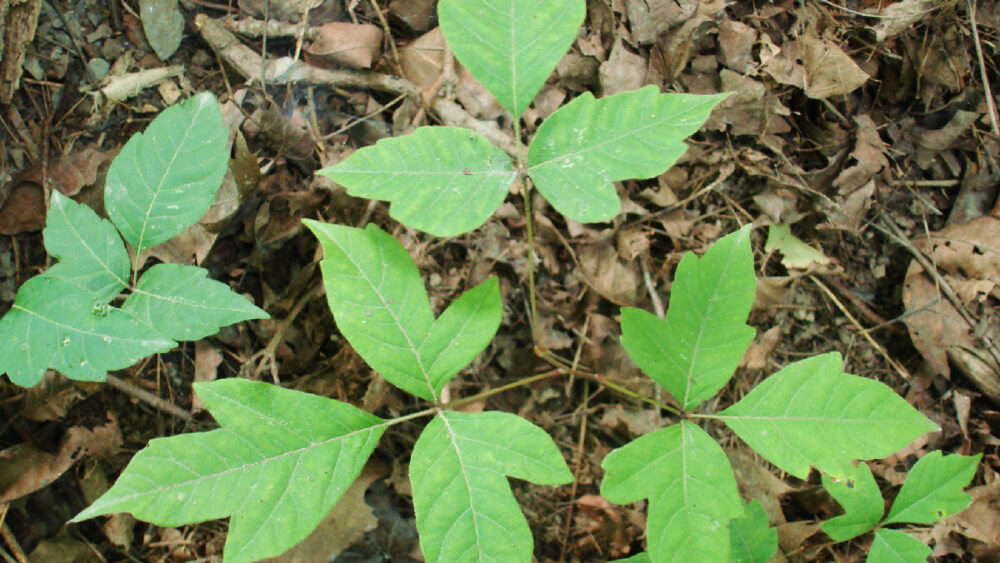
“Leaves of three, let it be” is the rhyme, and it holds: poison ivy grows its leaves in clusters of three, with the middle leaflet on a longer stalk than the two side ones.
The supporting details: leaf edges may be smooth or coarsely notched, young growth often flushes reddish before turning green, fall foliage goes brilliant red-orange, and clusters of small waxy white berries appear in late season. The plant shape-shifts, growing as a ground creeper, a shrub, or a climbing vine, and the climbing version has a giveaway: a thick vine coated in dark, hairy-looking aerial rootlets gripping the tree. A “hairy rope” going up a trunk is poison ivy until proven otherwise.
The common false alarms: Virginia creeper (five leaflets, not three), box elder seedlings (three leaflets but opposite branching and no hairy vine), and wild raspberry (three leaflets but thorny stems). If it has five leaves or thorns, it is not your enemy.
And the cousins: poison oak carries the same leaves-of-three pattern with lobed, oak-like leaflets, and poison sumac grows rows of 7 to 13 leaflets in wet areas. Both carry the same urushiol, and every method in this guide kills them the same way.
Target confirmed. Now dress for the job.
Suit Up (Two Minutes That Save Two Weeks)
Urushiol causes a reaction in roughly 85 percent of people, it transfers by the faintest touch, and it clings to gloves, tools, shoelaces, and dog fur for months. Gear accordingly:
- Cover every inch of skin: long sleeves, long pants, socks over cuffs. For big jobs, a disposable coverall is worth its few dollars because the whole contamination problem goes in the trash with it.
- Disposable nitrile or vinyl gloves, ideally under a second layer for pulling work.
- Bag the shoes: duct-taping plastic bags over your footwear sounds absurd and works perfectly.
- Have heavy trash bags staged before you start, plus soap and a hose ready for the cleanup you will want immediately after.
Geared up. Start with the method that fits most home infestations.
Method 1: The Bag-Over-Hand Pull (Small Patches, Safest)
For scattered plants and small clumps, this is the cleanest trick in the book, because your skin never comes within a layer of plastic of the enemy.
- Slide your hand and forearm into a sturdy plastic bag like a giant mitten. Skip flimsy grocery bags; a small trash bag or heavy freezer bag resists tearing.
- Grab the plant through the bag, right at the soil line, and pull slowly to bring the root with it.
- With your free hand, peel the bag inside-out over the plant, so the ivy ends up sealed inside without ever being touched.
- Tie it off, trash it, repeat with a fresh bag per plant or two.
Gloves on underneath anyway, in case a bag rips. This method’s only weakness is scale: on a large or mature patch it turns slow, and old plants have root systems a mitten-pull will not fully extract, which is where the next method takes over.
Method 2: The Full Manual Pull (Roots and All)
Hand-pulling is the most complete kill available, because the root leaves with the plant, and poison ivy without a root does not come back. It is also the method with the strictest safety protocol.
- Wait for soaked ground, right after rain, or hose the area the day before. Wet soil releases roots; dry soil snaps them, and every snapped root is a future plant.
- Trace the whole plant first. Poison ivy runs horizontal roots and hidden runners under mulch and leaf litter. Follow the stems out before pulling so nothing regrows from a missed arm.
- Loosen around the base with a trowel or shovel, grip low, and pull slowly and steadily until the root slides out.
- Bag everything immediately. Never compost it (the oil survives composting for years) and never burn it (rule one).
- Sweep the area again for broken root pieces, which resprout enthusiastically.
- Then run the decontamination: disposable gear straight into the trash. Washable clothes go in the machine alone, hot, with detergent, followed by an empty rinse cycle to clear the washer itself. Tools get wiped down with rubbing alcohol or soapy water, because urushiol on a shovel handle is a booby trap with a months-long fuse.
- Wash your skin promptly with a degreasing dish soap, or a dedicated remover like Tecnu, per the exposure section near the bottom.
Thorough, free, and final. But if hands-on contact is the part you want to avoid entirely, the next three methods kill without touching.
Method 3: Smothering (Zero Contact, Zero Chemicals)
Poison ivy cannot photosynthesize through a tarp, and starving it of light kills the plant and, eventually, the root system it feeds.
- Optionally cut the ivy near the ground first (bag the cuttings), which speeds everything up.
- Cover the whole patch with a tarp, heavy cardboard, or thick black plastic, extending a foot or two past the visible edge.
- Weight it down thoroughly with bricks, rocks, or stakes. Any gap that lets light in becomes an escape hatch.
- Wait. Weeks at minimum, often a full season for a mature patch. This is the set-and-forget method, and patience is the price of never touching the plant.
- Verify the kill: after removal, no new sprouts following a good rain, and stems that lift with no resistance, mean dead roots.
Watch the perimeter, since roots at the edge of the cover sometimes survive and creep. For weeds in the open where covering is impractical, the kettle comes out.
Method 4: Boiling Water (Cracks, Edges, and Fence Lines)
Scalding water ruptures plant cells on contact, and for young poison ivy in driveway cracks, along walkways, and at fence bases, it is free and immediate.
- Boil a quarter to half gallon.
- Optionally trim the plant to its base first so the water hits the crown and roots instead of wasting heat on leaves.
- Pour slowly and directly onto the base.
- Repeat over several days for anything established.
Two honest limits: it kills every plant it touches, so it stays away from beds and lawns, and mature root systems usually outlast a kettle or two. It is a spot treatment, not a campaign weapon. For a campaign fought without chemicals, mix the sprayer.
Method 5: The Vinegar, Salt, and Soap Spray (Kill Poison Ivy Naturally)
The classic homemade weed killer works on poison ivy the same way it works on everything else: the vinegar’s acetic acid burns and desiccates the foliage, the salt attacks the plant’s water transport, and the soap glues the mixture to the leaves.
The mix: 1 gallon of white vinegar, 1 cup of salt, 1 tablespoon of dish soap, stirred until the salt fully dissolves so it cannot clog the sprayer. For a 32-ounce spray bottle: 30 ounces of vinegar, 2 tablespoons of salt, half a teaspoon of soap. Horticultural vinegar (30 to 50 percent acetic acid, from garden centers) hits far harder than kitchen 5 percent, and demands gloves and eye protection in exchange.
The technique: spray on a hot, sunny, dry day, when the sun turbocharges the desiccation, coating leaves and stems only. Shield anything you love with cardboard, because this spray is indiscriminate, and remember that salt accumulates in soil, so repeated heavy use in a garden bed trades poison ivy for dead dirt.
The expectation: browning within days, but regrowth from the roots of mature plants is common. Plan on repeat rounds, or pair a vinegar knockdown with a root-pull follow-up. Which raises the natural method almost nobody thinks of, and it is the most entertaining one in the guide.
Method 6: Rent Goats (Seriously, for Big Infestations)
Goats eat poison ivy the way kids eat candy, and urushiol does not bother them in the slightest. Across the US, rent-a-herd grazing services will deliver a crew of goats to a badly overgrown property, fence them onto the problem area, and let them mow through poison ivy, brush, and bramble that would take humans weeks of hazardous work.
Where goats shine: large, dense infestations, slopes, and overgrown lots where pulling is impractical and spraying would take gallons. They eliminate all human contact with the plant, and they fertilize as they go.
The honest limit: goats eat the tops, not the roots, so grazing alone knocks poison ivy back rather than out. The winning combo is a goat clearance first, then follow-up treatment of the regrowth (spray or pull) once the jungle is reduced to manageable sprouts.
Not every yard justifies a herd. For most large or woody infestations, the last two methods are the ones that end the war.
Method 7: Glyphosate (The Broad-Spectrum Heavyweight)
Glyphosate (the active ingredient in Roundup and many generics) is absorbed through the leaves and moves through the whole plant down into the roots, killing poison ivy from the inside out over 1 to 2 weeks. That systemic action is what most natural methods lack, and it is why glyphosate often finishes a plant in a single treatment.
How to use it: pick a calm, dry day (wind drifts the spray onto plants you like; rain washes it off before it absorbs), wear full covering plus gloves and a mask, and spray the leaves until wet but not dripping, keeping it strictly off surrounding plants, because glyphosate kills nearly anything green. Then leave the plant alone for 7 to 10 days while the chemical travels to the roots, check at 3 weeks, and re-treat any survivors.
The safety conversation, honestly: glyphosate’s possible link to certain cancers has been the subject of major lawsuits and ongoing scientific dispute, with the strongest concerns tied to heavy, repeated occupational exposure. The EPA’s position is that it is safe when used as directed. For a homeowner spraying a patch once or twice a season with gloves and a mask, following the label puts you well inside the cautious lane, and if you would rather skip the debate entirely, the next option is actually better suited to poison ivy anyway.
Method 8: Triclopyr (The Poison Ivy Specialist)
Triclopyr (sold as Ortho Brush-B-Gon Poison Ivy Killer, Crossbow, and similar brush killers) is the herbicide actually engineered for this job. It targets the growth hormones of broadleaf woody plants, which means two enormous advantages: it largely spares grass, so treating ivy in a lawn does not nuke the lawn, and it excels against thick, woody, mature vines that shrug off everything else.
Foliage treatment: same protocol as glyphosate, dry calm day, full coverage of leaves and stems, barriers around desirable broadleaf plants (it spares grass, not your hydrangeas). Damage often shows within days rather than weeks.
The cut-stump treatment, the killer move for big vines: cut the woody vine near the ground and immediately paint or spray triclopyr onto the fresh-cut stump. The chemical rides the plant’s own plumbing straight into the root system. This is the definitive answer for the thick climbers, which brings up exactly how to handle those.
Two cautions: triclopyr is toxic to aquatic life, so keep it and its runoff away from ponds and streams, and wait for dry soil with no rain forecast when treating near gardens, since wet ground can carry it to roots you love.
Poison Ivy Climbing Your Trees or Fence
A mature poison ivy vine going up a tree gets special handling, because the instinct, ripping it down, is the most dangerous move available. Pulling a live vine showers you with leaf fragments, oil, and debris, straight down onto your face.
The right sequence:
- Cut the vine at the base, removing a clean section a few inches wide so the upper vine is fully disconnected. Long sleeves, gloves, and eye protection, and treat the tool as contaminated afterward.
- Treat the rooted stump immediately with triclopyr (the cut-stump method above), or commit to pulling that root section by hand.
- Leave the upper vine in place to die. It will brown and drop its leaves over a season. Remember the dead-plant rule, though: that dry vine stays loaded with urushiol for years, so either leave it permanently or remove it later with the same full precautions as a live one.
On fences, the same logic: sever, stump-treat, and let the hanging growth die before carefully bagging it off the rails.
How to Stop Poison Ivy From Spreading
Killing the current patch is half the war. The other half is understanding how it got there, because it will try again the same way.
Birds are the delivery service. Those white berries are bird food, and every perching bird deposits pre-fertilized seeds along fence lines, under trees, and beside power line poles, which is exactly where new poison ivy always seems to appear. You cannot stop the birds, but killing plants before late-season berries form removes the payload from your own yard.
Underground runners are the ground game. Established plants send horizontal roots that pop up new shoots feet away, which is why a patch widens each year and why edge-of-property invasions creep in from a neglected neighbor lot. A perimeter check each spring, with immediate bag-pulls of new shoots, keeps runners from establishing.
And two spreading mistakes to never make: mowing or string-trimming poison ivy. A mower flings oil-coated fragments across the yard, and a string trimmer aerosolizes urushiol into a mist at shin height, both of which turn one plant into a yard-wide exposure event. Cut with tools deliberately, bag deliberately, and keep the power equipment away from anything with three leaves.
Getting Rid of Poison Ivy Permanently
Permanence is a season-long habit, not a single treatment, because poison ivy’s roots hold reserves and its seeds keep arriving.
The permanent protocol: kill the visible plants with whichever methods fit, then re-inspect after every decent rain, when surviving root fragments announce themselves as fresh sprouts. Pull or spot-treat sprouts immediately while they are small and rootless. Do a deliberate fall walk-through (the red foliage makes ivy easy to spot) and a spring perimeter check. After one full season of denying it a comeback, the root reserves are exhausted, and from there it is just intercepting the occasional bird delivery.
Persistence beats power here. Now, the section for the moment something went wrong anyway.
If the Oil Got on Your Skin (And the Overnight Question)
You have roughly a 10 to 30 minute window after contact before urushiol bonds to skin, and what you do in it decides everything.
Immediately: wash the area with a degreasing dish soap or a dedicated remover like Tecnu, under cool running water, with real friction, and scrub under fingernails, which are the classic re-exposure reservoir. Wash every tool, glove, and garment that touched the plant, and shampoo the dog if it romped through the patch, since pet fur carries oil to everyone who pets it.
If a rash comes anyway: it typically appears within a day or two and runs its course over 1 to 3 weeks. Two reassurances: the rash itself is not contagious, and the fluid from blisters does not spread it. What looks like spreading is areas that absorbed less oil reacting later.
For the itch: cool compresses, calamine lotion, over-the-counter hydrocortisone cream, oatmeal baths, and an oral antihistamine at night for sleep. Keep it clean, and resist scratching, which invites infection.
The overnight answer, honestly: there is no getting rid of a poison ivy rash overnight, and any page promising it is selling something. What you can do tonight is stop it from getting worse (wash everything that might re-expose you) and knock the itch down hard enough to sleep (antihistamine plus cool compress plus hydrocortisone). The immune reaction runs its 1-to-3-week course regardless.
See a doctor promptly if: the rash covers a large area of your body, involves your face, eyes, or genitals, blisters are weeping heavily or look infected, you develop fever, or you have any trouble breathing after possible smoke exposure, which is an emergency. Severe cases respond well to prescription steroids, and there is no medal for suffering through a bad one.
One never: no bleach on skin, ever. It is a folk remedy that adds chemical burns to an allergic reaction and helps nothing.
The Cheat Sheet (Save This)
Screenshot before you head out.
The two rules: never burn poison ivy (the smoke can hospitalize you), and treat dead plants as fully toxic for years.
ID: leaves of three, longer middle stalk, hairy climbing vines, white berries. Five leaflets or thorns = not poison ivy.
Small patches: bag-over-hand pull, seal, trash. Full removal: pull after rain, chase every root, bag everything, decontaminate clothes, tools, and skin.
No-touch options: tarp-smother for a season, boiling water on cracks, vinegar-salt-soap spray on hot days (1 gal vinegar + 1 cup salt + 1 tbsp soap), goats for jungles.
Heavy artillery: glyphosate for broad kills, triclopyr for lawns and woody vines, cut-stump treatment for climbers. Never rip a live vine off a tree.
Stop the spread: kill before berries form, patrol edges each spring, never mow or string-trim it.
Exposure: wash with degreasing soap within 30 minutes, nails included. Rash = 1 to 3 weeks, not contagious, no overnight cure. Face, eyes, genitals, fever, or breathing trouble = doctor now.
The Bottom Line
Poison ivy wins through fear and persistence, and it loses to exactly the same things pointed back at it. Suit up once, kill it with whichever method fits your patch, and then simply refuse to let the regrowth restart, one rain-check at a time, for a single season.
Respect the two rules, keep the mower away from it, wash like you mean it, and by this time next year the most dangerous thing in your yard will be the goat rental invoice.