
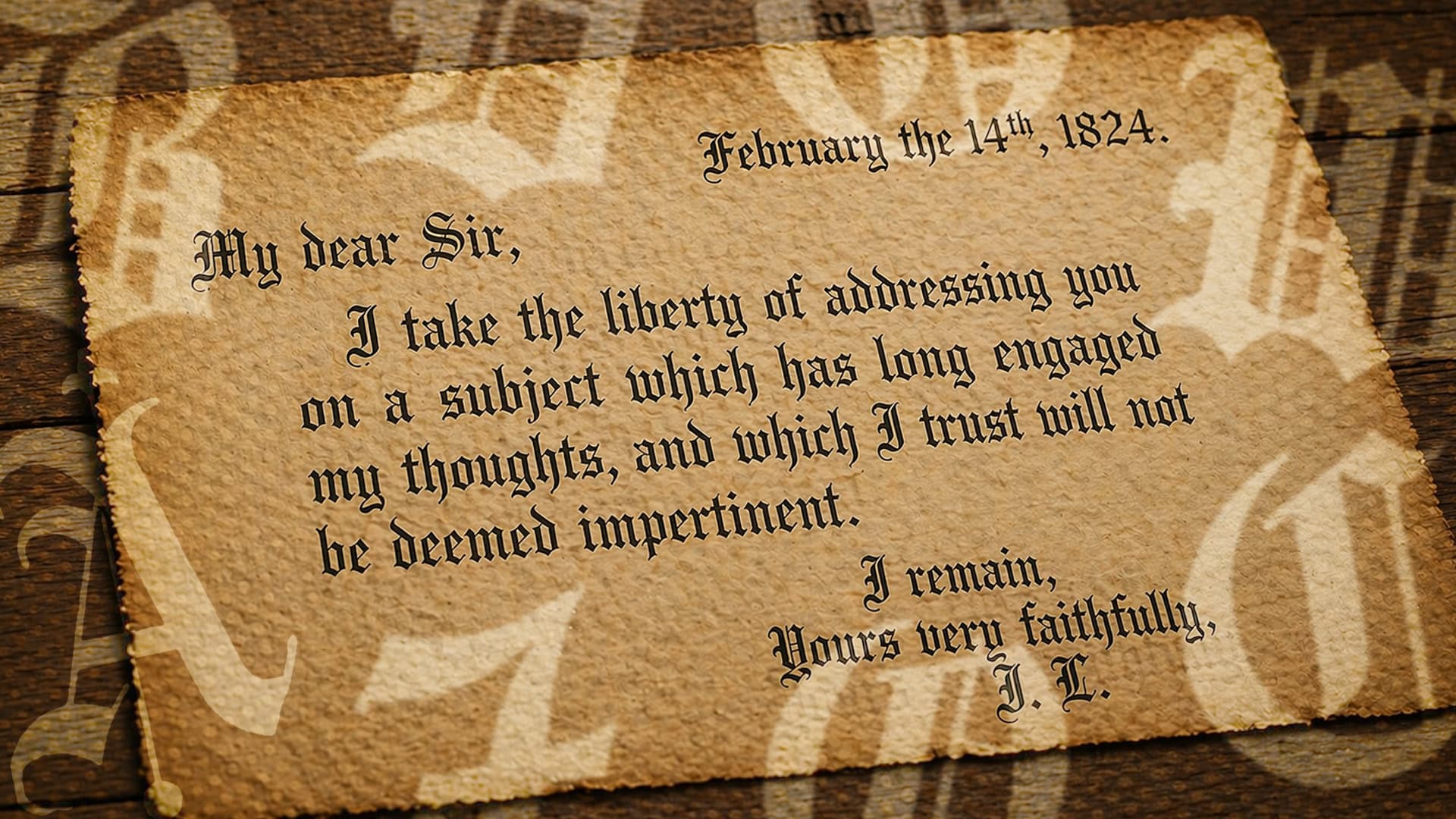
Imagine opening a letter from the 1820s and expecting something half-unreadable, only to find that you can follow most of it just fine. That is the surprising part. English 200 years ago was not Old English, and it was not Shakespearean English either. It was already recognizably modern. You would understand a lot of it. You would also notice some differences almost immediately.
The biggest changes were not that people spoke a completely different language. It was more about tone, spelling habits, sentence style, pronunciation, and the kinds of words people reached for in everyday writing.
First, it was much closer to modern English than most people think
A lot of people hear “200 years ago” and assume the language would sound almost medieval. Not even close.
By the early 19th century, English had already gone through the huge shifts that separate Old English, Middle English, and Early Modern English from the version we know today. The grammar was mostly familiar. Basic sentence structure looked modern. Common everyday verbs, pronouns, and word order would not shock you.
You would still hear things like:
- I am going home
- Have you seen him
- She wrote the letter yesterday
- We shall return tomorrow
That part would feel comfortably familiar.
What would sound different right away
The real difference would be style.
English 200 years ago often sounded more formal, even when people were not trying especially hard. Letters, newspapers, speeches, and essays leaned toward a heavier tone. Writers liked balance, politeness, and a certain amount of verbal decoration.
A sentence that feels normal now:
- I am sorry I could not reply earlier.
A more 19th-century-feeling version:
- I regret exceedingly that I was unable to furnish a reply at an earlier period.
That is a bit exaggerated, but not by much. The older style often had more padding around the main point.
People tended to write longer sentences
This is one of the first things modern readers notice.
Writers 200 years ago were often far more comfortable with long, winding sentences full of subordinate clauses. A paragraph could take its time getting where it was going. That did not necessarily mean the writer was trying to show off. It was just a more normal rhythm for educated prose.
Modern writing usually rewards speed and clarity. Nineteenth-century writing often rewarded control, structure, and polish.
Personally, I think this is why older English sometimes feels “smarter” at first glance. It is not always smarter. It is often just slower and more dressed up.
Some words were common then but feel old now
A lot of English from 200 years ago is readable, but certain words instantly date it.
You are more likely to run into words and phrases like:
- amongst
- whilst
- hath in older-styled religious or literary writing
- thither
- hence
- pray tell
- shall used more often than it is today
- obliged
- beg your pardon in more literal formal use
You would also see polite formulas that sound stiff now, especially in letters:
- I remain your obedient servant
- I have the honour to inform you
- permit me to state
- your most humble servant
Those expressions were not theatrical in the way they feel now. They were part of the social style of the time.
Spelling was more familiar, but not always as fixed
By the 1820s, English spelling was already much more settled than it had been in earlier centuries. Still, you would notice a few things:
- Some spelling preferences varied more between British and American usage
- Certain words still appeared in forms that now look slightly dated
- Capitalization could be less consistent than modern style guides prefer
- Hyphenation was often used more freely
You might see words printed differently depending on region, publisher, or writer. You would not be staring at chaos, but you would notice that modern spelling rules had a little more wiggle room.
British and American English were drifting apart more clearly
Two hundred years ago, English was not one flat, unified global standard.
By the early 19th century, British and American English were already developing more distinct habits in spelling, pronunciation, and vocabulary. Noah Webster had pushed for spelling reforms in the United States, which helped standardize forms like:
- color instead of colour
- honor instead of honour
- center instead of centre
That kind of difference was becoming more visible in print.
So if you were reading English from 200 years ago, part of what you noticed would depend on where that English came from.
Pronunciation would not sound identical either
This is where things get interesting.
You would understand spoken English from 200 years ago far more easily than you would understand Shakespeare’s era or anything earlier. But accents would still sound different from modern ones. Some vowels, rhythms, and regional speech patterns would stand out. American English was continuing to separate itself from older British patterns, and local dialects were often stronger and less smoothed out by mass media.
In plain terms, the language would be recognizable. The music of it would be less familiar.
That is true now, too, of course. English changes not only by words and grammar, but by sound.
Grammar was mostly modern, but usage could feel stricter
The grammar of 1820s English would not throw you off the way Middle English would. Still, some habits would feel more rigid or formal.
For example:
- “Shall” was more common, especially in first-person future statements
- “Whom” appeared more naturally and more often
- Formal negatives and question forms sounded more careful
- Agreement and sentence balance mattered a lot in educated writing
You would also notice that many writers avoided contractions more often than we do now.
Modern:
- I can’t attend the meeting.
Older style:
- I cannot attend the meeting.
That may seem small, but it changes the whole tone.
Everyday conversation was probably less stiff than the books make it seem
This part gets overlooked all the time.
If you read only formal letters, speeches, and novels from 200 years ago, you can get the impression that everybody walked around sounding like a solemn history professor. Real life was almost certainly messier, looser, and more idiomatic than the polished writing suggests.
People joked. They shortened phrases. They used slang. They spoke in regional dialects. They interrupted each other. They did all the human things people do now.
The problem is that everyday speech does not survive on paper as neatly as formal writing does. So our view of old English is often filtered through its most polished forms.
Slang existed then too, just not the slang you know
Every era thinks it invented informal language. It did not.
English 200 years ago had slang, fashionable expressions, insults, playful phrases, and class-coded vocabulary. A lot of it sounds odd now because slang ages fast. That is one reason older English can feel both familiar and strange. The structure looks normal, but the flavor is different.
Even when the grammar was recognizable, the social meaning of certain words was not always the same as it is now.
Letter writing shows the difference especially well
If you want the clearest picture of English 200 years ago, look at letters.
Letters from that period often begin and end with phrases that feel much more ceremonial than modern messages. A modern text says:
- Got your note. I will be there at six.
A 19th-century letter might take a scenic route:
- I was much gratified by the receipt of your recent note and shall endeavour to present myself at the appointed hour.
Same basic meaning. Very different delivery.
This is one reason old English can feel more distant than it really is. The etiquette of writing makes it seem older than the grammar actually is.
Newspapers and public writing could be dense
Public writing 200 years ago often expected more patience from the reader.
Newspaper articles, essays, and political writing could be long, packed with clauses, and less broken up by headings or short paragraphs. Modern online writing is built for skimming. Nineteenth-century prose was built for sustained reading.
If you are used to fast, mobile-friendly writing, older English can feel heavier even when every individual sentence is understandable.
What had already changed long before 200 years ago
This is worth clearing up, because people often mix the periods together.
By 200 years ago, English had already moved far beyond:
- Old English, which is mostly unreadable to modern readers without study
- Middle English, which still feels foreign on the page
- Early Modern English, which includes Shakespeare and sounds closer, but still noticeably older
So the English of the 1820s was not ancient English. It was closer to us than to Chaucer, and much closer to us than to Beowulf.
That timeline matters because it explains why the language feels old, but not alien.
What people usually get wrong about English 200 years ago

They think it was Shakespearean
It was not. Shakespeare was writing more than 400 years ago.
They think it was barely understandable
Also not true. Most of it is readable with a little patience.
They assume everyone sounded formal all the time
Formal writing survives better than casual speech. That skews our impression.
They overlook regional variation
English 200 years ago already had strong regional and national differences.
The biggest change is not grammar. It is attitude.
If I had to reduce the whole topic to one point, it would be this: English 200 years ago was not dramatically different in its basic structure. It was different in posture.
It stood straighter.
It explained itself more.
It tolerated longer sentences.
It cared more about ceremony.
It was less afraid of sounding serious.
Modern English, especially online, values speed, clarity, and informality. Older English often valued elegance, restraint, and social polish.
That is the shift people are usually hearing, even when they think they are noticing vocabulary or grammar.
If you were dropped into 1825, could you follow the language?
Yes, mostly.
You would struggle more with accent, etiquette, regional vocabulary, and writing style than with the basic language itself. A casual conversation might be easier than a formal printed essay. A letter might sound more ornate than the same message spoken aloud.
But you would not be dealing with a foreign language. You would be dealing with an older version of your own, one that still makes sense but takes its time and carries itself differently.
That is what makes English 200 years ago so interesting. It is close enough to feel familiar and distant enough to remind you that language never stands still.