

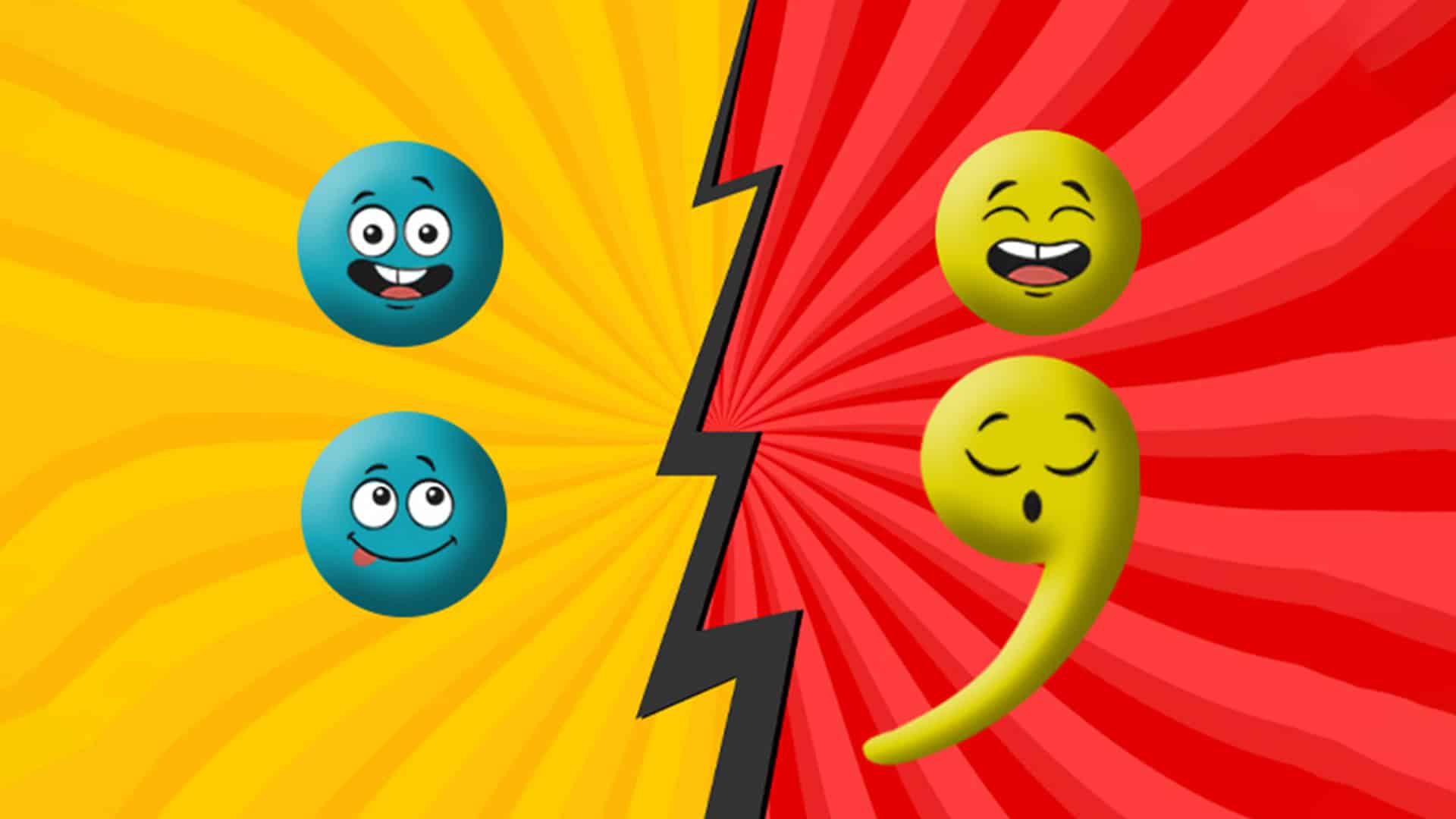
You are halfway through a sentence, you know a comma feels weak, a period feels too final, and suddenly you are staring at two punctuation marks that look weirdly similar. That is where most people get stuck with the colon and semicolon. They do different jobs, but once you see the pattern, the choice gets much easier.
Here is the simple version. A colon points forward. A semicolon links sideways.
If that sounds abstract now, it will not in about two minutes.
The fastest way to tell them apart
Use a colon when the first part of the sentence sets up what comes next.
Use a semicolon when you are joining two complete, closely related sentences without using a word like “and” or “but.”
That is the core difference.
Quick examples
Colon:
- She brought three things to class: a notebook, a pen, and a charger.
Semicolon:
- She forgot her notebook; she borrowed paper from a friend.
The colon introduces. The semicolon connects.
What a colon does
A colon works like a signal that says, “Here it comes.”
It tells the reader that the next part will explain, list, clarify, define, or emphasize what came before.
Use a colon to introduce a list
This is the use most people learn first.
Correct:
- We need four ingredients: pasta, garlic, olive oil, and parmesan.
The part before the colon needs to stand on its own as a complete sentence.
Correct:
- I packed everything for the trip: socks, chargers, snacks, and a jacket.
Incorrect:
- I packed: socks, chargers, snacks, and a jacket.
Why that last one is wrong: “I packed” is not a complete setup. The sentence has not earned the colon yet.
Use a colon to introduce an explanation
A colon can also introduce the reason, result, or explanation that follows.
Examples:
- He had one goal: finish the paper before midnight.
- The answer was obvious: nobody had actually read the instructions.
- She knew what the silence meant: the email had landed badly.
This is where colons start to feel more useful in real writing. They are not just for lists. They are great for emphasis.
Use a colon to introduce an example or restatement
Examples:
- One habit changed everything: writing the first draft badly and moving on.
- The team needed one thing most: time.
- His style had a pattern: short sentences, dry humor, no wasted words.
I like this use more than the list use, honestly. It makes a sentence feel deliberate without sounding stiff.
What a semicolon does
A semicolon joins two complete sentences that are closely related.
That part matters. Both sides have to be able to stand alone as full sentences.
Correct:
- The show started late; nobody seemed to mind.
- I wanted coffee; the line was ridiculous.
- She studied all weekend; the exam still felt brutal.
Each side could be its own sentence:
- The show started late.
- Nobody seemed to mind.
That is why the semicolon works.
The semicolon is stronger than a comma, softer than a period
That is the easiest way to hear it.
A comma is too light for two full sentences.
A period separates them completely.
A semicolon keeps them together without smashing them into a comma splice.
Incorrect:
- I wanted to go, I was too tired.
Correct:
- I wanted to go; I was too tired.
Also correct:
- I wanted to go, but I was too tired.
That last example is important. If you use a coordinating conjunction like “but,” “and,” or “so,” you usually do not need the semicolon.
Colon vs semicolon in one line
If you only want the memory trick, use this:
- Colon = “Here is what I mean.”
- Semicolon = “These two thoughts belong together.”
That rule will get you through most real-world writing.
When to use a colon
Here are the most common situations where a colon makes sense:
1. Before a list
- She bought three things: apples, bread, and tea.
2. Before an explanation
- I stopped checking the group chat: nobody ever answered on time.
3. Before an example
- He had one favorite excuse: “I thought it was due tomorrow.”
4. Before a restatement or emphasis
- The truth was simple: we waited too long.
5. In formal labels or headings
- Note: bring your ID.
- Warning: the floor is wet.
That last use shows up all the time in signs, schedules, school instructions, and work messages.
When to use a semicolon
Here are the most common situations where a semicolon is the better pick:
1. Between two related full sentences
- The room was quiet; everyone was reading the email.
2. Before transitional words like “however” or “therefore”
- I wanted to leave early; however, the meeting ran long.
- She practiced for weeks; therefore, the performance felt easy.
This is one of the most useful semicolon rules to learn. If you put words like “however,” “moreover,” “therefore,” or “meanwhile” between two full sentences, a semicolon often fits before the transition.
3. In a complicated list where commas would get messy
- The speakers came from Delhi, India; Paris, France; and Nairobi, Kenya.
- We invited Ava, the designer; Marcus, the editor; and Tia, the photographer.
This use gets ignored a lot, but it is one of the clearest reasons semicolons exist. They keep crowded lists readable.
The biggest difference people miss
A colon usually points to something that expands or reveals the first clause.
A semicolon usually keeps two equal ideas side by side.
Compare these:
- She knew what she wanted: a quiet apartment with lots of light.
- She knew what she wanted; her roommate wanted the opposite.
In the first sentence, the second part explains the first.
In the second sentence, the two parts are parallel thoughts.
That is the real difference.
Colon vs semicolon examples
Sometimes seeing them next to each other helps more than any rule.
Example 1
Colon:
- He brought exactly what we needed: ice.
Semicolon:
- He brought the ice; I brought the drinks.
Why:
The colon introduces the specific thing. The semicolon joins two complete related statements.
Example 2
Colon:
- There was one problem: the tickets were fake.
Semicolon:
- The tickets were fake; the concert was sold out anyway.
Why:
The colon introduces the problem. The semicolon links two separate facts.
Example 3
Colon:
- She has one weekend hobby: restoring old chairs.
Semicolon:
- She restores old chairs; her brother flips vintage lamps.
Why:
The colon points forward. The semicolon connects two full sentences.
The safest rule
Use a colon when you want to introduce something.
Use a semicolon when you want to join two complete, related thoughts.
That covers most situations people actually run into at school, at work, or while trying not to embarrass themselves in an email.