

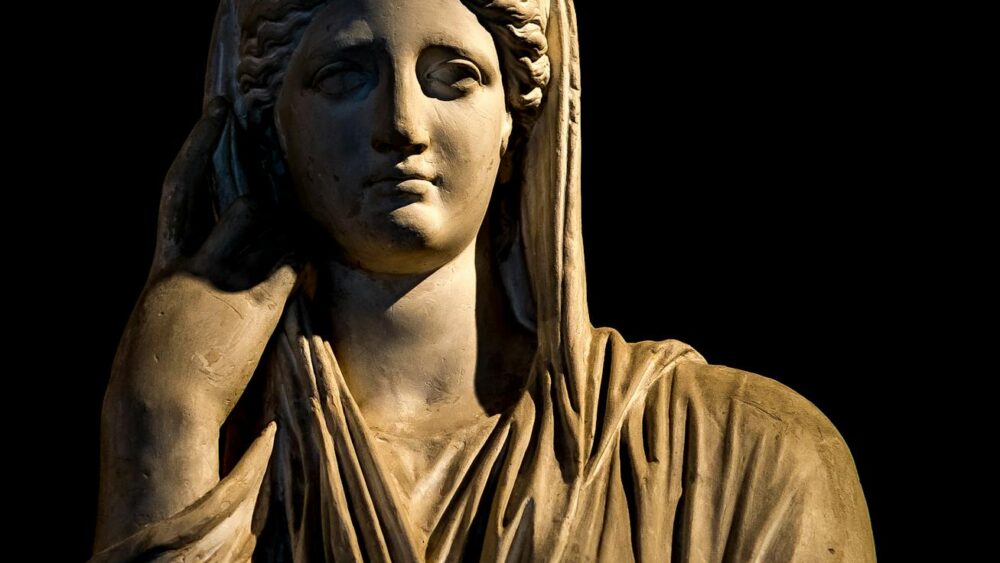
Greek girl names carry something most modern names simply don’t: a direct line to the oldest stories in Western culture. These are names that belonged to goddesses, nymphs, muses, queens, and heroines long before they appeared on birth certificates, and that history gives them a weight and a beauty that is genuinely hard to replicate.
Whether you are drawn to the fierce energy of a warrior goddess, the lyrical grace of a sea nymph, or the celestial pull of a star deity, this list covers the full range of Greek mythology’s female names. Every entry here is a real given name with a genuine mythological connection, organized by theme so you can find your way to the right vibe quickly.
Olympian Goddesses and Their Names
The twelve Olympians are the most recognizable names in Greek mythology, and several of the goddesses among them have crossed over into modern use with real staying power.
Athena
The goddess of wisdom, warfare, and crafts, Athena is one of the great crossover success stories among Greek girl names. Its etymology is debated but likely pre-Greek in origin; the city of Athens may have been named for her, or she for it. It has become a genuine top-500 name in the United States and is climbing steadily.
Artemis
Goddess of the hunt and the moon, Artemis is fierce, independent, and utterly distinctive. The name’s exact etymology is uncertain, though some scholars link it to a root meaning “safe” or “butcher” depending on the source. It remains rare enough to feel bold but familiar enough to wear easily.
Hera
Queen of the Olympians and goddess of marriage and women, Hera may derive from a Greek word meaning “lady” or “mistress.” She has a complicated mythological reputation, but as a name it is regal and striking, with that clean two-syllable snap that ages well.
Aphrodite
Goddess of love and beauty, Aphrodite is famously said to have risen from the sea foam, and her name may connect to the Greek word aphros, meaning “foam.” It is a bold, maximalist choice, rarely used as a given name in English-speaking countries, which makes it genuinely rare.
Demeter
Goddess of the harvest and the cycles of the earth, Demeter likely contains the Greek element meter, meaning “mother,” paired with an element possibly meaning “earth.” It has a warm, grounded quality that its mythology fully supports.
Persephone
Daughter of Demeter and queen of the Underworld, Persephone has an uncertain etymology but may derive from roots meaning “to destroy” and “murder,” which is a dark origin for such a beautiful-sounding name. It is long, lyrical, and increasingly fashionable among parents who love mythology-forward choices.
Hecate
Goddess of magic, crossroads, and the night, Hecate (also spelled Hekate) likely derives from the Greek hekatos, meaning “far-reaching” or “far-working.” It is rare, atmospheric, and deeply connected to the mystical side of Greek religion.
Nike
The goddess of victory, Nike comes directly from the Greek nike, meaning “victory.” Long before the athletic brand, this was a genuine given name in ancient Greece, and it still circulates as a girl’s name in Greece and among Greek diaspora communities today.
Eos
Goddess of the dawn, Eos comes from the Greek word for “dawn” and is related to the Latin aurora. It is one of the shortest Greek mythological names, with just three letters, and its simplicity gives it a quiet elegance that longer names can’t quite match.
Iris
Goddess of the rainbow and messenger of the gods, Iris comes from the Greek word for “rainbow.” It is one of the most successfully modernized Greek mythological names, sitting comfortably in the top 200 in many English-speaking countries and beloved for its botanical double meaning (the iris flower).
Hestia
Goddess of the hearth and home, Hestia derives from a Greek root meaning “hearth” or “fireside.” She is one of the most underused Olympian names in modern circles, which is genuinely surprising given the current appetite for soft, vintage-feeling names.
Selene
The goddess of the moon herself, Selene comes from the Greek selas, meaning “light” or “brightness.” It predates Artemis’s association with the moon and has a romantic, flowing quality that makes it one of the most wearable names on this list.
Nymphs and Nature Spirits
Greek mythology is full of nymphs, the divine nature spirits who inhabited every river, forest, spring, and mountain. Many of their names are genuinely beautiful and surprisingly usable.
Calypso
A sea nymph who detained Odysseus on her island for seven years, Calypso comes from the Greek kalypto, meaning “to cover” or “to conceal.” It has a musical, rhythmic quality and has seen renewed interest partly through Caribbean music and partly through parents hunting for mythological names with a lyrical feel.
Thetis
A sea nymph and the mother of Achilles, Thetis is thought to derive from a Greek root meaning “to place” or possibly from a pre-Greek word. It is rare and quietly beautiful, with that crisp two-syllable structure that wears well on a person.
Naiad
The Naiads were the freshwater nymphs of springs, rivers, and lakes. Naiad as a given name derives from the Greek naein, meaning “to flow.” It is extremely rare as a personal name but is genuinely used in some Greek and classical-leaning naming traditions.
Dryad
The Dryads were the tree nymphs of Greek mythology, with the name coming from the Greek drys, meaning “oak tree.” Used occasionally as a given name, it has a wild, forest-spirit quality that is entirely its own.
Arethusa
A naiad nymph who was transformed into a freshwater spring to escape the river god Alpheus, Arethusa has an uncertain etymology but has been used as a given name in classical contexts. It is elaborate and rare, a genuine conversation piece.
Chloris
A nymph associated with flowers and spring, Chloris comes from the Greek chloros, meaning “pale green” or “fresh.” She was also associated with the goddess Flora in Roman mythology. It has a botanical freshness that feels very current.
Daphne
A naiad nymph transformed into a laurel tree to escape Apollo, Daphne comes directly from the Greek word for “laurel.” It has been a recognizable given name in English-speaking countries for over a century and sits in a lovely sweet spot between familiar and distinctive.
Echo
An Oread mountain nymph cursed to repeat only the last words spoken to her, Echo comes from the Greek echo, meaning “sound” or “reverberation.” As a name it is bold and minimalist, a single concept distilled into four letters.
Syrinx
A naiad nymph transformed into hollow reeds, from which Pan made his famous pipes, Syrinx derives from the Greek syrinx, meaning “pipe” or “tube.” It is rare as a given name but genuinely appears in classical naming traditions.
Cyane
A naiad nymph who tried to prevent Hades from abducting Persephone and was turned into a pool of water, Cyane comes from the Greek kyanos, meaning “blue” or “dark blue.” It is unusual and striking, with that clean two-syllable rhythm.
Minthe
A naiad nymph transformed into a mint plant by Persephone out of jealousy, Minthe is the mythological origin of the word “mint” in English, which traces back through Latin to this Greek name. Rare and herb-fresh, it is a genuine mythological find.
Oenone
A mountain nymph and the first love of Paris before he abandoned her for Helen, Oenone comes from the Greek oinos, meaning “wine.” It is elaborate, romantic, and carries a bittersweet story that gives it real emotional depth.
Muses and Goddesses of the Arts
The nine Muses were the goddesses of creative and intellectual inspiration, and their names are some of the most beautiful in the entire Greek mythological canon.
Calliope
The Muse of epic poetry, Calliope means “beautiful voice” from the Greek kalos (“beautiful”) and ops (“voice”). It is the most famous of the Muse names in modern use, beloved for its lush, rolling sound and strong meaning.
Clio
The Muse of history, Clio comes from the Greek kleos, meaning “glory” or “fame.” Short, crisp, and deeply learned-feeling, it is one of those rare names that manages to be both minimal and resonant.
Erato
The Muse of love poetry, Erato derives from the Greek eros, meaning “love” or “desire.” It is rare as a modern given name but entirely wearable, with a soft, romantic sound.
Euterpe
The Muse of music and lyric poetry, Euterpe means “rejoicing well” or “delight” from the Greek eu (“good, well”) and terpein (“to delight”). Unusual in modern use, it has a vintage grandeur that could appeal to parents who love elaborate classical names.
Melpomene
The Muse of tragedy, Melpomene means “to celebrate with song” from the Greek melpo. It is long and dramatic, which seems exactly right for the muse of tragedy, and it is a genuinely rare find for parents who want something truly uncommon.
Polyhymnia
The Muse of sacred poetry and hymns, Polyhymnia means “many hymns” from polys (“many”) and hymnos (“hymn”). It is elaborate to the point of being a statement, but “Polly” as a nickname makes it surprisingly approachable.
Terpsichore
The Muse of dance, Terpsichore means “delight in dancing” from terpsis (“delight”) and choros (“dance”). Famously difficult to spell and pronounce for non-classicists, but absolutely magnificent as a full name.
Thalia
The Muse of comedy and pastoral poetry, Thalia comes from the Greek thallein, meaning “to flourish” or “to bloom.” It is the most successfully modern of the Muse names, appearing regularly in popularity charts and beloved for its cheerful, flowing sound.
Urania
The Muse of astronomy, Urania means “heavenly” from the Greek ouranos, meaning “sky” or “heaven.” It has an otherworldly, celestial quality and was used as a given name in Europe through the Renaissance and beyond.
Heroines and Mortal Women of Myth
Not every great name in Greek mythology belongs to a goddess. The mortal women and heroines of the myths have equally compelling names, and many of them translate beautifully to modern use.
Andromeda
The Ethiopian princess chained to a rock and rescued by Perseus, Andromeda means “ruler of men” from the Greek aner (“man”) and medon (“ruler”). It is long and starry (there is also a galaxy named for her), and it has been quietly gaining traction among mythology-loving parents.
Cassandra
The Trojan prophetess cursed to speak true prophecies that no one would believe, Cassandra’s etymology is disputed but may relate to Greek roots meaning “she who entangles men.” It has been a steady presence in the English-speaking world for decades, with the nickname Cassie providing an easy everyday option.
Helena
The Greek form of Helen, the face that launched a thousand ships, Helena derives from the Greek helene, meaning “torch” or possibly relating to the moon. It is more formal and regal than plain Helen and has seen significant revival in recent years.
Helen
The most famous mortal woman in Greek mythology, whose abduction sparked the Trojan War, Helen comes from the Greek helene, meaning “torch” or “bright one.” Classic, enduring, and never truly out of fashion.
Iphigenia
The daughter of Agamemnon, sacrificed (or saved by Artemis) before the Greek fleet could sail to Troy, Iphigenia means “born to strength” from iphios (“strong”) and genos (“born”). It is elaborate and rare, carrying the full weight of its tragic story.
Electra
The daughter of Agamemnon and Clytemnestra who drove her brother Orestes to avenge their father’s murder, Electra comes from the Greek elektron, meaning “amber” or “shining.” It also gave us the word “electricity,” making it one of the most consequential names in the Western canon.
Medea
The sorceress and princess of Colchis who helped Jason obtain the Golden Fleece, Medea comes from a Greek root meaning “to think” or “to plan.” It is a bold choice given its mythological associations, but as a name it is hauntingly beautiful.
Penelope
The faithful wife of Odysseus who wove and unwove her tapestry for years to delay her suitors, Penelope likely derives from the Greek pene (“bobbin” or “thread”) and ops (“face”). It is one of the most successfully revived classical names of the past two decades, now a firm top-20 favorite in many countries.
Ariadne
The Cretan princess who gave Theseus the thread to navigate the labyrinth and escape the Minotaur, Ariadne comes from the Greek ari (“most”) and possibly adnos (“holy”), giving it a meaning close to “most holy” or “most pure.” It is flowing, romantic, and increasingly fashionable.
Phaedra
The daughter of King Minos and wife of Theseus, Phaedra comes from the Greek phaidros, meaning “bright” or “radiant.” Like Medea, it carries a complicated mythological story, but the name itself is genuinely beautiful.
Alcyone
A figure from myth transformed into a kingfisher bird, Alcyone comes from the Greek alkyon, the word for the kingfisher, itself possibly from alke (“strength”) and yon (relating to the sea). The Halcyon Days trace their name back to her.
Atalanta
The legendary huntress and athlete who could outrun any man, Atalanta may come from a Greek root meaning “equal in weight” or “balanced.” She is one of mythology’s great feminist figures, and her name has a strong, athletic energy.
Antigone
The daughter of Oedipus who defied the king of Thebes to bury her brother, Antigone means “against birth” or “in place of one’s parents” from anti and gone. It is a name that carries enormous moral and dramatic weight.
Alcmene
The mortal mother of Heracles (Hercules), Alcmene means “might of the moon” from the Greek alke (“strength, might”) and mene (“moon”). It is rare and classical, with a lovely sound and an impressive mythological pedigree.
Chryseis
A Trojan woman whose capture by Agamemnon set off the chain of events at the start of the Iliad, Chryseis comes from the Greek chrysos, meaning “gold.” It is elaborate and rare, with that golden meaning giving it an immediate warmth.
Briseis
A Trojan captive whose removal from Achilles by Agamemnon sparked Achilles’ famous wrath in the Iliad, Briseis is thought to derive from the name of her father Briseus, possibly connected to a Greek root meaning “to prevail.” Rare and literary, it has a soft, romantic sound despite its martial context.
Titan and Primordial Goddesses
Before the Olympians, the Titans and primordial deities ruled the cosmos. Several of the female Titans have names that are genuinely beautiful and largely underused in modern naming.
Rhea
The Titan goddess and mother of the Olympians, Rhea may derive from a Greek root meaning “flow” or “ease.” It is short, soft, and currently enjoying a significant revival, sitting in the top 200 in the United States and climbing.
Themis
The Titan goddess of divine law and order, Themis comes from the Greek thesmos, meaning “law” or “custom.” It has a strong, principled meaning and a clean, modern sound that makes it more wearable than many Titan names.
Mnemosyne
The Titan goddess of memory and the mother of the nine Muses, Mnemosyne comes from the Greek mneme, meaning “memory.” It is famously difficult for English speakers to pronounce (roughly “neh-MOS-ih-nee”), but it is one of the most conceptually powerful names in all of Greek mythology.
Metis
The Titan goddess of wisdom and cunning, and the first wife of Zeus, Metis comes from the Greek word meaning “wisdom,” “skill,” or “counsel.” Short, meaningful, and almost entirely unused in modern naming, which makes it a genuine discovery.
Phoebe
A Titan goddess associated with the moon and prophecy, Phoebe comes from the Greek phoibos, meaning “bright” or “radiant.” It is one of the most successful mythological names in modern use, sitting comfortably in the top 100 in the UK and climbing in the United States.
Tethys
The Titan goddess of fresh water and the grandmother of rivers and springs, Tethys may derive from a Greek root meaning “nurse” or “grandmother.” It is almost entirely unused as a modern given name, which is a genuine gap given how lovely it sounds.
Dione
A Titan goddess and, in some traditions, the mother of Aphrodite, Dione comes from a Greek root meaning “divine woman” or “goddess,” related to Zeus and the Proto-Indo-European root for “sky deity.” It has a serene, flowing quality.
Leto
The Titan goddess and mother of Apollo and Artemis, Leto’s name may derive from the Greek letho, meaning “to be hidden” or “to move unseen,” or from a Lycian word meaning “woman.” It is short, elegant, and very much in the sweet spot of the current minimalist naming trend.
Maia
A daughter of the Titan Atlas and the mother of Hermes, Maia comes from the Greek maia, meaning “good mother” or “nurse.” It is one of the softest and most wearable names on this list, currently popular across Europe and the English-speaking world.
Nyx
The primordial goddess of the night itself, Nyx comes directly from the Greek word nyx, meaning “night.” It is one of the most powerful monosyllabic names in the entire mythological canon, and it is starting to appear on real birth certificates for parents who love short, striking choices.
Gaia
The primordial goddess of the earth, Gaia comes from the Greek ge or gaia, meaning “earth” or “land.” It is one of the most ecologically resonant names in the canon and has been used as a given name in Greece and increasingly in other countries.
Hemera
The primordial goddess of the day, Hemera comes from the Greek hemera, meaning “day.” It is almost entirely unused as a modern given name, which feels like a real oversight given its clear meaning and appealing sound.
Ananke
The primordial goddess of necessity, compulsion, and fate, Ananke comes from the Greek word meaning “necessity” or “inevitability.” It is rare and philosophical, the kind of name that invites questions.
Sea Goddesses and Water Deities
Greek mythology gave names to every river, spring, and stretch of sea, and the goddesses associated with water produced some of the most fluid and beautiful names in the tradition.
Amphitrite
The goddess of the sea and wife of Poseidon, Amphitrite likely derives from Greek roots meaning “the third one who encircles” or relating to the sea encircling the land. It is elaborate and rare, with a grandeur that suits its mythological status.
Galatea
A sea nymph (Nereid) whose name comes from the Greek gala, meaning “milk,” suggesting the whiteness of sea foam. She also appears in the story of the sculptor Pygmalion. It is romantic, flowing, and deeply classical.
Thalassa
The primordial goddess of the sea herself, Thalassa comes from the Greek thalassa, meaning “sea.” It is the root of the modern medical term “thalassemia” and the word “Mediterranean” (via Latin). As a name it is lyrical and rare.
Nereid
The Nereids were the fifty sea nymph daughters of the sea god Nereus. While individual names like Galatea and Thetis are more commonly used, Nereid itself has appeared as a given name and carries the full weight of oceanic mythology.
Cymothoe
One of the fifty Nereid sea nymphs, Cymothoe comes from the Greek kyma (“wave”) and thoos (“swift”), meaning “swift wave.” It is rare and genuinely beautiful, for parents who want something entirely off the beaten path.
Leucothea
A sea goddess who aided Odysseus by giving him a veil that kept him afloat, Leucothea means “white goddess” from the Greek leukos (“white”) and thea (“goddess”). She was originally the mortal Ino before her deification.
Goddesses of Fate, Justice, and the Stars
Some of the most compelling names in Greek mythology belong to the abstract goddesses who governed fate, justice, and the natural order of the cosmos.
Moira
One of the Moirai (the Fates), Moira comes from the Greek moira, meaning “fate,” “share,” or “lot.” It has been widely used as a given name in Ireland, Scotland, and Greece and has a lovely, melancholy depth to it.
Clotho
The youngest of the three Fates, who spun the thread of life, Clotho comes from the Greek klotho, meaning “spinner.” It is rare as a modern given name but carries a powerful meaning.
Lachesis
The second of the three Fates, who measured the thread of life, Lachesis comes from the Greek lagchanein, meaning “to obtain by lot.” It is elaborately classical and extremely rare in modern use.
Atropos
The eldest of the three Fates, who cut the thread of life, Atropos means “she who cannot be turned” from the Greek a (negative prefix) and tropos (“turning”). The plant atropine is named for her. Rare, powerful, and deeply meaningful.
Nemesis
The goddess of retribution and divine vengeance, Nemesis comes from the Greek nemein, meaning “to give what is due.” It has a strong, modern edge and has appeared as a given name, though its English-language connotations make it a bold choice.
Dike
The goddess of justice and moral order, Dike comes from the Greek word meaning “justice” or “custom.” One of the Horae (goddesses of the seasons and order), she embodies the principle of right action. Rare in modern use.
Tyche
The goddess of fortune and prosperity, Tyche comes from the Greek tychein, meaning “to hit the mark” or “to succeed.” She governed the luck of cities and individuals alike, and her name has a sharp, modern sound despite its antiquity.
Eunomia
One of the Horae and the goddess of law and legislation, Eunomia means “good order” or “good law” from the Greek eu (“good”) and nomos (“law”). It is rare and principled, with a meaning that resonates far beyond mythology.
Eirene
The goddess of peace and one of the Horae, Eirene comes from the Greek eirene, meaning “peace.” It is the source of the name Irene, which has been widely used in Christian and secular naming traditions across Europe for centuries.
Astraea
The goddess of justice and innocence who lived among humans during the Golden Age before ascending to the stars as the constellation Virgo, Astraea means “starry” from the Greek astron (“star”). It is celestial, rare, and genuinely beautiful.
Aletheia
The goddess or spirit of truth and sincerity, Aletheia comes from the Greek aletheia, meaning “truth” or “disclosure.” It is one of the most meaningful names in the entire Greek tradition and is used as a given name in Greece today.
How to Choose the Right Greek Girl Name
The first thing to think about is usability in daily life. A name like Persephone or Terpsichore is magnificent but comes with a real-world learning curve: you will spend years spelling it out and correcting mispronunciations. If that sounds like fun, go for it. If it sounds exhausting, look at the shorter names on this list, like Iris, Rhea, Clio, or Nyx, which carry full mythological weight in a much more manageable package.
Think about the nickname situation. Many of the longer Greek girl names have natural shortcuts that make them practical for everyday use. Persephone becomes Percy or Seph. Calliope becomes Callie. Penelope is already well-served by Penny or Nell. Polyhymnia, improbably, works beautifully with Polly. A long, elaborate mythological name paired with the right nickname gives you the best of both worlds: a full name that is a genuine statement and a daily name that is easy and warm.
Consider the meaning as something your daughter will grow into. A name like Aletheia (“truth”), Eirene (“peace”), or Eunomia (“good law”) is not just a pretty sound; it is a value embedded in a name. Greek mythological names have this quality more than almost any other naming tradition, because so many of them were the names of goddesses who literally embodied abstract concepts. That is a meaningful thing to pass on.
Finally, check the cultural weight. Some names on this list, like Medea and Nemesis, carry such strong mythological associations that they may work against the bearer in certain contexts. Others, like Cassandra and Electra, have complicated stories but have been used as normal given names for long enough that the mythology is more backdrop than burden. Know the story behind the name you choose, and decide whether it adds depth or complication to the name you are giving.
Greek girl names have been traveling the world and collecting new meanings for thousands of years. The best one for your daughter is the one whose sound, meaning, and story you genuinely love, and with a tradition this deep, there is no shortage of extraordinary options to choose from.