

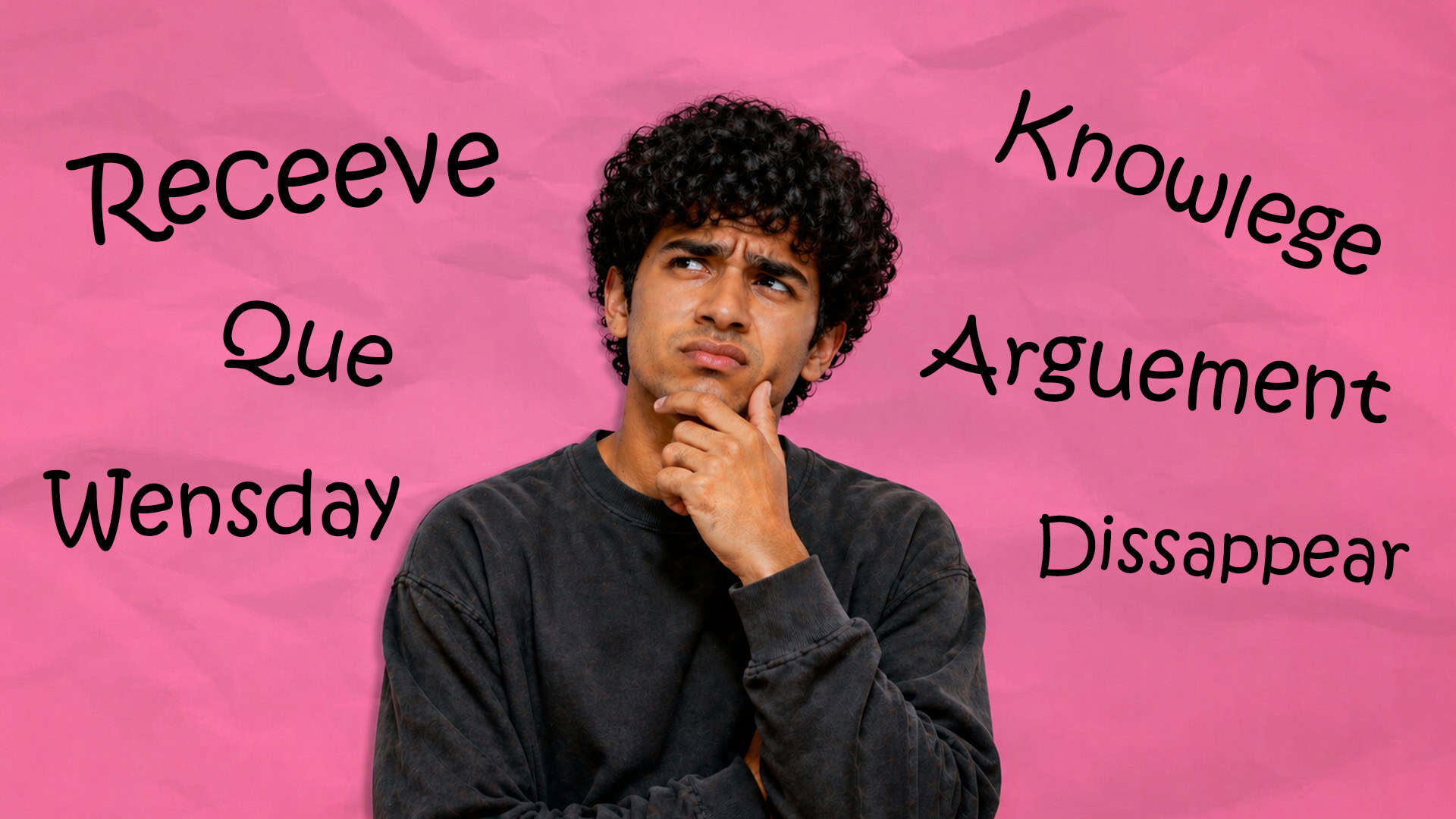
You know that moment when you type a word, stare at it for five seconds, delete it, type it again, and somehow it still looks fake? English is full of words like that. Some have silent letters. Some borrowed their spelling from other languages. Some look like they were assembled during a power outage.
These weird spellings are the ones that make students groan, writers double-check themselves, and group chats briefly turn into spelling bees. Use this list as a quick guide, a classroom helper, a trivia source, or a satisfying reminder that English spelling is not always your fault.
Weird Spellings With Silent Letters
Knight
The “k” and “gh” are silent, which makes this word look much heavier than it sounds. Think of the “k” as a leftover from older English.
Knife
The “k” does nothing in modern pronunciation, but it still sits there at the front.
Knock
Another silent “k” word. It sounds like “nock,” but the spelling keeps its old shape.
Knee
The “k” is silent, and the double “e” carries the long vowel sound.
Know
The “k” stays quiet, while the word sounds exactly like “no.”
Gnome
The silent “g” makes this little word look more mysterious than it needs to.
Gnat
The “g” is silent, which is probably why this tiny insect causes spelling trouble.
Gnaw
The “g” stays silent, and the word sounds like “naw.”
Wrist
The “w” is silent. The word begins with an “r” sound even though it does not look that way.
Write
The “w” is silent, which is why “write” sounds exactly like “right.”
Wrong
The “w” disappears when spoken, even though it remains in spelling.
Wreck
The “w” is silent, making this word sound like “reck.”
Sword
The “w” is silent. Many learners expect to hear it, but English says no.
Answer
The “w” is silent here too, which is easy to forget.
Half
The “l” is silent in many accents, so the spelling feels slightly fuller than the sound.
Calm
The “l” is silent for many speakers. The word sounds softer than it looks.
Walk
The “l” usually disappears in speech.
Talk
The “l” is silent, though it often tricks young spellers.
Could
The “l” is silent. It is there by spelling tradition, not sound.
Would
The “l” is silent, just like in “could” and “should.”
Should
The “l” is silent, making the word shorter in speech than on the page.
Debt
The “b” is silent, which makes this word a classic spelling trap.
Doubt
The “b” is silent again. The word sounds like “dowt.”
Subtle
The “b” is silent, and the word sounds like “suttle.”
Thumb
The “b” is silent, but many people want to add it when saying the word slowly.
Weird Spellings With Odd Pronunciation
Colonel
This word is pronounced like “kernel,” which feels wildly unfair the first time you learn it.
Wednesday
Most people say it more like “Wenz-day,” but the spelling keeps the full “dnes” cluster.
February
The first “r” often gets softened or skipped in casual speech, but it belongs in the spelling.
Queue
Five letters, one sound. The extra letters are doing decorative work.
Quay
This word is pronounced like “key,” not “kway.”
Yacht
The spelling looks sharp and complicated, but the word sounds like “yot.”
Choir
It looks like it should start with “ch,” but it is pronounced like “kwire.”
Chaos
The “ch” sounds like “k,” thanks to its Greek roots.
Chameleon
Another “ch” with a “k” sound. The spelling feels fancy because the word is borrowed.
Character
The “ch” sounds like “k,” not like the start of “chair.”
Archive
The “ch” sounds like “k,” which can surprise readers.
Stomach
The “ch” sounds like “k,” making it a quiet spelling trap.
Brooch
It looks like it should rhyme with “mooch,” but it is pronounced like “broach.”
Bury
This word often sounds like “berry,” even though it is spelled with “u.”
Busy
It sounds like “bizzy,” which makes the “u” feel out of place.
Business
The spelling looks like “busy-ness,” but the word is usually said more like “biz-ness.”
Build
The “u” is silent, and the word sounds like “bild.”
Circuit
This spelling looks more complicated than its pronunciation.
Biscuit
The “ui” does not sound the way many beginners expect.
Gauge
The spelling is odd, but the word rhymes with “cage.”
Plague
The “gue” ending looks heavier than it sounds.
Tongue
The word is pronounced like “tung,” not “tong-you.”
Rogue
The “gue” ending is quiet, and the word rhymes with “vogue.”
Vague
The ending looks similar to “plague” and rhymes with “egg” in no universe.
Cough
The “ough” sounds like “off,” because English enjoys keeping everyone alert.
Weird Spellings With “Ough”
Though
The “ough” sounds like “oh.”
Through
Here, “ough” sounds like “oo.”
Thought
Now “ough” sounds like “aw.”
Rough
In this one, “ough” sounds like “uff.”
Tough
Same “uff” sound as “rough.”
Bough
The “ough” sounds like “ow.”
Dough
The “ough” sounds like “oh,” like in “though.”
Thorough
The spelling looks long, and the pronunciation changes depending on accent.
Enough
The “ough” sounds like “uff.”
Bought
The “ough” sounds like “aw,” as in “thought.”
Brought
Another “aw” sound hiding inside “ough.”
Fought
The “ough” sounds like “aw,” not “ow” or “oo.”
Trough
This one often sounds like “troff,” which feels unfair beside “through.”
Slough
This word has more than one pronunciation depending on meaning and place name, which makes it extra tricky.
Hiccough
An older spelling of “hiccup.” It looks like it should belong with “though,” but it does not.
Weird Spellings With Double Letters

Accommodate
This word has double “c” and double “m.” Miss one, and it looks off.
Embarrass
Double “r” and double “s” make this word embarrassingly easy to misspell.
Occurrence
Double “c” and double “r” create a classic spelling headache.
Millennium
Double “l” and double “n” are easy to mix up.
Committee
Double “m,” double “t,” and double “e.” This word came prepared to cause trouble.
Possession
Double “s” appears twice, which makes the word look crowded.
Misspell
A funny one because the word “misspell” itself is easy to misspell.
Necessary
One “c” and two “s” letters. A common memory trick is “one collar, two sleeves.”
Success
Double “c” and double “s” make it feel more complicated than the sound suggests.
Address
Double “d” and double “s.” Many people forget one of them.
Weird Spellings With Tricky Vowels
Weird
Yes, “weird” itself has a weird spelling. It breaks the familiar “i before e” pattern.
Seize
Another “ei” word that refuses to behave.
Receive
This one follows the “i after c” version of the rule, but still catches people.
Ceiling
The “ei” after “c” makes it a common classroom spelling word.
Foreign
The “ei” spelling does not sound obvious from pronunciation.
Height
The “ei” and silent-looking “gh” make this word easy to second-guess.
Neighbor
The “ei” spelling appears again, with American spelling dropping the “u” used in British “neighbour.”
Leisure
The vowel sound can shift by accent, which makes the spelling feel slippery.
Friend
The spelling looks like it should rhyme with “fiend,” but it does not.
People
The “eo” combination sounds like “ee,” which surprises beginners.
Leopard
It looks like it should start with “lee,” but it sounds like “lep.”
Jeopardy
The “eo” does not sound the way many people expect.
Aisle
The “a” and “s” are silent, leaving a word that sounds like “isle” or “I’ll.”
Isle
The “s” is silent, and the word sounds like “aisle.”
Eerie
The double “e” plus “ie” makes this short word look strangely stretched.
Weird Spellings Borrowed From Other Languages
Ballet
The final “t” is silent because the word comes through French.
Buffet
The ending often sounds like “ay,” not “et,” when referring to the meal setup.
Bouquet
The “quet” ending sounds like “kay.”
Croissant
The spelling comes from French, and English pronunciation only partially follows it.
Faux
It means fake, and the “x” is silent.
Rendezvous
A French-looking word with a pronunciation that surprises many English learners.
Genre
The “g” and final sound do not behave like everyday English spelling.
Hors d’oeuvre
This one looks intimidating because it keeps much of its French form.
Tsunami
The “t” is often silent in English pronunciation.
Pneumonia
The “p” is silent, and the word looks much harder than it sounds.
Weird Spellings That Sound Like Other Words
Some spellings get extra confusing because they sound just like another word.
Right
Sounds like “write,” “rite,” and “wright.”
Write
The silent “w” makes it sound exactly like “right.”
Rite
A ceremony or formal act, pronounced like “right.”
Wright
A maker or builder, as in “playwright,” pronounced like “right.”
There
A place word that sounds like “their” and “they’re.”
Their
Shows possession, but sounds like “there.”
They’re
A contraction of “they are,” pronounced like “there.”
To
Often confused with “too” and “two.”
Too
Means also or more than needed.
Two
The number, with a silent “w.”
Bare
Means uncovered, and sounds like “bear.”
Bear
The animal or the verb meaning to carry or endure.
Piece
Sounds like “peace,” but means a part of something.
Peace
A state of calm, not a slice of pizza.
Flour
Sounds like “flower,” but belongs in baking.
Flower
The plant, not the baking ingredient.
Principal
Can mean a school leader or main thing.
Principle
Means a rule, belief, or basic truth.
Compliment
Means praise.
Complement
Means something that completes or goes well with something else.
Weird Spellings People Often Get Wrong
These words are not always strange at first glance, but they are famous for tripping people up.
Definitely
The middle is “finite,” not “finately.”
Separate
Remember “par” in the middle, not “per.”
Calendar
Ends with “ar,” not “er.”
Grammar
Ends with “ar,” even though people often write “grammer.”
Privilege
No “d” after the “le,” even though many people expect one.
Maintenance
The vowel pattern feels odd because it does not match “maintain” perfectly.
Pronunciation
The noun is “pronunciation,” not “pronounciation.”
Acknowledgment
The spelling can feel crowded, especially around “dge.”
Conscience
The “science” inside the word helps, but the beginning is still tricky.
Conscious
Similar to “conscience,” but not the same word.
Restaurant
Many people want to add extra vowels because of the way it is pronounced.
Guarantee
The “guar” beginning and double “e” ending make it tricky.
Vacuum
Double “u” looks strange, but it is correct.
License
Spelling varies by American and British usage, which adds confusion.
Rhythm
Almost no obvious vowel, unless you count “y” doing the work.
A Simple Way to Handle Weird Spellings
English spelling is not always logical, so do not take every mistake personally. Some words are weird because of history. Some are weird because of borrowed roots. Some are weird because pronunciation changed and spelling refused to update.
The best approach is practical: learn the common traps, keep your own trouble list, and slow down on words that always look suspicious. If “necessary,” “definitely,” “colonel,” “queue,” or “Wednesday” makes you pause, you are not bad at spelling. You are just dealing with English being English.