

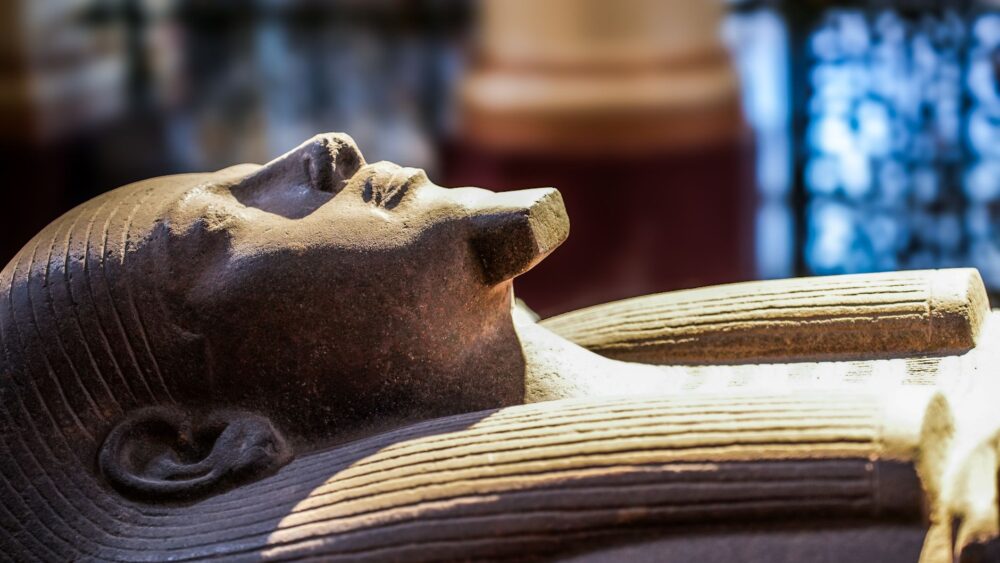
Egyptian names carry thousands of years of history in just a few syllables. From the pharaohs of the Old Kingdom to the streets of Cairo today, names in Egypt have been shaped by ancient hieroglyphic tradition, the rise of Christianity, the spread of Islam, and a continuous thread of cultural pride that never quite broke. Whether you are drawn to the mythological weight of ancient Egyptian names or the lyrical sound of modern Arabic-Egyptian ones, this list has something worth considering.
These are real names used by real people, organized by era and theme. Each one reflects something genuine about Egyptian naming culture, from the gods they invoked to the virtues they celebrated.
Ancient Egyptian Names for Boys
These names come directly from the ancient Egyptian language, found in hieroglyphic texts, royal inscriptions, and historical records. Several have been revived or retained in modern Egypt as a mark of cultural heritage.
Amenhotep
Means “Amun is satisfied” in ancient Egyptian, combining the name of the god Amun with the word for peace or contentment. Borne by four pharaohs of the New Kingdom, it is one of the most historically significant Egyptian names in existence.
Thutmose
From the ancient Egyptian “Djehutymes,” meaning “Thoth is born” or “born of Thoth,” where Thoth is the god of wisdom and writing. Several pharaohs carried this name, including Thutmose III, one of Egypt’s most celebrated military rulers.
Ramesses
Means “born of Ra” or “Ra has fashioned him,” from the ancient Egyptian “Ra-mes-su.” Ramesses II, known as Ramesses the Great, made this the most famous name in pharaonic history.
Khepri
The name of the scarab-headed god associated with the rising sun and creation, meaning something close to “he who has come into being.” It was used as a given name in ancient times and has seen occasional modern revival among Egyptians with an interest in ancient heritage.
Seti
Means “of Set” or “he who belongs to Set,” referring to the god of storms and chaos. Seti I was a powerful pharaoh of the Nineteenth Dynasty and father of Ramesses II.
Mentuhotep
Means “Montu is satisfied,” where Montu is the ancient Egyptian god of war. Mentuhotep II reunified Egypt after a period of division and founded the Middle Kingdom.
Horemheb
Means “Horus is in jubilation” in ancient Egyptian. Horemheb was a military commander who became pharaoh near the end of the Eighteenth Dynasty and worked to restore traditional order after the Amarna period.
Nebamun
Means “my lord is Amun,” a name used by officials and nobles in ancient Egypt. A scribe named Nebamun is immortalized in a famous set of tomb paintings now housed in the British Museum.
Amenemhat
Means “Amun is foremost” or “Amun at the head.” Several pharaohs of the Twelfth Dynasty bore this name, and it remains one of the most historically documented ancient Egyptian names for men.
Khufu
The pharaoh who commissioned the Great Pyramid of Giza. The name is believed to be a shortened form of “Khnum-Khufu,” meaning “Khnum protects me,” where Khnum is the ram-headed god of creation.
Ancient Egyptian Names for Girls
Ancient Egyptian women had names that were just as rich and theologically layered as men’s. Many honored goddesses or expressed religious devotion, and some have survived or been revived in modern Egypt.
Nefertiti
Means “the beautiful one has come” in ancient Egyptian. The queen consort of Pharaoh Akhenaten, she is one of the most recognizable faces of the ancient world, and her name is still used in Egypt today.
Nefertari
Means “the most beautiful” or “the beautiful companion,” from ancient Egyptian. Nefertari was the beloved chief wife of Ramesses II, and her tomb in the Valley of the Queens is considered one of the finest in Egypt.
Hatshepsut
Means “foremost of noble women” in ancient Egyptian. She ruled as pharaoh in the Eighteenth Dynasty and is regarded as one of Egypt’s most successful rulers. The name is rare today but carries extraordinary historical weight.
Cleopatra
Although Greek in origin, Cleopatra was the name of the last active ruler of the Ptolemaic Kingdom of Egypt, making it deeply woven into Egyptian history. It means “glory of the father” from the Greek “kleos” and “patros.”
Merit
A short, elegant ancient Egyptian name meaning “beloved.” It was a common name in ancient times and has a clean, modern feel that makes it appealing today.
Neferu
Means “beauty” or “goodness” in ancient Egyptian. Several royal women of the Middle Kingdom bore this name, and it shares a root with the more famous Nefertiti.
Mutnofret
Means “Mut is beautiful,” honoring Mut, the mother goddess of ancient Egypt. Mutnofret was a queen of the early Eighteenth Dynasty, wife of Thutmose I.
Ahmose
Means “the moon is born” or “child of the moon,” from the ancient Egyptian “Iah-mes.” Both men and women bore this name in ancient Egypt, and Queen Ahmose-Nefertari is one of its most celebrated female bearers.
Sitamun
Means “daughter of Amun” in ancient Egyptian. It was a name used by royal daughters of the Eighteenth Dynasty, including a daughter of Amenhotep III.
Tiye
The name of the powerful chief queen of Amenhotep III and mother of Akhenaten. Its exact ancient Egyptian meaning is debated, but Tiye was a hugely influential figure at court and the name carries real historical presence.
Names from Egyptian Mythology
Ancient Egyptians named their children after gods and goddesses more freely than almost any other ancient culture. These names were acts of devotion and identity simultaneously.
Osiris
The god of the afterlife and resurrection, whose name may derive from ancient Egyptian words relating to power or a throne. Osiris was one of the most important deities in the Egyptian pantheon, and the name has been used occasionally as a given name.
Isis
The name of the great mother goddess of ancient Egypt, associated with magic, healing, and protection. In ancient Egyptian her name was “Aset,” meaning “throne.” Isis has been used as a given name in modern times, though contemporary associations have made it complicated for some parents.
Horus
The falcon-headed god of the sky and kingship, whose name in ancient Egyptian meant something close to “the distant one” or “he who is above.” Horus has been used as a given name and has a strong, confident sound.
Bastet
The cat goddess of protection, pleasure, and the home. The name likely derives from the ancient Egyptian word “bas,” related to a type of ointment jar. Bastet has been used as a given name, particularly among those drawn to ancient Egyptian heritage.
Thoth
The ibis-headed god of wisdom, writing, and the moon. The origin of the name is uncertain, possibly derived from the ancient Egyptian word for the ibis. Thoth has been used occasionally as a given name in modern contexts.
Sekhmet
The lioness goddess of war and healing, whose name means “the powerful one” in ancient Egyptian, from the root “sekhem.” She is one of the oldest deities in the Egyptian pantheon, and Sekhmet has been used as a given name.
Anubis
The jackal-headed god of embalming and the dead, whose ancient Egyptian name “Anpu” or “Inpu” may relate to a word for decay or a royal child. Anubis has been used as a given name in some modern contexts.
Coptic Christian Egyptian Names
Egypt has a large and ancient Christian community, the Copts, whose names blend Greek, Hebrew, and ancient Egyptian roots through centuries of religious tradition. These names have been in continuous use in Egypt for over a thousand years.
Mina
One of the most beloved Coptic names in Egypt, honoring Saint Menas of Alexandria, a Roman-era martyr venerated throughout the Eastern church. The name is widespread among Egyptian Christian families and has a clean simplicity that works across cultures.
Bishoy
A Coptic name meaning “he who is raised” or “elevated,” honoring Saint Bishoy, one of the most revered monks in Coptic tradition. It is a distinctly Egyptian Christian name, rarely found outside the Coptic community.
Kyrillos
The Greek-rooted form of Cyril, meaning “lordly” or “masterful,” widely used by Coptic Christians in Egypt. Several Coptic popes have borne this name, making it deeply embedded in Egyptian church history.
Girgis
The Egyptian Coptic form of George, from the Greek “Georgios,” meaning “farmer” or “earth worker.” Saint George is a major figure in Coptic Christianity, and Girgis is one of the most common Christian names in Egypt.
Maryam
The Arabic and Coptic form of Mary or Miriam, used by both Christian and Muslim Egyptians. Its Hebrew origin is debated but may relate to bitterness, beloved, or rebellion depending on the tradition. It is one of the most common female names in Egypt across religious lines.
Verena
A name used in the Coptic Christian tradition, honoring Saint Verena, an early Christian figure associated with Egypt and Switzerland. It has a soft, European sound while carrying distinctly Coptic roots.
Nadia
Used widely among Egyptian Christians, this Slavic-origin name meaning “hope” has been thoroughly adopted into Egyptian Christian naming culture. It is one of the most recognizable Egyptian women’s names internationally.
Modern Arabic-Egyptian Names for Boys
Since the Arab conquest of Egypt in the seventh century, Arabic names have become the dominant naming tradition. These names are used daily across Egypt and reflect Islamic devotion, Arabic poetic tradition, and cross-cultural appeal.
Omar
From the Arabic meaning “flourishing” or “long-lived.” Omar is a top-tier Egyptian name and was the name of one of the most important early caliphs of Islam. Egyptian actor Omar Sharif made it globally familiar.
Karim
Means “generous” or “noble” in Arabic. It is one of the names of God in Islam (“Al-Karim”) and an extremely common given name throughout Egypt. Karim Benzema has raised its international profile, but in Egypt it has always stood on its own.
Tariq
Means “he who knocks at the door” or, poetically, “the morning star,” from the Arabic root related to knocking or striking. It is a classic Arabic-Egyptian name with strong historical associations, including the Umayyad general Tariq ibn Ziyad.
Youssef
The Egyptian Arabic form of Joseph, from the Hebrew “Yosef,” meaning “God will add” or “God increases.” Youssef is one of the most consistently popular names in Egypt across centuries, beloved in both Muslim and Christian communities.
Mostafa
Means “the chosen one” in Arabic and is one of the honorific names of the Prophet Muhammad. It is among the most common male names in Egypt and carries deep religious significance.
Hamza
From the Arabic root meaning “strong” or “steadfast.” Hamza was the name of the Prophet’s uncle, a beloved figure in Islamic tradition, and the name is widely used across Egypt today.
Amr
A classic Arabic name meaning “prosperity” or “life,” deeply embedded in Egyptian history. Amr ibn al-As was the Arab general who led the conquest of Egypt, and the name has been in continuous Egyptian use ever since.
Hisham
Means “generous” or “one who breaks bread,” from the Arabic root relating to generosity and hospitality. It is a well-established name in Egypt with a confident, grounded sound.
Modern Arabic-Egyptian Names for Girls
Egyptian women’s names in the Arabic tradition tend to be melodic and meaning-rich, often evoking beauty, light, joy, or nature. These are names heard daily across Egypt and recognized far beyond its borders.
Farida
Means “unique” or “precious gem” in Arabic. It is a confident, beautiful name with long use in Egypt, and Queen Farida, the first wife of King Farouk, gave it royal associations in the twentieth century.
Hana
Means “happiness” or “bliss” in Arabic. Short, warm, and immediately appealing, Hana is popular across the Arab world and fits comfortably in almost any cultural context.
Layla
Means “night” in Arabic, and is one of the most romantically charged names in Arab literary tradition, immortalized in the classic story of Layla and Majnun. It is enormously popular in Egypt and internationally recognized.
Salma
Means “peaceful” or “safe,” from the Arabic root “salam.” It is one of the most widely used female names in Egypt and across the Arab world, with a gentle sound that has also found fans far beyond Arabic-speaking countries.
Amira
Means “princess” or “commander” in Arabic, from the root “amir.” Amira is a staple of Egyptian female naming, regal without being heavy, and widely used across generations.
Dina
Used across Egypt by both Muslims and Christians, Dina has roots in both Arabic and Hebrew traditions. In Arabic it connects to religion and judgment, and it is one of the most common everyday names in modern Egypt.
Rana
Means “beautiful” or “to gaze” in Arabic, sometimes interpreted as “eye-catching.” It is a popular Egyptian name with a soft, easy sound and strong use across the Arab world.
Nour
Means “light” in Arabic and is used for both boys and girls in Egypt, though it skews feminine in practice. It is one of the most popular names in Egypt today, beloved for its simplicity and meaning.
Gender-Neutral and Cross-Cultural Egyptian Names
Some Egyptian names cross gender lines or fit comfortably in multiple cultural contexts, making them particularly versatile choices.
Sami
Means “elevated” or “sublime” in Arabic, used for both boys and girls across Egypt. It is common, accessible, and works well in an international setting without losing its Egyptian identity.
Rami
From the Arabic meaning “archer” or “one who throws,” used across Egypt as a male name but with a soft enough sound that it has crossed gender lines in some communities. It is simple, strong, and widely recognized.
Yasmin
From the Arabic and Persian word for the jasmine flower, used for girls throughout Egypt and the broader Arab world. Yasmin is one of the most internationally recognized Egyptian female names, with a floral freshness that has made it popular far beyond Egypt’s borders.
How to Choose an Egyptian Name
The first question worth asking is which tradition speaks to you. Ancient Egyptian names carry mythological depth and historical grandeur, but they can be genuinely difficult to pronounce for people outside Egypt, and some of them run quite long. If you want the ancient Egyptian connection without the complexity, a name like Merit or Seti is far more wearable day-to-day than Mentuhotep or Mutnofret.
Coptic Christian names are a strong choice if you have ties to the Egyptian Christian community or want a name that reflects Egypt’s pre-Islamic history without going all the way back to the pharaohs. Names like Mina and Girgis are deeply rooted in Egyptian life and have a human-scale warmth that purely mythological names sometimes lack.
Modern Arabic-Egyptian names tend to travel the best internationally. Names like Omar, Layla, Nour, and Salma are immediately recognizable in many countries outside Egypt, which matters if your child will grow up in a multilingual or multicultural environment. They carry their meaning clearly and sound confident in any context.
Finally, consider the sound alongside the meaning. Egyptian names, whether ancient or modern, tend to be phonetically satisfying: open vowels, clear consonants, and a natural rhythm. Trust your ear. A name that sounds right to you and carries genuine meaning is the right starting point.
Egyptian names, across every era and tradition, share one quality: they mean something. The ancient Egyptians believed names had power, that to speak a name was to make it real. That instinct has never really left Egyptian naming culture, and it is a good instinct to carry into any naming decision.