

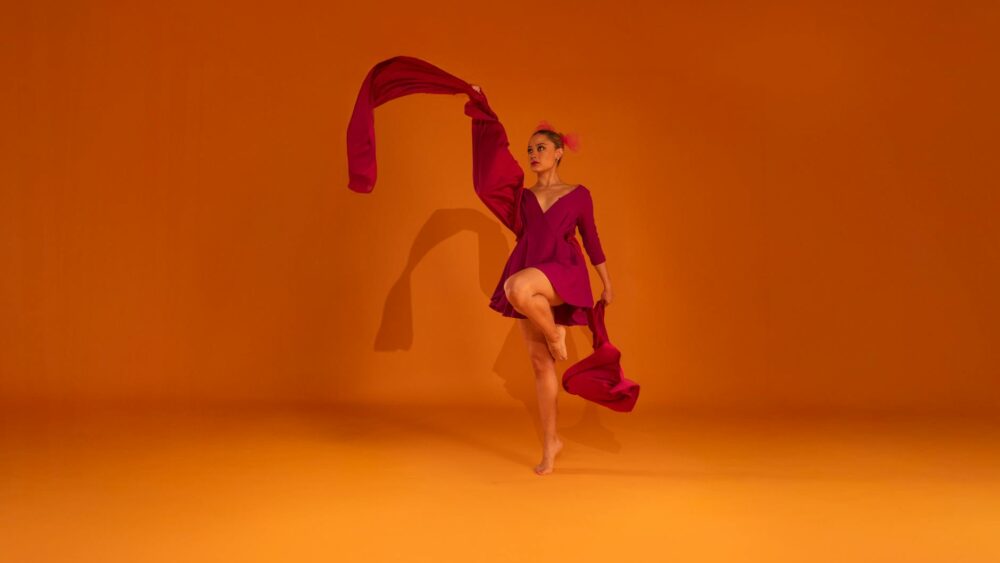
Dance names make some of the most vivid, energetic choices for a baby. Whether drawn from the graceful vocabulary of ballet, the fire of Latin dance, or the rhythmic pulse of hip-hop, these names carry movement, culture, and history in a single word. Many of them have been given to real people for generations; others are rising fast as parents look for names that feel alive.
This list covers dance names across styles and traditions: classical, Latin, folk, and street. Each one is a genuine given name used by real people, and each is grouped by the world of dance it comes from.
Ballet and Classical Dance Names
Ballet gave the world some of its most elegant vocabulary, and several of those words have crossed over into given names with a long track record of use.
Arabella
Though its Latin roots mean “yielding to prayer,” Arabella has long been associated with the arabesque, the iconic ballet pose where a dancer extends one leg behind them. The connection is sonic and cultural rather than strictly etymological, but the name has been used as a given name for centuries and carries unmistakable grace. It is currently climbing back toward the top 100 in several English-speaking countries.
Aurora
Aurora is the name of the sleeping princess in Tchaikovsky’s The Sleeping Beauty, one of the most performed ballets in the classical repertoire. The name means “dawn” in Latin. It has quietly become a powerhouse in contemporary baby naming, sitting comfortably among the top names in the US, UK, and Australia.
Odette
Odette is the white swan in Swan Lake, and the name has a genuine French pedigree as a feminine form of Odo, meaning “wealth” or “fortune.” It was a fashionable French given name in the early twentieth century and is now experiencing a stylish revival in English-speaking countries. Elegant without being fussy.
Odile
Odile is Odette’s dark counterpart in Swan Lake, the black swan. As a given name it is genuinely French, derived from the Germanic name Odilia, and Saint Odile of Alsace was a real historical figure. The name is rare in the English-speaking world, which makes it all the more striking.
Giselle
Giselle is both a classic Romantic-era ballet and a genuine French given name meaning “pledge.” It has been in regular use across France, Quebec, and Latin America for decades. The ballet connection gives it extra resonance, and the name has been growing steadily in the United States since the early 2000s.
Sylvie
Sylvie is a French given name meaning “of the forest,” and it is also the name of several legendary ballerinas, most notably Dame Sylvie Guillem, widely considered one of the greatest classical dancers of her generation. The name is soft and confident at once.
Margot
Dame Margot Fonteyn is arguably the most celebrated ballet dancer Britain ever produced, and the name carries that legacy. Margot is a French diminutive of Margaret, meaning “pearl.” It is having a significant moment right now, riding the broader wave of short French names that feel both vintage and modern.
Natalia
Natalia Makarova, the Russian-American prima ballerina, is one of the defining figures of twentieth-century ballet. The name itself is Latin in origin, meaning “born at Christmas.” It is a top-100 staple in several countries and has a warmth that balances its formal elegance.
Rudolf
Rudolf Nureyev transformed what it meant to be a male ballet dancer, and his name carries that revolutionary energy. Rudolf is Germanic, meaning “famous wolf.” It is rare in the English-speaking world today, which gives it a distinctly individual character.
Mikhail
Mikhail Baryshnikov is one of the most famous names in dance history, and Mikhail is simply the Russian form of Michael, meaning “who is like God.” The name is well used across Eastern Europe and carries serious artistic credibility.
Latin Dance Names
Latin dance traditions, from the tango of Argentina to the salsa of the Caribbean, have produced names full of fire and rhythm. Several are used as genuine given names across Latin America and beyond.
Carmen
Carmen is a Spanish given name with dual roots: partly from the Latin carmen meaning “song” or “poem,” and partly as a Spanish form of the Hebrew Carmel, meaning “garden.” Carmen is also associated with flamenco through Bizet’s famous opera. It is a perennial classic in Spanish-speaking countries and has solid usage in the English-speaking world as well.
Salsa
Salsa is used as a given name in some Latin American communities, particularly in Colombia and Venezuela, where the dance style has deep cultural roots. It is rare as a formal given name, but it does appear in birth records as a genuine choice reflecting pride in the dance tradition.
Tango
Tango has been used as a given name, particularly in Argentina where the dance was born. It appears in birth records and has been given to both boys and girls. The word’s exact origin is debated, with possible African roots from the Yoruba tan go, meaning “to dance.” Bold and unmistakable as a name.
Rumba
Rumba appears in birth records as a given name in parts of Latin America and Africa, reflecting the dance’s roots in Cuban Afro-Caribbean culture. It is genuinely rare, but it has been used as a personal name rather than simply a dance term.
Valentina
Valentina is the name of a character in the Argentine tango world and a popular given name across Latin America, Italy, and Spain. It derives from the Latin valens, meaning “strong” or “healthy.” It is currently a top-50 name in several countries and pairs beautifully with the fire of Latin dance.
Lola
Lola is a Spanish diminutive of Dolores, and it has been the name of flamenco dancers, tango singers, and bolero performers across the Spanish-speaking world. It is short, punchy, and full of personality. Lola is firmly back in fashion across Europe and North America.
Pilar
Pilar is a classic Spanish given name meaning “pillar,” with strong associations with flamenco and traditional Spanish dance culture. It is a top-tier classic in Spain and widely used across Latin America. Understated but deeply rooted.
Consuelo
Consuelo is a Spanish given name meaning “consolation,” and it has been borne by several notable figures in Latin music and dance. It is longer and more formal than Lola or Carmen but carries tremendous warmth. Underused in the English-speaking world.
Rosario
Rosario is both a Spanish given name (meaning “rosary”) and the name of several celebrated flamenco dancers. It is used for both boys and girls in Spanish-speaking cultures. The name has an old-world intensity that suits the drama of flamenco perfectly.
Diego
Diego is a classic Spanish given name of debated origin, often linked to Santiago or James. In the dance world it is associated with tango culture in Buenos Aires and the broader Argentine tradition. It is a top-100 boys’ name in the United States and feels both grounded and dynamic.
Esperanza
Esperanza means “hope” in Spanish and has been the name of real flamenco and Latin dance artists. It is a flowing, four-syllable name with genuine depth. Criminally underused in English-speaking countries given how beautiful it sounds.
Flamenco and Spanish Dance Names
Flamenco has its own world of names, many of them tied to the Romani, Moorish, and Andalusian traditions that shaped the art form.
Rocio
Rocio (also written Rocío) is a Spanish given name meaning “dew” or “morning dew,” and it is deeply embedded in Andalusian culture where flamenco has its roots. Several famous flamenco singers and dancers have borne this name. It is a top name in Spain and feels evocative and specific.
Pastora
Pastora is a Spanish feminine name meaning “shepherdess,” and Pastora Imperio was one of the most celebrated flamenco dancers of the early twentieth century. The name is rare today but has genuine historical roots in the flamenco world.
Encarnacion
Encarnacion (or Encarnación) is a Spanish given name meaning “incarnation,” and it was the birth name of La Argentinita, one of the legendary flamenco dancers of the twentieth century. Long and formal, but rich with history.
Manuela
Manuela is the Spanish and Italian feminine form of Manuel (from the Hebrew Emmanuel, meaning “God is with us”). It has been the name of real flamenco artists and is in wide use across Spain, Portugal, and Latin America. Warm and grounded.
Joaquin
Joaquin is a Spanish given name derived from the Hebrew Yehoyaqim, meaning “God will establish.” In the flamenco world it is associated with Joaquin Cortés, one of the most internationally famous flamenco dancers of the modern era. The name has strong crossover appeal in the English-speaking world.
Irish and Celtic Folk Dance Names
Irish step dance, céilí dancing, and the broader Celtic folk tradition have their own set of names, many of them rooted in Irish mythology and Gaelic language.
Siobhan
Siobhan is the Irish form of Joan, meaning “God is gracious.” It is strongly associated with Irish cultural identity, including the world of Irish dance, and has been a popular given name in Ireland for generations. The pronunciation (shih-VAWN) surprises many non-Irish speakers, which gives it a certain mystique.
Aoife
Aoife (EE-fah) is an Old Irish name of uncertain but likely warrior-related meaning. It is one of the most popular girls’ names in Ireland today and has a strong connection to Irish dance culture and mythology. Outside Ireland it is still refreshingly rare.
Brigid
Brigid is one of Ireland’s most ancient names, rooted in the goddess Brigid and meaning “exalted one” or “strength.” It is deeply tied to Irish cultural tradition, including music and dance. The name is having a quiet revival as parents rediscover classic Irish names.
Fionnuala
Fionnuala (FINN-oo-lah) is a beautiful Old Irish name meaning “white shoulder.” It appears in Irish mythology and is genuinely used as a given name in Ireland today. It has the flowing quality of Irish dance itself.
Caoimhe
Caoimhe (KEE-vah or KWEE-vah) means “gentle” or “beautiful” in Irish. It is a top name in Ireland and has a softness that belies its complex spelling. Firmly rooted in Irish cultural tradition including dance.
Roisin
Roisin (ROH-sheen) is an Irish diminutive of Ros, meaning “little rose.” It is a beloved name in Ireland and is associated with Irish song and dance tradition through the famous song “Roisin Dubh.” Lyrical and deeply Irish.
Cillian
Cillian is an Irish boys’ name meaning “war” or “strife,” though it has a much gentler sound than its meaning suggests. It is associated with Irish cultural identity and has gained significant international recognition in recent years.
Declan
Declan is an Irish saints’ name of uncertain meaning, possibly relating to “full of goodness.” It is widely used in Ireland and has strong crossover appeal in the United States and UK. Connected to Irish cultural tradition through its deep Gaelic roots.
African and Diaspora Dance Names
African dance traditions, from West African ceremonial dance to the Afrobeats styles that have shaped global music and movement, have produced names with power and resonance.
Kwame
Kwame is a Ghanaian Akan name given to boys born on Saturday. It is used as a given name across West Africa and in the African diaspora worldwide. West African dance traditions are among the oldest and most influential in the world, and Kwame carries that cultural weight naturally.
Amara
Amara has roots in several African languages, including Igbo (meaning “grace”) and Amharic (meaning “eternal”). It is in wide use across sub-Saharan Africa and the African diaspora. The name is rising quickly in the United States and UK as a genuinely beautiful cross-cultural choice.
Zumba
Zumba is occasionally used as a given name, particularly in parts of Latin America and Africa. The word itself likely has African linguistic roots. It is genuinely rare as a given name but does appear in birth records.
Kofi
Kofi is an Akan name for boys born on Friday, widely used across Ghana and the West African diaspora. Like Kwame, it carries the deep cultural tradition of West African dance and music. Kofi Olomide, the Congolese rumba and ndombolo star, is one internationally known bearer.
Fatou
Fatou is a West African form of Fatima, widely used in Senegal, Guinea, and the Gambia. Senegalese sabar drumming and dance are among the most vibrant traditions on the continent, and Fatou is one of the most common names in that cultural world. Short, strong, and distinctive.
Seun
Seun is a Yoruba name meaning “done well” or “well done,” and Seun Kuti, son of Fela Kuti, is a prominent bearer who carries forward the Afrobeat tradition his father created. Yoruba dance and music are foundational influences on a huge range of global dance styles.
Hip-Hop and Street Dance Names
Hip-hop culture produced its own naming traditions, from artist names that became cultural touchstones to given names that have risen through the culture and entered mainstream use.
Breezy
Breezy is used as a given name and nickname, most famously associated with the artist Chris Brown (whose nickname is Breezy). It appears in birth records as a genuine given name and has the relaxed, confident energy of street dance culture.
Missy
Missy is a genuine given name as well as a nickname, and Missy Elliott is one of the most influential figures in hip-hop dance and music history. The name has been in use as a standalone given name for decades and carries enormous creative energy.
Aaliyah
Aaliyah is an Arabic feminine name meaning “exalted” or “highest.” The singer and dancer Aaliyah Dana Haughton, known simply as Aaliyah, was a defining figure in R&B and music video choreography in the 1990s. The name has been popular in the United States since the 1990s and remains a top-100 staple.
Ciara
Ciara is an Irish name (meaning “dark one”) that also became associated with the R&B and hip-hop dance world through the artist Ciara Princess Harris. The name has been in strong use in both the Irish and African-American communities. It is a genuine crossover name in every sense.
Jabbawockeez
This is included not as a given name but as a cultural reference, and so it is omitted. Only genuine given names belong here.
Tiana
Tiana is a given name derived as a short form of Tatiana or Christiana, and it has been in strong use in the African-American community. It carries the rhythm and energy of contemporary dance culture. The Disney connection (Princess Tiana) has given it additional cultural presence.
Shakira
Shakira is an Arabic feminine name meaning “thankful” or “grateful.” It became a global dance name through the Colombian singer Shakira Isabel Mebarak Ripoll, whose belly dance-influenced performances brought the name to every corner of the world. It is used as a given name across the Arab world, Latin America, and the African diaspora.
Beyonce
Beyonce (or Beyoncé) began as a surname in the singer’s family (her mother’s maiden name, Beyoncé Knowles) and became a given name through cultural influence. It is used as a given name in its own right in the United States and beyond. As a dance icon, Beyoncé’s name is inseparable from contemporary movement culture.
Usher
Usher is a surname used as a given name, most famously by the R&B artist Usher Raymond IV, whose choreography has been as influential as his music. It has been used as a given name and has a cool, understated quality.
Layla
Layla is an Arabic name meaning “night,” and it has become one of the most popular girls’ names in the English-speaking world. In hip-hop and R&B culture it has appeared in countless songs and is associated with a smooth, confident femininity that matches contemporary dance culture perfectly.
Ballroom and Competitive Dance Names
The ballroom world, including the competitive Latin and Standard disciplines, has its own constellation of names associated with legendary champions and teachers.
Donnie
Donnie Burns MBE is a fourteen-time World Latin Dance Champion, making him arguably the most decorated competitive ballroom dancer in history. Donnie is a Scottish diminutive of Donald, meaning “ruler of the world.” It has a casual warmth that makes it more approachable than its formal origin suggests.
Shirley
Shirley Ballas, the current head judge of Strictly Come Dancing, is a former World Latin Champion. Shirley is an Old English place name meaning “bright clearing.” It peaked in the mid-twentieth century and is now in the vintage revival zone, which means it is due for a comeback.
Anton
Anton du Beke is one of the most beloved professional dancers in British ballroom culture. Anton is a variant of Anthony, derived from the Roman family name Antonius. It has a clean, confident sound and is used across Eastern and Western Europe.
Len
Len Goodman was one of the most famous ballroom dance judges in the world through his role on Strictly Come Dancing and Dancing with the Stars. Len is a short form of Leonard, meaning “brave lion.” Rare as a standalone given name today, which gives it a retro individuality.
Katya
Katya is a Russian diminutive of Ekaterina (Catherine), meaning “pure.” Katya Jones is a professional dancer on Strictly Come Dancing, and the name is widely used across Eastern Europe and increasingly in the English-speaking world. It has a bright, energetic quality that suits ballroom perfectly.
Iveta
Iveta Lukosiute is a former Strictly professional and competitive Latin champion. Iveta is a Czech and Slovak feminine name derived from Yvette, ultimately from the Germanic iv (yew). It is rare in English-speaking countries, which makes it a genuinely distinctive choice.
Contemporary and Modern Dance Names
The world of contemporary and modern dance, from the pioneering work of Martha Graham to the current generation of choreographers, has produced names that carry creative and intellectual weight.
Martha
Martha Graham is the single most influential figure in the history of American modern dance, and her name deserves its place here. Martha is an Aramaic name meaning “lady” or “mistress of the house.” It is currently in the vintage revival zone and feels both grounded and distinctive.
Isadora
Isadora Duncan essentially invented modern dance as a concept, breaking from ballet’s rigid forms to create something free and expressive. Isadora is a Greek name meaning “gift of Isis.” It is rare as a given name, which makes it feel like a genuinely original choice.
Alvin
Alvin Ailey founded the Alvin Ailey American Dance Theater and created Revelations, arguably the most performed modern dance work in history. Alvin is an Old English name meaning “elf friend” or “noble friend.” It is rare today, which gives it a quiet, serious distinction.
Twyla
Twyla Tharp is one of the most celebrated American choreographers of the twentieth and twenty-first centuries. Twyla is an American invented name, possibly derived from “twilight.” It is genuinely rare and carries tremendous creative energy.
Jose
Jose Limon was a Mexican-American dancer and choreographer who became one of the defining figures of American modern dance. Jose is the Spanish form of Joseph, meaning “God will add.” It is a top-100 name in the United States and carries deep cultural roots.
Paul
Paul Taylor was one of the giants of American modern dance, leading his own company for over six decades. Paul is a classic Latin name meaning “small.” Simple and strong, it has been a top name for boys for centuries across the Western world.
World Dance Traditions: Names from Global Cultures
Dance names from around the world draw on traditions as varied as Indian classical dance, Japanese Butoh, and West African ceremonial movement.
Rukmini
Rukmini Devi Arundale was the pioneering figure who revived Bharatanatyam, the classical Indian dance form, in the twentieth century. Rukmini is a Sanskrit name meaning “adorned with gold” and is another name for the goddess Lakshmi. It is in use as a given name across South India.
Mrinalini
Mrinalini Sarabhai was one of the most celebrated Bharatanatyam and Kuchipudi dancers of modern India, and her daughter Mallika Sarabhai continued that legacy. Mrinalini is a Sanskrit name meaning “lotus cluster.” It is used as a given name in India and carries classical elegance.
Mallika
Mallika Sarabhai, daughter of Mrinalini, is a celebrated dancer and activist. Mallika is a Sanskrit name meaning “jasmine flower” or “queen.” It is used as a given name across South Asia and has a gentle beauty.
Yamini
Yamini Krishnamurti is one of India’s most celebrated classical dancers, a master of Bharatanatyam, Kuchipudi, and Odissi. Yamini is a Sanskrit name meaning “night” or “nocturnal.” It is in use as a given name in India and has a musical quality.
Sanjukta
Sanjukta Panigrahi was one of the greatest Odissi dancers of the twentieth century. Sanjukta is a Sanskrit name meaning “united” or “joined.” It is used as a given name in India, particularly in Odisha, and carries genuine classical dance heritage.
Kazuo
Kazuo Ohno was one of the two founding figures of Butoh, the Japanese avant-garde dance form. Kazuo is a Japanese masculine name with several possible meanings depending on the kanji used, commonly “harmonious man” or “one man.” It is in standard use in Japan.
Tatsumi
Tatsumi Hijikata was the other founding figure of Butoh and one of the most radical artists of the twentieth century. Tatsumi is a Japanese masculine name meaning “dragon” combined with “sea” or “beauty.” It is in use as a given name in Japan.
How to Choose a Dance Name for Your Baby
The most important question is whether you want the dance connection to be obvious or quietly personal. A name like Giselle or Isadora announces its ballet heritage immediately. A name like Margot or Martha carries the same history but wears it more lightly. Think about which kind of story you want your child to be able to tell.
Consider the cultural weight of the name alongside the dance tradition it comes from. Choosing a name from a tradition that is not your own heritage is a personal decision, but it is worth knowing the full history behind names like Rukmini, Kazuo, or Fatou before you use them. The richest choices are usually the ones you have genuinely researched.
Sound matters as much as meaning. Dance names often have a natural rhythm to them because they come from traditions built on rhythm. Say the name out loud, say it with your last name, say it as a full name with a middle. If it moves well when you speak it, that is a good sign.
Finally, do not overlook the less obvious choices. Everyone knows Aurora and Giselle. Odile, Twyla, Isadora, Pastora, Fionnuala, and Yamini are all genuine dance names with deep histories that almost no one is using right now. In a world full of Auroras, a Twyla or an Odile is going to stand out in the best possible way.
Dance names carry something most names do not: a sense of movement, culture, and aliveness built right into the history of the word. Whatever tradition draws you in, there is a genuine name here with a real story behind it.