

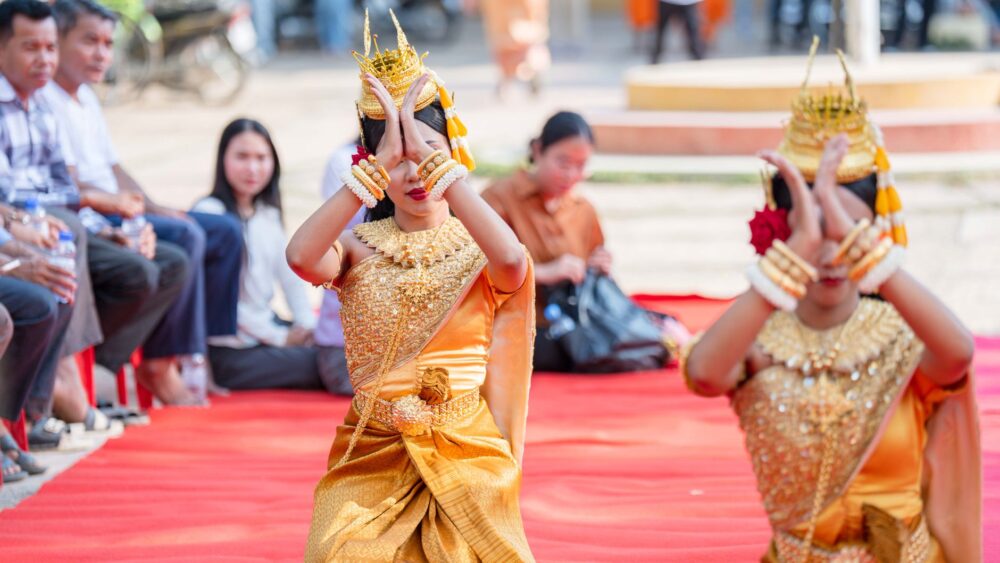
Cambodian names are among the most intentional in the world. Unlike naming traditions that lean on family lineage or fixed saint’s calendars, Khmer parents often consult monks, astrologers, or elders to choose a name whose meaning, syllables, and spiritual resonance all align with the moment of a child’s birth. The result is a naming culture where every name carries a story, a wish, or a prayer.
The Khmer Language and How Names Are Built
Cambodian names come primarily from the Khmer language, with a significant layer of Sanskrit and Pali influence flowing in through centuries of Hinduism and Theravada Buddhism. Many of the most formal and ceremonial names are Sanskrit-derived, while everyday, affectionate names are often pure Khmer words with clear, direct meanings.
Khmer is a Mon-Khmer language, part of the Austroasiatic family, and its words tend to be monosyllabic or disyllabic. That structure shapes naming: Cambodian given names are usually one or two syllables, occasionally three, and the sounds are soft and flowing, heavy on vowels and gentle consonants.
Most Cambodian names are not gender-neutral in the Western sense, but many share roots across genders. The same Sanskrit word might produce a masculine and a feminine form, and meanings like “light,” “blessing,” “gold,” and “moon” appear in names used by both boys and girls.
The Role of Buddhism and Astrology in Choosing a Name
In Cambodia, naming a child is a ritual as much as a decision. Many families bring the birth time and date to a Buddhist monk or a Khmer astrologer, who will calculate an auspicious syllable or sound for the child’s name. This syllable is considered cosmically aligned with the child’s destiny.
The name is then built around that syllable, which is why two siblings in the same family might have names that sound completely unrelated. In some Western naming cultures, siblings often share initials or themes; in traditional Cambodian practice, each name is tailored individually to the child’s spiritual profile.
Monks also play a role at naming ceremonies, where prayers are recited and the name is formally announced. The name is understood not just as an identifier but as a kind of protection, carrying positive meaning that helps shape the child’s life.
Nicknames: The Names Cambodians Actually Use
One of the most distinctive features of Cambodian naming culture is the gap between the formal name and the name people actually use. Nearly every Cambodian has a formal given name and a separate nickname, and the nickname is what friends, family, and colleagues use in daily life.
These nicknames, called chhmouv leng in Khmer, are often completely unrelated to the formal name. They are frequently short, one-syllable words drawn from Khmer vocabulary: fruits, animals, colors, objects, or endearments. A girl might be formally named Sreymom but called Kola (meaning orange fruit) or Mao (meaning cat). A boy formally named Visal might go by Kbach (meaning elegant form) or Oun (meaning younger sibling, used as a term of endearment).
These nicknames are chosen for affection and ease, not for spiritual significance. They are the names written in friends’ phones, called across market stalls, and shouted at children who are running too fast. Understanding this two-name system is essential to understanding Cambodian names in practice.
Traditional Cambodian Girls’ Names and Their Meanings
Cambodian girls’ names frequently invoke beauty, light, grace, flowers, and the moon. Sanskrit and Pali roots give many of them a lyrical, formal quality, while pure Khmer names tend to be earthier and more direct.
Sreymom
A classic Khmer girls’ name built from srey, meaning “woman” or “girl,” and mom, a term of endearment meaning something close to “beloved” or “dear.” Sreymom is deeply traditional and widely used.
Channary
From Sanskrit-influenced Khmer, meaning “moon-faced” or “like the moon.” The chan element relates to the moon, one of the most beloved images in Khmer poetic tradition. Channary is elegant and recognizably Cambodian.
Bopha
A pure Khmer name meaning “flower.” It is one of the most straightforwardly beautiful names in the Cambodian tradition, short and soft, and has been in continuous use for generations.
Dara
Meaning “star” in Khmer, Dara is used for both girls and boys, though it leans feminine in practice. It is one of the more internationally recognizable Cambodian names because of its brevity and its clear meaning.
Kolab
Meaning “rose” in Khmer. Kolab is a warm, familiar girls’ name that evokes both beauty and the flower that is widely admired in Cambodian gardens and culture.
Mealea
Meaning “garland of flowers” or “bouquet,” Mealea is a name with visual and ceremonial resonance, since flower garlands are central to Cambodian Buddhist rituals and offerings.
Sokunthea
A formal, Sanskrit-influenced name meaning “good smell” or “fragrant,” with sokun relating to goodness or virtue. It is a name that carries aspiration, wishing the child to be sweet in character and presence.
Sreyleak
Built from srey (woman/girl) and leak, meaning “to hide” or “secret” in the sense of something precious and rare. Sreyleak suggests a girl of quiet, understated grace.
Chanda
From Sanskrit, meaning “moon” or “shining.” Chanda is used across South and Southeast Asia and is one of the more recognizable Khmer names with a pan-regional presence.
Vanna
Meaning “golden” or “gold-colored,” from a Pali/Sanskrit root also found in neighboring languages. Vanna is considered auspicious, since gold is associated with prosperity, royalty, and Buddhist temple imagery throughout Cambodia.
Pisey
A Khmer name often understood to mean “beautiful” or “lovely,” and widely used for girls. It is soft in sound and warm in connotation, a popular choice across generations.
Kunthea
Meaning “fragrant” or “sweet-smelling,” related to kun, meaning goodness or virtue. Kunthea is a shorter, more casual form of the longer Sokunthea and is equally beloved.
Traditional Cambodian Boys’ Names and Their Meanings
Boys’ names in the Cambodian tradition often carry meanings of strength, victory, prosperity, wisdom, and cosmic imagery. Sanskrit-derived names dominate the more formal register, giving boys’ names a particularly ceremonial feel.
Visal
From Sanskrit, meaning “great,” “vast,” or “magnificent.” Visal is one of the most common Cambodian boys’ names and is considered both strong in meaning and pleasant in sound.
Sokha
From Pali sukha, meaning “happiness,” “well-being,” or “peace.” Sokha is a deeply auspicious name in a Buddhist context, where the pursuit of well-being is a central spiritual goal.
Davan
A Khmer boys’ name meaning “sun” or “like the sun.” Davan carries imagery of warmth, energy, and vitality, and is a popular choice for boys born in the dry season.
Rith
From Sanskrit, meaning “prosperity” or “success.” Short, punchy, and easy to say across languages, Rith is a name that works as both a formal and an everyday name.
Boran
Meaning “ancient” or “old tradition” in Khmer, Boran is a name that honors heritage and continuity. It is sometimes given to boys whose families want to emphasize connection to Khmer cultural roots.
Chanthol
A boys’ name built on the chan (moon) root, with thol suggesting brightness or radiance. Chanthol is a formal, poetic name with a distinctly Cambodian sound.
Panha
Meaning “wisdom” or “understanding,” from a Pali root related to panna, the Pali word for wisdom that appears throughout Buddhist scripture. Giving a child this name is an explicit aspiration toward intellectual and spiritual depth.
Kosal
From Sanskrit, meaning “skilled,” “proficient,” or “expert.” Kosal is a name that wishes the child competence and mastery, valued qualities in Cambodian society.
Makara
The Khmer name for the month of January, but also a given name. Makara derives from the Sanskrit word for a mythical sea creature, a kind of cosmic sea dragon that appears in Hindu and Buddhist iconography. It is a strong, distinctive name.
Sambath
Meaning “treasure,” “wealth,” or “fortune” in Khmer, with Sanskrit roots. Sambath is a hopeful name, wishing material and spiritual abundance for the child.
Rathana
From Pali ratana, meaning “jewel” or “gem.” In Buddhist tradition, the Three Jewels (the Buddha, the Dharma, and the Sangha) are the most precious things in existence, so this name carries profound spiritual weight.
Sovann
Another name meaning “gold” or “golden,” closely related to Vanna but distinctly masculine in usage. Sovann appears frequently in Cambodian royal and literary tradition.
Names Rooted in Khmer Royal and Literary Tradition
Cambodia has one of Southeast Asia’s great classical literary traditions, and names from the royal courts and epic poetry have filtered down into everyday naming. The Reamker, Cambodia’s version of the Hindu Ramayana epic, is a primary source of names that feel both mythological and alive in modern usage.
Sita
The name of the heroine of the Reamker, derived from Sanskrit and meaning “furrow” or, in its poetic interpretation, “born of the earth.” Sita is a name that carries enormous weight across Hindu and Buddhist cultures in Southeast Asia.
Preah
Meaning “sacred” or “holy” in Khmer, Preah appears as a title in royal and religious contexts but is also used as a name element in compound names. It signals divine blessing or royal association.
Norodom
A name associated with the Cambodian royal family, most famously Norodom Sihanouk. It is Sanskrit-influenced and carries regal connotations. It is rarely given outside of families with royal or aristocratic connections, but it stands as one of the most recognizable Cambodian names internationally.
Sisowath
Another royal name, associated with a different branch of the Cambodian royal family. Like Norodom, it is formal, rare, and historically significant.
Gender-Neutral and Crossover Names
Several Cambodian names cross gender lines or are genuinely used for both boys and girls, which is worth noting for anyone trying to understand the full scope of Cambodian naming.
- Dara (star) is used for both, though it trends feminine
- Chantha (moon) appears in both boys’ and girls’ names, often as a name element
- Vanna (golden) is used for both, though it is more commonly feminine
- Sokha (happiness) crosses genders in different regions and families
- Rathana (jewel) is used for both, often with a qualifying element added for boys
In practice, gender distinction in Cambodian names often comes from context, from the srey (girl) prefix in compound female names, or from the specific syllable combination rather than the root meaning alone.
The Influence of Sanskrit and Pali on Cambodian Names
It is impossible to understand Cambodian names without understanding the Sanskrit and Pali layer. When Hinduism arrived in the Khmer kingdom in the early centuries of the common era, it brought not just religion but an entire vocabulary of sacred words. Names like Visal, Rathana, Sambath, Panha, and Chanda are all Sanskrit or Pali words wearing Khmer pronunciation.
Theravada Buddhism, which became dominant in Cambodia around the 13th century, reinforced the Pali layer. Pali is the language of the Theravada Buddhist canon, and monks who name children often draw directly on Pali vocabulary for auspicious meanings. Words related to wisdom (panna), happiness (sukha), jewel (ratana), and virtue (sila) show up regularly in Cambodian given names.
This makes Cambodian names part of a wider South and Southeast Asian naming world. A name like Chanda or Dara will be recognized from India to Indonesia, even as the Khmer pronunciation and usage give it a distinctly Cambodian identity.
How the Khmer Rouge Era Affected Names
The Khmer Rouge period (1975-1979) had a devastating impact on Cambodian culture in every dimension, and naming was no exception. The regime attempted to erase class distinctions, royal associations, and religious influence, which meant that formal, Sanskrit-derived, or royally-inflected names were dangerous to have and dangerous to give. Some families deliberately chose plain, unremarkable names for children born during this period.
In the aftermath, as Cambodia rebuilt, there was a cultural recovery of traditional names. Families began returning to the Sanskrit and Pali-rooted names that connected them to pre-war Cambodian identity. Names with Buddhist meanings became newly precious as temples reopened and religious life resumed.
This history means that the age distribution of certain names in Cambodia is not random. Names that cluster heavily in younger generations or older generations often reflect which names were fashionable, safe, or symbolically important at different points in the country’s painful 20th-century history.
Cambodian Names in the Diaspora
There are significant Cambodian diaspora communities in the United States, France, Australia, and Canada, many of them descended from refugees who fled the Khmer Rouge era. In these communities, Cambodian names have navigated the familiar immigrant tension between cultural preservation and practical adaptation.
Some diaspora families kept traditional Cambodian names and accepted that teachers and neighbors would mispronounce them. Others gave children Western names alongside Cambodian formal names, using the Western name for school and the Cambodian name at home. The nickname system, already deeply embedded in Cambodian culture, made this easier: a child named Sambath might go by Sam in American schools without the family feeling the name was lost.
Second and third-generation Cambodian Americans have shown increasing interest in reclaiming Cambodian names for their own children, particularly names with clear, beautiful meanings like Bopha, Dara, Vanna, and Sokha. These names travel well: they are short, phonetically accessible to English speakers, and carry unmistakable meaning.
Surname Conventions and Name Order
In the Cambodian naming system, the family name comes first and the given name comes second, following the East and Southeast Asian convention rather than the Western one. So in the name Norodom Sihanouk, Norodom is the family name and Sihanouk is the given name.
However, many Cambodians in Western countries or in international contexts reverse this order to fit Western expectations, which can create genuine confusion. When reading Cambodian names, knowing the family is essential context.
Family names in Cambodia are far less fixed than in the West. Historically, Cambodians did not always use hereditary surnames in the Western sense, and the surname system as it exists today was influenced by French colonial administration in the 19th and 20th centuries. Some Cambodian families use the father’s given name as the children’s surname, while others use a stable hereditary surname. This variation is worth understanding if you are researching Cambodian names across generations.
Modern Trends in Cambodian Naming
Contemporary Cambodia shows the same tension between tradition and modernity that appears in naming cultures worldwide. Urban families in Phnom Penh increasingly choose names that are shorter, easier to spell in Roman script, and recognizable across Southeast Asian and international contexts. Names like Dara, Vanna, and Rith fit this profile: they are genuinely Cambodian but also work in a globalized world.
There is also a growing interest among younger Cambodian parents in names with explicit Buddhist meanings, partly as a form of cultural revival after decades of trauma and partly because Theravada Buddhism has never lost its central role in Cambodian life. Names meaning “wisdom,” “peace,” “jewel,” and “blessing” have a steady, reliable appeal that is not going anywhere.
Western names given to Cambodian children, particularly in the diaspora, remain common but are slowly declining among parents who feel confident enough in their cultural identity to choose traditional names. This mirrors a global pattern where diaspora communities in the second and third generation often move back toward heritage names rather than away from them.
A Closer Look at the Most Beloved Cambodian Names
If you want a shortlist of the names that define the Cambodian naming tradition, these stand out for their frequency, their meaning, and their cultural resonance.
- Bopha: flower, beloved across generations
- Dara: star, one of the most internationally recognized Cambodian names
- Vanna / Sovann: golden, deeply auspicious and historically royal
- Sokha: happiness, rooted in the Buddhist concept of well-being
- Visal: great, vast, one of the most common boys’ names
- Channary: moon-faced, one of the most poetic girls’ names
- Panha: wisdom, a name that carries explicit spiritual aspiration
- Sambath: treasure, warm and abundant in meaning
- Rathana: jewel, connected to the deepest symbols of Buddhist faith
- Kolab: rose, simple, sweet, and enduring
These are names that have lasted because they mean something real and sound beautiful doing it. That combination is exactly what makes Cambodian names worth knowing.
Cambodian names reward the attention you give them. Whether you are of Khmer heritage researching your own naming tradition, a parent considering a Cambodian name for a child, or simply someone curious about how one culture built an entire philosophy into the act of naming, the tradition here is genuine and deep. The meanings are not decorative; they are intentional, spiritually grounded, and chosen with care that stretches back centuries.