

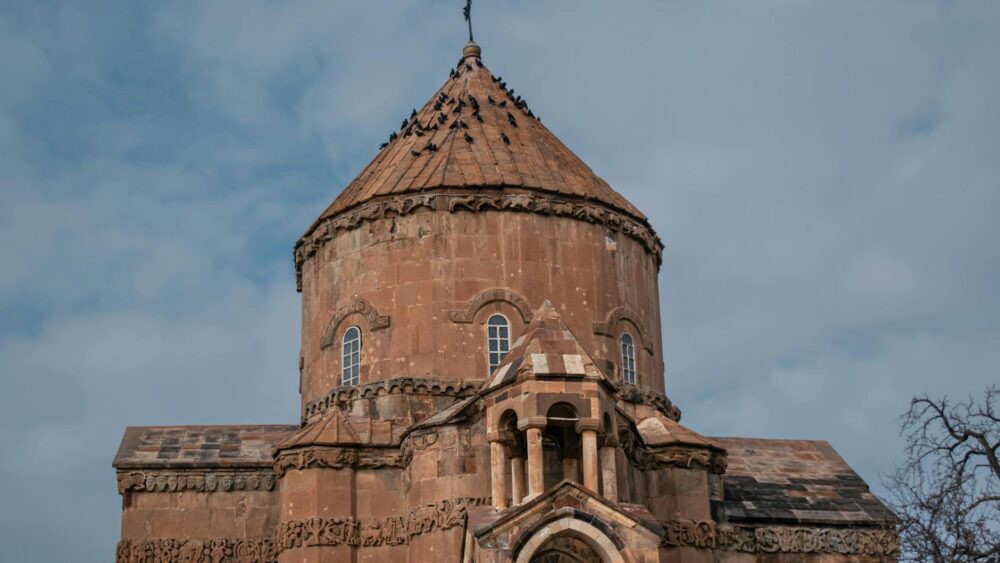
Armenian names carry one of the oldest continuous naming traditions on earth. Armenians have been recording their names in writing since at least the fifth century CE, and many of the names in use today connect directly to pre-Christian beliefs, ancient Iranian and Urartian linguistic roots, and the flowering of Christian culture that followed Saint Gregory the Illuminator’s conversion of the Armenian kingdom in 301 CE, the first nation in history to adopt Christianity as its state religion. That distinction shapes Armenian names in ways that are still visible and audible today.
The Deep Roots of Armenian Names
The Armenian language is a unique branch of the Indo-European family, it is not a dialect of any other language, and its closest relatives are distant. This independence means Armenian names often have roots that are not immediately recognizable to speakers of Greek, Latin, or Persian, even when those cultures also influenced Armenia over the centuries.
Three main sources feed the traditional Armenian naming pool. The first is native Armenian vocabulary: words for nature, strength, light, and virtue that became names organically. The second is the Old Iranian (Parthian and Avestan) layer, a legacy of centuries of Parthian rule and the Arsacid dynasty that gave Armenia many of its royal and aristocratic names. The third is the Christian layer, which brought Hebrew and Greek names into wide use after the adoption of Christianity and the creation of the Armenian alphabet by Saint Mesrop Mashtots around 405 CE.
These three streams rarely stayed separate. A name like Tigran is native Armenian and ancient; a name like Varduhi blends Iranian roots with Armenian feminizing suffixes; a name like Mariam is the Armenian form of the Hebrew Miriam, filtered through centuries of Armenian liturgical tradition. The result is a naming culture that is layered, historically dense, and deeply expressive.
The Armenian Alphabet and How It Shapes Names
You cannot talk about Armenian names without talking about the Armenian alphabet, because the script is inseparable from Armenian cultural identity. Mesrop Mashtots created the 36-letter alphabet (later expanded to 38) specifically to translate the Bible into Armenian, and from that moment forward, names became anchored to a written tradition of extraordinary staying power.
The alphabet contains sounds that have no direct equivalent in Latin script, which is why Armenian names are often romanized in multiple ways. The name spelled Հայկ in Armenian script appears in English as Hayk, Haig, or Haig depending on the community. The name Arpine might also appear as Arpineh. These are not different names, they are the same name navigating the gap between two writing systems.
For parents choosing Armenian names today, this means that the “correct” English spelling is often a matter of family tradition and diaspora community rather than a single fixed standard. Western Armenian (spoken by diaspora communities with roots in Anatolia) and Eastern Armenian (spoken in the Republic of Armenia) also differ in pronunciation, which adds another layer of variation to romanized spellings.
Traditional Armenian Male Names and Their Meanings
Armenian men’s names tend toward strength, light, and heroic legacy. Many of the most traditional names are either ancient royalty names or names tied to the founding mythology of the Armenian people.
Hayk
The legendary patriarch of the Armenian nation, Hayk is the mythological ancestor from whom the Armenians (Hay in their own language) take their name. It is one of the most distinctly Armenian names imaginable, no other culture uses it, and every Armenian speaker recognizes its founding weight immediately. Choosing Hayk is a deliberate act of cultural pride.
Tigran
Borne by Tigran the Great, the Armenian king who briefly turned Armenia into one of the largest empires in the ancient Near East in the first century BCE, Tigran comes from an Old Iranian root meaning “arrow” or connected to the tiger (Avestan tighri). It has been in continuous use for over two millennia and is one of the most recognized Armenian names internationally.
Armen
Armen is derived from the name of the country itself, it is, essentially, “the Armenian one,” a name that serves as a declaration of ethnic identity. It is widely used in both Armenia and the diaspora and has a clean, modern sound that travels well across languages.
Vartan
From the Old Iranian root meaning “rose” (related to the Persian word for rose, vard), Vartan is the name of Saint Vartan Mamikonian, the hero of the Battle of Avarayr in 451 CE, where Armenian forces fought against forced Zoroastrianization by the Sasanian Empire. Vartan is both a saint’s name and a national hero’s name, making it one of the most charged names in the entire Armenian tradition.
Aram
Ancient and cross-cultural, Aram appears in both Armenian tradition (as a legendary king) and in the Bible (as a grandson of Noah and ancestor of the Arameans). In Armenian usage, it carries mythological royal weight. The writer William Saroyan immortalized it in his stories about Armenian-American life, giving it a soft cultural glow for diaspora communities.
Levon
The Armenian form of Leon, from the Greek and Latin for “lion.” Levon has been a royal name in Armenian history, several kings of Armenian Cilicia bore it, and it remains one of the most popular traditional names in Armenia today. It has a warmth and familiarity that makes it feel both ancient and approachable.
Ararat
Named for Mount Ararat, the great volcanic peak that towers on the border of modern Turkey and Armenia and is the most powerful symbol in Armenian national consciousness. Using Ararat as a given name is a profound statement of cultural and political identity. It is used, though not widely, its weight is considerable.
Khachatur
From the Armenian words khach (cross) and tur (give), meaning “given by the cross” or “gift of the cross.” Khachatur is a deeply Christian Armenian name with no real equivalent in other traditions. The composer Aram Khachaturian (whose first name is also Armenian) carried a version of this name into global classical music.
Gagik
A royal name borne by several Armenian kings of the Bagratid dynasty, Gagik has ancient roots and a specifically Armenian ring that makes it almost impossible to find outside Armenian communities. It is less common among younger generations but still used and recognized.
Sargis
The Armenian form of Sergius, from Latin. Saint Sargis (Sergius) is venerated in the Armenian Apostolic Church, and the name has been in use since the early Christian period. It is still a living traditional name in Armenia and among diaspora communities.
Traditional Armenian Female Names and Their Meanings
Armenian women’s names are among the most beautiful in any language, they tend toward nature imagery, light, and flowers, and many end in the characteristically Armenian feminine suffixes -uhi (-ուհի) meaning “woman of” or simply marking femininity, and -ine or -ik as softening diminutive endings.
Anahit
The name of the pre-Christian Armenian goddess of fertility, healing, wisdom, and water, Anahit (related to the Iranian Anahita) is one of the oldest Armenian names still in active use. Converting a pagan goddess name into a beloved given name after Christianization is a remarkable act of cultural continuity. Anahit feels simultaneously ancient and thoroughly Armenian.
Arpine
From the Armenian word for “sunrise” or “dawn,” Arpine is one of those names that is almost entirely confined to Armenian speakers, you will rarely hear it outside the community, which gives it a quietly exclusive feel. It is warm, feminine, and unmistakably Armenian.
Siranush
From the Armenian words siro (of love) and nush (almond or sweet), Siranush means something close to “lovely” or “sweet-loved.” It is a deeply romantic name, used in Armenian poetry and literature, and carries a 19th-century literary quality that feels both nostalgic and elegant.
Mariam
The Armenian form of Mary/Miriam, Mariam is one of the most common women’s names in Armenia and has been since early Christianity. Its Hebrew roots mean “bitter,” “beloved,” or “sea of sorrow” depending on the scholarly tradition, but in Armenian usage it is simply the name of the Virgin Mary, sacred, enduring, and entirely natural to use.
Varduhi
From vard (rose, from Old Iranian) plus the feminine suffix -uhi, Varduhi literally means “rose woman” or “lady of roses.” It is a classic Armenian feminine name with a formal, traditional quality. Many older Armenian women in both Armenia and the diaspora carry this name.
Narine
The origin is debated, some connect it to a Scythian or Iranian root, others to a native Armenian word. What is not debated is that Narine is one of the most quintessentially Armenian women’s names, widely used in the Republic of Armenia and well recognized in diaspora communities. It has a clean, modern sound despite its antiquity.
Astghik
From the Armenian word astgh, meaning “star,” with the diminutive suffix -ik. Astghik was also the name of the pre-Christian Armenian goddess of love and beauty, the Armenian counterpart to Aphrodite or Venus. Like Anahit, it survived the Christianization of Armenia as a given name, carrying its pagan beauty forward through the centuries.
Lusine
From the Armenian word lus, meaning “light,” Lusine can also be interpreted as a form meaning “moon” in some traditions. It is a lyrical, soft name with a distinctly Armenian sound, widely used and beloved across generations.
Tamar
A Hebrew name meaning “date palm,” Tamar entered Armenian usage through the Bible and Christian tradition. It is shared with Georgian naming culture (the great medieval Queen Tamar of Georgia was celebrated in Armenian literature as well), and it has a clean biblical authority that makes it feel both sacred and contemporary.
Shoghakat
From the Armenian for “ray of light” or “light beam,” Shoghakat is also the name of a small but historically significant Armenian church built in 618 CE in Vagharshapat (now Etchmiadzin). It is a name that carries both luminous literal meaning and deep historical resonance.
Names from Armenian Christian Tradition
The Armenian Apostolic Church is the world’s oldest national church, and its saints’ calendar has shaped Armenian naming for over 1,600 years. Many Armenian names are saint names that entered the tradition through liturgy rather than through simple cultural inheritance.
Beyond Mariam and Sargis already mentioned, the tradition includes names like Grigor (the Armenian form of Gregory, after Saint Gregory the Illuminator), Nerses (a Parthian name borne by several Armenian Catholicos leaders and saints), and Sahak (the Armenian form of Isaac, after Saint Sahak the Great, who worked with Mesrop Mashtots on the alphabet). These are names where a child’s name is also a statement of religious lineage.
The feast day tradition (namedaynapping, as it’s sometimes called in diaspora communities) means that many Armenians celebrate not only a birthday but also the feast day of their patron saint, a practice that keeps the connection between names and religious calendar alive in a way that secular Western naming culture has largely abandoned.
Diaspora Armenian Names: Adaptation and Survival
The Armenian Genocide of 1915 to 1923 shattered the demographic landscape of the Armenian world and scattered survivors across the Middle East, Europe, and the Americas. Diaspora communities formed in Lebanon, Syria, France, the United States, Argentina, and elsewhere, and Armenian names adapted differently in each context.
In the United States and France, families often chose Armenian names that were easy to pronounce in the local language, or they gave children dual names, an Armenian name at home and a Western name for school. Aram became Adam in casual use. Anahit became Anna. Vartan became Bart or even Victor in some communities. The core Armenian name was preserved within the family even when it was softened at the edges for the outside world.
In Lebanon and Syria, where Armenian communities were large and relatively self-contained for much of the 20th century, Armenian names retained their full forms. Communities in Beirut kept names like Khachatur, Varduhi, and Siranush in active use well into the late 20th century in ways that American diaspora communities sometimes did not.
Today, in the Republic of Armenia, there is a strong cultural movement to revive pre-Christian and mythological names, Hayk, Anahit, Astghik, Arshak, as expressions of national identity. Younger parents increasingly choose names that feel distinctly Armenian rather than names shared with broader Christian or international naming pools.
Royal and Noble Armenian Names
Armenia’s royal dynasties left a trail of names that feel weighty and historical even today. The Arsacid (Arshakuni) dynasty, which ruled Armenia from 52 to 428 CE, gave Armenia names like Arshak (from Parthian, meaning “strong one” or connected to the dynasty’s founder Arsaces), Trdat (the Armenian form of Tiridates, a Parthian royal name borne by several Armenian kings), and Artashes (the Armenian form of Artaxerxes, from Old Persian meaning “whose reign is through truth”).
The Bagratid dynasty, which ruled from the 9th to the 11th century and presided over a golden age of Armenian culture, contributed names like Ashot (from Old Iranian, meaning “fire” or “brilliant,” borne by multiple Bagratid kings) and the already-mentioned Gagik. The kingdom of Armenian Cilicia (1198 to 1375 CE), a crusader-era Armenian state on the Mediterranean coast, produced royal names that blended Armenian tradition with French and Byzantine influence.
These royal names carry a gravitas that makes them powerful choices for parents who want a name with historical depth. Trdat and Artashes in particular are striking, rare outside Armenia, and connected to a real and documented royal history.
Nature and Meaning in Armenian Names
Armenian names are unusually transparent in their meanings. Many are direct vocabulary words from Armenian or Old Iranian that were converted into names, which means a speaker of Armenian can often hear exactly what a name means the moment they hear it.
Light is the single most common theme. Lusine (light/moon), Arpine (sunrise), Shoghakat (ray of light), Arev (sun), the Armenian naming tradition returns to light again and again, possibly reflecting the landscape of the Armenian plateau and the importance of solar symbolism in pre-Christian Armenian religion.
Flowers appear primarily through the rose: Vartan, Varduhi, and the male name Vard all share the Old Iranian root for rose. The rose was a symbol of both love and martyrdom in Armenian culture, which is part of why it saturates the naming tradition so thoroughly.
Eagles and strength appear in names like Arsen (from Greek arsenios, strong, but long naturalized in Armenian), Ardzrun (eagle, a great Armenian noble family name that became a given name), and Artak (a name with Old Iranian roots connected to fire or the righteous).
Armenian Names in the Modern World
Armenian names occupy an interesting position in 2026. In the Republic of Armenia, names like Narek (from the great 10th-century poet and saint Gregory of Narek, formally named Grigor Narekatsi), Ani (from the ancient Armenian capital city), and Arpi (another sun/light name, from the Armenian word for sun) are popular with younger parents who want names that are distinctly Armenian without feeling archaic.
In Western diaspora communities, there has been a noticeable uptick in parents choosing traditional Armenian names rather than assimilated versions. Anahit, Tigran, and Aram are all names that work in English-speaking environments without heavy modification while retaining their full Armenian identity.
Internationally, a handful of Armenian names have crossed over into broader use without most people knowing their origin. Arman, for example, is used across Iran, Turkey, and Central Asia as well as Armenia. Tamar is shared widely. But names like Khachatur, Astghik, Siranush, and Hayk remain firmly inside Armenian culture, which is precisely what makes them valuable to families who want a name that is theirs and no one else’s.
Naming Customs and Traditions
Historically, Armenians followed a strong tradition of naming children after grandparents, particularly paternal grandparents. A firstborn son would typically carry his paternal grandfather’s name. a firstborn daughter would carry her paternal grandmother’s name. This created chains of recurring names through Armenian family trees that make genealogical research both rewarding and occasionally confusing.
The tradition of namesakes is connected to a belief in the continuation of the family line and the honoring of ancestors, not merely sentiment, but a structured obligation. In more traditional families, deviating from this pattern required explanation and sometimes negotiation.
Modern Armenian families, both in Armenia and the diaspora, are more flexible about this custom, but many still observe it in modified form: honoring a grandparent’s name while choosing a modern variant, or using the grandparent’s name as a middle name when the given name is a newer choice.
The Armenian surname tradition is also worth noting: the suffix -yan or -ian (meaning “son of” or “from the family of”) is the signature of Armenian surnames worldwide. Kardashian, Petrosian, Gregorian, Khachaturian, the -ian ending is an immediate identifier of Armenian heritage. Given names and surnames together tell the story of a family’s Armenian lineage with remarkable clarity.
A Short List of Standout Armenian Names Worth Knowing
If you are looking for Armenian names that combine genuine cultural depth with real-world usability, these deserve particular attention:
- Narekfrom the great medieval poet-saint Gregory of Narek. a name with profound literary and spiritual resonance in Armenian culture, and easy to pronounce in most Western languages.
- Anithe name of the ancient Armenian capital, a stunning medieval city now in ruins in eastern Turkey. short, strong, and instantly recognizable as Armenian.
- Arpifrom the Armenian word for sun. warm, feminine, and almost entirely exclusive to Armenian speakers.
- Trdata royal Arsacid name with documented history going back to the first century CE. rare, striking, and historically grounded.
- Arevsimply the Armenian word for sun used as a name. radiant, short, and completely distinctive.
- Arshakthe great Parthian-Armenian dynastic name. strong, historical, and rarely heard outside Armenian communities.
- Nvardfrom a medieval Armenian literary tradition. a name meaning “rose” in an older form, used in poetry and still given today.
- Mherfrom the Armenian deity Mihr (related to the Iranian Mithra, the sun deity). a name that connects directly to pre-Christian Armenian religion and carries real mythological weight.
Why Armenian Names Matter
Armenian names are a form of cultural memory. For a people whose homeland was largely destroyed in the 20th century and whose diaspora is scattered across dozens of countries, a name is one of the most portable and durable expressions of identity available. Naming a child Hayk or Anahit or Vartan is not nostalgia, it is an act of continuity, a thread connecting a child born in Los Angeles or Paris or Beirut to a civilization that has been writing its names down for sixteen centuries.
The names themselves are worth knowing for anyone interested in naming history, because they open a window into a language branch, a religious tradition, and a cultural history that most Western naming guides barely touch. The Armenian naming tradition is one of the most coherent, historically documented, and linguistically distinctive in the world, and it deserves far more attention than it typically gets.
Whether you are Armenian and looking to reclaim a family connection, or simply drawn to names with genuine historical depth and beautiful sounds, the Armenian naming tradition offers something rare: names that are truly distinctive, unmistakably meaningful, and connected to a real and living culture.