
Irish place names are among the oldest living language records in Europe. Almost every town, river, hill, and county in Ireland carries a name rooted in Old Irish or Middle Irish, describing the land itself: its shape, its water, its history, or the people who once lived there. Learning to read those names is like learning to read the landscape.
This guide walks through the most interesting Irish place names by category, unpacking what they actually mean in Gaelic and why the landscape inspired each one. Whether you are tracing ancestry, planning a trip, or simply curious about the logic behind the map, this is where the names start to make sense.
Place Names Rooted in Water
Ireland is a wet island, and its place names prove it. Words for rivers, lakes, fords, and estuaries appear more often than almost anything else across the Irish map.
Shannon (An tSionainn)
Ireland’s longest river takes its name from the Old Irish Sionainn, likely derived from the name of a mythological figure, a goddess associated with the river itself. Some scholars connect the root to a word meaning “old” or “ancient one.” The Shannon drains roughly a fifth of the island.
Liffey (An Life)
The river running through Dublin carries a name whose exact origin is debated, but the most widely accepted derivation is from an ancient word meaning “life” or possibly from a personal name associated with early mythology. It gives the city its Irish name, Baile Átha Cliath, meaning “town of the ford of the hurdles.”
Lough Corrib (Loch Coirib)
Lough is the Irish word for lake, and Corrib derives from the name Orbsen, a legendary sea god also known as Manannán mac Lir. The name effectively means “the lake of Orbsen.” It is the second-largest lake in Ireland and sits largely in County Galway.
Lough Neagh (Loch nEathach)
The largest lake in the British Isles takes its name from Eochaid, a legendary king whose name means something close to “horseman.” The Gaelic form nEathach is a genitive of that personal name, so the name translates roughly as “the lake of Eochaid.”
Boyne (An Bhóinn)
The river famous for the Battle of the Boyne carries a name rooted in Old Irish mythology. Bóinn is the name of a goddess, likely connected to a root meaning “white cow” or “luminous.” The river runs through the Brú na Bóinne complex, home to Newgrange.
Erne (An Éirne)
The River Erne, which flows through Cavan, Fermanagh, and Donegal, takes its name from a mythological figure, a woman named Éirne who drowned in the river. The name itself may derive from a word meaning “game bird” or “lamb,” though the mythological association is the stronger tradition.
Avoca (Abhainn Mhór)
The Vale of Avoca in County Wicklow carries a Latinised name, but its Irish name Abhainn Mhór simply means “great river.” The meeting of the two rivers here, the Avonmore and Avonbeg, inspired Thomas Moore’s poem “The Meeting of the Waters.”
Bann (An Bhanna)
The River Bann, which divides much of Northern Ireland, comes from an Old Irish root meaning “goddess” or possibly “white.” It is one of the older river names on the island, appearing in early medieval texts.
Foyle (An Feabhal)
Lough Foyle and the River Foyle on the northern coast derive from Feabhal, an Old Irish personal name of uncertain meaning. The name is ancient enough that its original sense has been largely lost to time.
Place Names That Describe the Land
The Irish were practical namers. A hill was named for its shape, a plain for what grew there, a ridge for what it resembled. These descriptive place names are some of the most satisfying to decode.
Slieve Donard (Sliabh Dónairt)
Sliabh means “mountain” in Irish, and Dónairt is derived from the name of Saint Domhangart, an early Irish monk. The mountain sits in the Mourne Mountains of County Down and is the highest peak in Northern Ireland. The name essentially means “Domhangart’s mountain.”
Knocknarea (Cnoc na Ríogh)
This flat-topped hill in County Sligo carries a name meaning “hill of the kings” or possibly “hill of executions,” depending on the interpretation of ríogh. It is crowned by a massive cairn traditionally said to be the burial place of the legendary Queen Maeve.
Mourne (Múrn)
The Mourne Mountains take their name from the Mugdorna, a historical people who lived in the region. The name contracted over centuries into its modern form. The mountains inspired C. S. Lewis’s descriptions of Narnia.
Ben Bulben (Binn Ghulbain)
Binn means “peak” in Irish, and Gulbain may refer to a beak or a pointed jaw shape, describing the mountain’s distinctive flat-topped, sheer-sided profile. The mountain in County Sligo is closely associated with the mythological story of Diarmuid and Gráinne.
Curragh (An Currach)
The Curragh of Kildare takes its name from the Irish word for “racecourse” or “marsh.” It refers to the open plain, and the word itself comes from a root meaning “a low-lying, wet area.” The Curragh has been used for horse racing since at least the medieval period.
Clonmacnoise (Cluain Mhic Nóis)
Cluain means “meadow” or “pasture,” and the full name means “the meadow of the sons of Nos.” Nos was a man whose sons apparently settled the area before Saint Ciarán founded his famous monastery there in the sixth century.
Blarney (An Bhlarna)
The name comes from the Irish bláirne, meaning “small field” or “little plain.” The village in County Cork is best known for Blarney Castle and its famous stone, but the name itself is entirely unremarkable in its literal sense.
Burren (Boíreann)
The Burren in County Clare takes its name from a word meaning “rocky place” or “great rock,” from Old Irish boíreann. The name is exactly right: the Burren is a karst limestone landscape unlike anywhere else in Ireland.
Connemara (Conmaicne Mara)
The name means “the sea people of Conmac,” referring to a tribal group, the Conmaicne, who lived along the coast. Mara is the genitive of “sea” in Irish. The region in western Galway is one of the largest Irish-speaking areas in the country.
Inishowen (Inis Eoghain)
Inis means “island” or “peninsula,” and Eoghain is the genitive of Eoghan, a son of the legendary Niall of the Nine Hostages. The name means “Eoghan’s peninsula.” Inishowen in County Donegal is the largest peninsula in Ireland.
Place Names Built on Forts and Settlements
Several Irish words for human settlement appear constantly across the map. Dún (fort), ráth (ringfort), lios (enclosure), and baile (town or homestead) are the building blocks of hundreds of place names.
Dublin (Baile Átha Cliath / Dubhlinn)
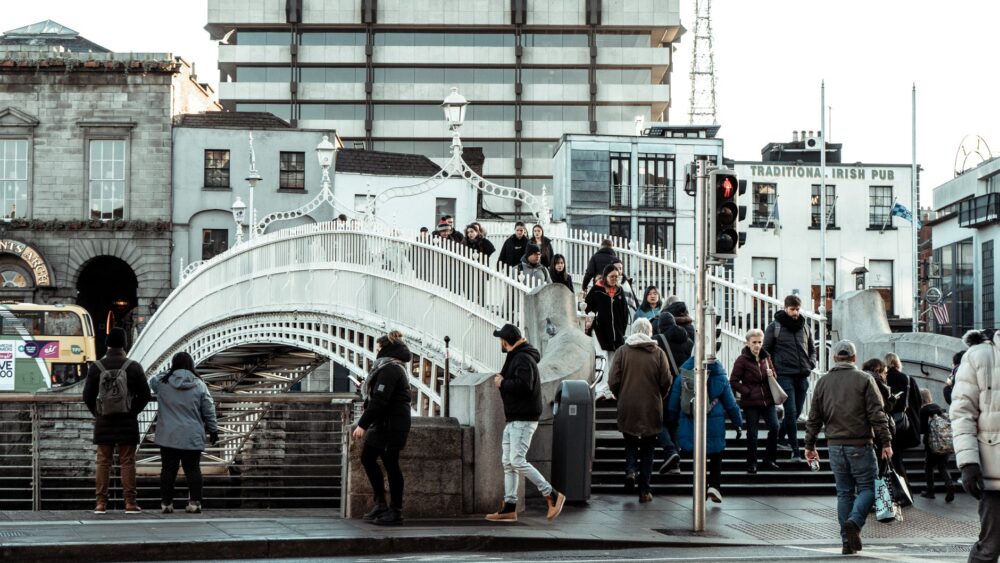
Dublin has two Irish names. The older, Dubhlinn, means “black pool,” from dubh (black) and linn (pool), referring to a dark tidal pool where the Poddle River met the Liffey. The official Irish name, Baile Átha Cliath, means “town of the ford of the hurdles,” describing a wattle crossing on the Liffey.
Dún Laoghaire (Dún Laoghaire)
This coastal town south of Dublin means “the fort of Laoghaire,” referring to a fifth-century High King of Ireland. The name is famously mispronounced by visitors: it is said “dun-LEER-ee.” The fort itself is long gone, but the name remains.
Dundalk (Dún Dealgan)
The county town of Louth takes its name from “the fort of Dealga,” a legendary figure said to have built a stronghold here. Dundalk is also closely associated with the mythological hero Cú Chulainn, who was raised in the area.
Dunmore (Dún Mór)
A straightforward compound: dún (fort) and mór (great or large). Dunmore simply means “the great fort.” The name appears in several counties across Ireland.
Rathfarnham (Ráth Fearnáin)
A Dublin suburb whose name breaks down as “the ringfort of Fearnán,” an Old Irish personal name. Ráth refers to a circular earthen fort, one of the most common settlement types in early medieval Ireland. Thousands of these ring-forts survive in the Irish landscape.
Lismore (Lios Mór)
Lios means an enclosure or ringfort, and mór means great. Lismore in County Waterford means “the great enclosure” and was once one of the most important monastic cities in early medieval Europe.
Ballyshannon (Béal Átha Seanaidh)
Béal Átha means “ford mouth” or “the mouth of the ford,” and Seanaidh is a personal name. The full name means something like “the ford mouth of Seanach.” The town in County Donegal sits at a natural crossing point on the River Erne.
Ballymena (An Baile Meánach)
This town in County Antrim takes its name from baile meánach, meaning “the middle town” or “the central townland.” The name is purely geographical, marking its position relative to surrounding settlements.
Ballymote (Baile an Mhóta)
The móta here is not the Irish mór but a borrowing from the Anglo-Norman word for a motte, the earthen mound of a motte-and-bailey castle. The name means “the town of the motte” and reflects the Norman influence on the Irish landscape after the twelfth century.
Naas (An Nás)
The county town of Kildare takes its name from the Irish word for an assembly place or fair, related to the Norse word nes meaning headland, though the Irish derivation from “assembly” is the more accepted origin. Naas was historically the seat of the kings of Leinster.
County Names and Their Origins
Ireland’s thirty-two counties each carry a name with its own history. Some are named for their principal towns, others for geographical features, and a few for ancient tribal territories.
Kerry (Ciarraí)
Kerry takes its name from the Ciarraíge, a tribal people whose name derives from ciar, meaning “dark” or “black,” and the suffix -raíge meaning “people of.” The county is named for the dark-haired people who inhabited it.
Clare (An Clár)
The name comes from the Irish clár, meaning “a flat place” or “a board,” describing the flat limestone plain that characterises much of the county. Some accounts connect it to the Anglo-Norman town of Clare, but the Irish meaning predates the Norman arrival.
Galway (Gaillimh)
The name derives from the River Gaillimh, which runs through the city. The word itself likely comes from a root meaning “stony river” or possibly from a personal name. The river and the county share the name.
Sligo (Sligeach)
The name comes from sligeach, meaning “shelly place” or “abounding in shells,” from slige (shell). It refers to the shellfish-rich estuary of the Garavogue River. The town built around that estuary kept the name.
Tyrone (Tír Eoghain)
Tír means “land” in Irish, and Eoghain is the genitive of Eoghan. Tyrone means “the land of Eoghan,” the same Eoghan who gives his name to Inishowen. He was a son of Niall of the Nine Hostages and an ancestor of the O’Neill dynasty.
Fermanagh (Fear Manach)
The name means “the men of Manach,” referring to a historical tribal group. Fear is the plural-genitive form of the Irish word for “man.” Manach itself may derive from a word for a monk, suggesting a monastic community gave the territory its identity.
Meath (An Mhí)
The name simply means “the middle,” from Old Irish mide, because Meath was historically considered the central province of Ireland. It was once the fifth province of the traditional four, a symbolic heartland.
Leitrim (Liatroim)
The name breaks into liath (grey) and druim (ridge), meaning “grey ridge.” It refers to a specific grey-stoned hill near the village of Leitrim in the south of the county. The county took its name from that village.
Roscommon (Ros Comáin)
Ros means “headland” or “wooded promontory” in Irish, and Comán is the name of a sixth-century bishop who founded a monastery here. The full name means “the wood or headland of Comán.”
Antrim (Aontroim)
The name derives from aon (one) and troim (elder tree), meaning “the solitary elder tree.” It refers to a specific elder tree that once stood near the original settlement, used as a landmark in the landscape.
Armagh (Ard Mhacha)
Ard means “height” or “high place,” and Mhacha is the genitive of Macha, a legendary queen or goddess. The name means “the height of Macha.” Armagh is the ecclesiastical capital of Ireland for both the Catholic and Anglican churches.
Monaghan (Muineachán)
The name derives from muine, meaning a shrubbery or thicket, with a diminutive suffix. Monaghan means something like “the little shrubbery” or “the place of thickets.” The drumlin landscape of the county, dense with small hills and hedgerows, makes the name feel right.
City Names and Their Layers
Ireland’s major cities carry names that have been translated, Anglicised, Latinised, and fought over for centuries. Getting to the Irish original reveals a different city underneath.
Belfast (Béal Feirste)
The name means “the mouth of the sandbar ford,” from béal (mouth or ford approach), feirsde (a spindle-shaped sandbank). It describes the natural crossing point on the River Farset where the city began. The Farset now flows underground through the city centre.
Cork (Corcaigh)
The name comes from corcach, meaning “a marshy place.” Cork was built on a series of islands in a marsh at the mouth of the River Lee. The city literally rose out of the bog, and its Irish name says exactly that.
Limerick (Luimneach)
The name derives from an Old Irish word meaning “bare area of ground” or possibly “flat area near the sea,” from luimneach. It refers to the flat land on the banks of the Shannon where the city sits. The five-line humorous poem called a limerick takes its name from the city, though the connection is indirect.
Waterford (Port Láirge)
The English name comes from the Old Norse Veðrafjörðr, “ram fjord,” reflecting the Viking foundation of the city. The Irish name, Port Láirge, means “the port of the haunch” or “the port of the thigh,” likely describing the shape of the land along the River Suir.
Kilkenny (Cill Chainnigh)
Cill means “church” in Irish, and Chainnigh is the genitive of Cainnech, an Irish saint also known as Saint Canice. The name means “the church of Cainnech.” The medieval St Canice’s Cathedral still stands in the city and bears the saint’s name directly.
Drogheda (Droichead Átha)
The name means “the bridge of the ford,” from droichead (bridge) and átha (genitive of ford). The town grew up around a river crossing on the Boyne and the name is a straightforward description of that crossing.
Derry / Londonderry (Doire)
The original Irish name, Doire, simply means “oak grove” or “oak wood.” Saint Colmcille founded a monastery here in the sixth century in a place famous for its oak trees. The prefix “London” was added in 1613 when the city was granted to the London guilds; the Irish-derived name Derry remained in common use.
Monastic and Church Place Names
Christianity arrived in Ireland in the fifth century and transformed the naming of the landscape. The words cill (church), mainistir (monastery), domhnach (church, from Latin dominica), and teampall (temple or church) spread across the map as monasteries became the centres of settlement.
Kildare (Cill Dara)
The name means “the church of the oak,” from cill (church) and dair (oak tree). Saint Brigid founded her monastery here beside an oak tree, and the name preserves that founding moment. The county takes its name from the town.
Killarney (Cill Airne)
The name means “the church of the sloes” or “the church of the blackthorn berries,” from cill and airne (sloe berry). The lakes and mountains around Killarney in County Kerry are among the most visited landscapes in Ireland.
Kilmore (Cill Mhór)
Another compound of cill and mór: “the great church.” The name appears in several counties and always points to a site of early ecclesiastical importance.
Glendalough (Gleann Dá Loch)
The name means “the valley of the two lakes,” from gleann (valley), dá (two), and loch (lake). The monastic settlement founded by Saint Kevin in the sixth century sits between two lakes in the Wicklow Mountains. The name is pure landscape description.
Clonard (Cluain Ioraird)
From cluain (meadow) and a personal name, Ioraird. The monastery at Clonard in County Meath was one of the great early Christian schools of Ireland, said to have educated twelve apostles of Ireland in the sixth century.
Clonfert (Cluain Fearta)
The name means “the meadow of the miracles” or “the meadow of the grave mounds,” from cluain and feart (miracle, or sometimes grave). Saint Brendan the Navigator founded his monastery here in County Galway in the sixth century.
Tuam (Tuaim)
The name means “burial mound” or “tumulus,” from the Old Irish word for a raised earthen grave. Tuam in County Galway was a major ecclesiastical centre in medieval Ireland, seat of the Archdiocese of Tuam.
Viking and Norman Layers in Irish Place Names
Irish place names are not only Gaelic. The Vikings settled the coastline from the ninth century and the Normans arrived in the twelfth, and both left their marks on the map. Recognising these layers adds depth to any reading of Irish geography.
Wicklow (Víkingaló)
Wicklow is one of the clearest Norse survivals in Irish place names. The name comes from the Old Norse Víkingaló, meaning “the Vikings’ meadow” or “the meadow of the Vikings.” The town was a Norse settlement, and the county eventually took the town’s name.
Wexford (Loch Garman / Weisfjord)
The English name comes from Old Norse Weisfjord, meaning “the ford of the mudflats” or possibly “the estuary of the mud.” The Irish name, Loch Garman, is entirely separate and refers to a lagoon and a personal name. Both names have been in simultaneous use for centuries.
Carrickfergus (Carraig Fhearghais)
Carraig is Irish for “rock” and Fhearghais is the genitive of Fergus, a Scottish king who drowned near the rock in the early medieval period. The name means “the rock of Fergus.” Despite its Irish form, the town in County Antrim was a major Norman and later English stronghold.
Trim (Baile Átha Troim)
The full Irish name means “the town of the ford of the elder tree,” from troim (elder tree). Trim Castle in County Meath is the largest Anglo-Norman castle in Ireland, and the town grew up around the Norman presence, though the place name itself is purely Irish.
Tralee (Trá Lí)
Trá means “beach” or “strand” in Irish, and Lí is the name of a river now largely channelled. The name means “the strand of the River Lee” (a different Lee from Cork’s). The town in County Kerry is best known as the home of the Rose of Tralee festival.
Place Names That Have Become Given Names
Some Irish place names have crossed over into use as first names, particularly in the Irish diaspora, where parents chose them to honour heritage. These are names actually given to people, not just locations on a map.
Shannon
The name of Ireland’s longest river has been used as a given name, predominantly for girls, in Ireland, the United States, and Australia since the mid-twentieth century. It carries a soft, flowing sound that suits the name’s origin. In the US it peaked in popularity in the 1970s and 1980s.
Kerry
The county name has been used as a given name for both boys and girls, though predominantly girls in English-speaking countries outside Ireland. It carries a clear Irish identity while being easy to pronounce in any accent.
Clare
While Clare as a given name also derives from Latin clarus (bright, clear), the county name and the given name overlap in Irish usage, and many Irish parents choose it with the county in mind. It is one of the most genuinely versatile Irish place-derived names.
Slane
The village of Slane in County Meath, famous for its hill where Saint Patrick is said to have lit the Paschal fire, has appeared as a given name in Ireland, particularly among families with connections to the area. It is rare but genuine.
Tara
The Hill of Tara in County Meath was the ceremonial seat of the High Kings of Ireland. The Irish form is Teamhair, possibly meaning “a place with a wide view.” Tara became a popular given name in the twentieth century, boosted by its use in Margaret Mitchell’s Gone with the Wind, and is now firmly established as both a place name and a personal name.
Leinster
One of Ireland’s four ancient provinces, whose name derives from the Laigin people and the Old Norse staðr (place). Leinster is occasionally used as a given name, particularly as a surname-style first name in families with strong Leinster connections.
Erne
The river name has appeared as a given name in Ireland and among the diaspora, used for both boys and girls. It is rare but documented and carries a soft, distinctive sound.
How to Read an Irish Place Name
Once you know a handful of the most common Irish words, the map of Ireland starts to translate itself. Here are the building blocks that appear most frequently.
Bally (Baile): Town or homestead. This is the single most common element in Irish place names. Ballymena, Ballymote, Ballyshannon all begin here.
Kil (Cill): Church. Usually signals a site of early Christian settlement. Kildare, Kilkenny, Killarney all carry this prefix.
Glen (Gleann): Valley. Glendalough, Glengarriff, Glencree all describe valley landscapes.
Inis (Inis): Island or peninsula. Inishowen, Inishmore, Inishbofin.
Dun or Don (Dún): Fort or fortified place. Dundalk, Dunmore, Dún Laoghaire.
Knock (Cnoc): Hill. Knocknarea, Knocknagow, Knock.
Ard (Ard): Height or high place. Ardmore, Ardee, Armagh.
Ros (Ros): Headland or wooded promontory. Roscommon, Rosslare, Roscrea.
Lough (Loch): Lake. Lough Corrib, Lough Neagh, Lough Derg.
Rath (Ráth): Ringfort or circular earthen enclosure. Rathfarnham, Rathmines, Rathkeale.
Armed with these ten elements, you can decode most of the Irish map without a dictionary. The landscape speaks clearly once you know the vocabulary.
Irish place names are one of the oldest continuously used naming systems in Europe, and they are still doing exactly what they were designed to do: describe where you are. From the black pool at Dublin’s founding to the grey ridge that gave Leitrim its name, the land wrote these names and the language preserved them. That is a remarkable thing for any map to carry.