
- HUMOR
The 100 Best Knock Knock Jokes

I have spent a long time reading about space. And the facts that stick are never the complicated ones. They are the short ones, the single-sentence ones, the ones you read, stop, re-read, and then sit with for a while. Here are 30 of those facts. No filler, no fluff. Just the stuff that changes how you see the sky.
1. Our Sun is so big that 1.3 million Earths could fit inside it, yet it is still classified as an average, medium-sized star by astronomical standards.
2. The sunlight warming your skin right now left the Sun 8 minutes and 20 seconds ago, after travelling 150 million kilometres to reach you.
3. A day on Venus is longer than a year on Venus because it rotates so slowly that it completes a full orbit around the Sun before finishing a single spin.
4. Venus also spins backwards, so if you stood on its surface, the Sun would rise in the west and set in the east.
5. Mars is home to Olympus Mons, the largest volcano in the solar system, standing 22 kilometres tall, which is nearly three times the height of Mount Everest.
6. Saturn’s rings stretch 282,000 kilometres from edge to edge yet are less than 100 metres thick in most places, thinner than a sheet of paper at that scale.
7. Jupiter’s Great Red Spot is a single storm that has been continuously raging for at least 350 years and is currently wider than the entire Earth.
8. Neptune has the strongest winds in the solar system, reaching over 2,100 kilometres per hour, faster than the speed of sound on Earth.
9. The Milky Way contains between 100 and 400 billion stars, and our Sun is just one perfectly ordinary member sitting out in the quiet suburbs of the galaxy.
10. The number of stars in the observable universe is roughly 70 sextillion, which is about 10 times more than every grain of sand on every beach on Earth.
11. Proxima Centauri, our nearest stellar neighbour, is 4.24 light-years away, and at the speed of our fastest spacecraft it would still take roughly 6,000 years to reach it.
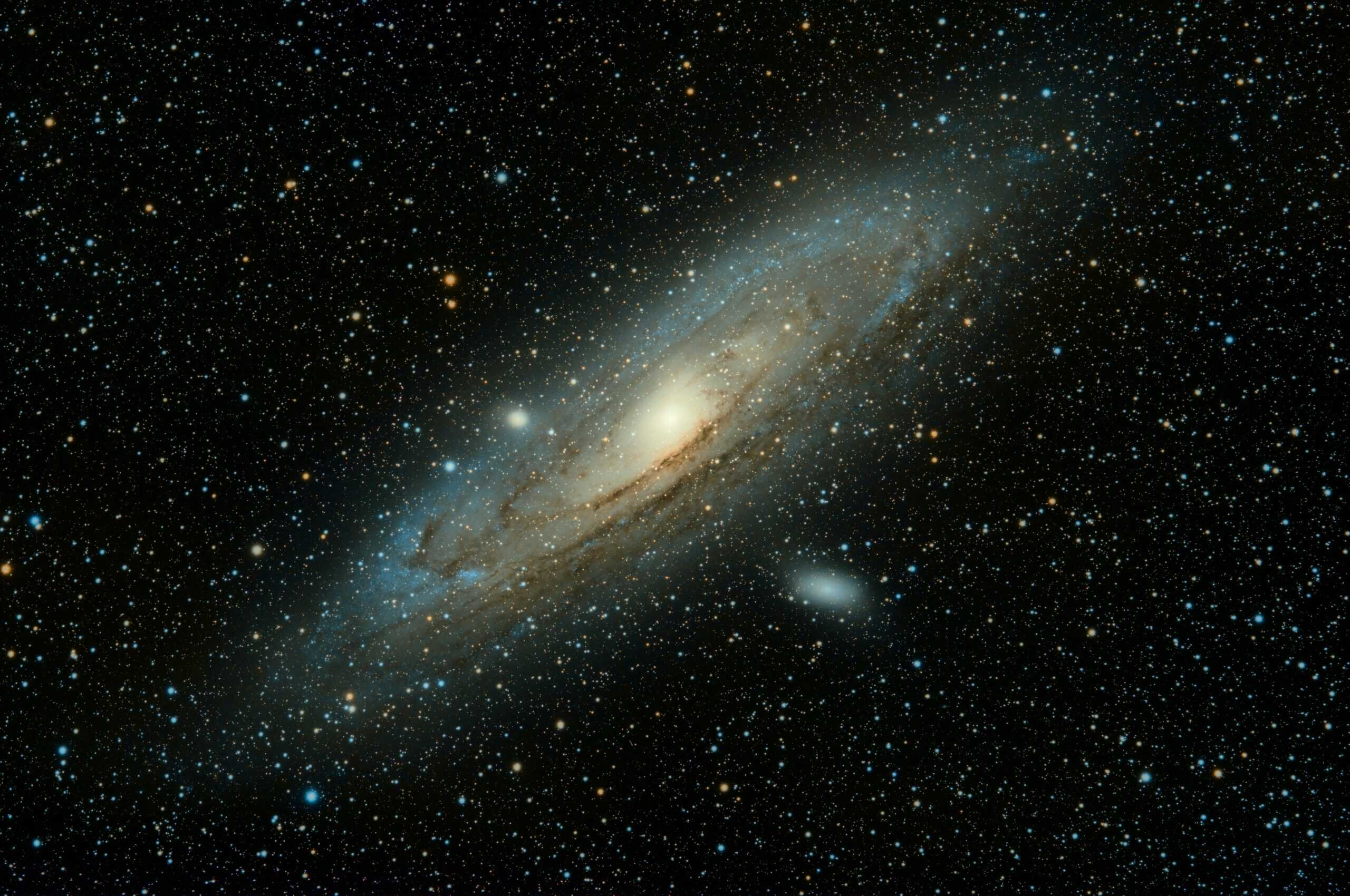
12. When you look at the Andromeda Galaxy with your naked eye, you are seeing light that left there 2.5 million years ago, before our species even existed.
13. The Andromeda Galaxy is heading straight for the Milky Way at 110 kilometres per second and will collide with us in about 4.5 billion years.
14. The observable universe is 93 billion light-years across, but that is only the portion we can see, and the full universe is almost certainly far larger.
15. In space, two bare metal surfaces permanently bond together the instant they touch, because there is no air to create the oxidation layer that prevents this on Earth.
16. A single teaspoon of material from a neutron star would weigh roughly 10 million tonnes on Earth, about the combined weight of every building in New York City.
17. There is a molecular cloud in space called Sagittarius B2 that contains a staggering amount of ethyl alcohol, along with many other far less appealing molecules.
18. Astronauts grow up to 3 centimetres taller in space because without gravity compressing the spine all day, the cartilage between vertebrae gently expands.
19. The footprints Neil Armstrong left on the Moon in 1969 will still be there 100 million years from now because the Moon has no wind, rain, or weather to erode them.
20. Explosions in space are completely silent because sound needs a medium to travel through, and space is a near-perfect vacuum with nothing to carry a vibration.
21. Time literally slows down near a black hole, an effect confirmed by real-world measurements and precise enough that GPS satellites have to correct for it every single day.
22. The first photograph of a black hole was taken in 2019 by linking eight radio observatories across the globe into a single virtual telescope the size of our entire planet.
23. Dark matter and dark energy make up about 95 percent of the universe, meaning everything we have ever seen, touched, or measured accounts for only around 5 percent of what actually exists.
24. Voyager 1, launched in 1977, is now over 23 billion kilometres from Earth and still transmitting, with signals that now take more than 22 hours to reach us even travelling at the speed of light.
25. There has not been a single day without a human living in space since November 2, 2000, when the International Space Station welcomed its first permanent crew.
26. NASA’s Europa Clipper launched in October 2024 to study Jupiter’s moon Europa, which has a global liquid water ocean beneath its ice that may hold conditions suitable for life.
27. The James Webb Space Telescope has photographed galaxies that formed just 570 million years after the Big Bang, the deepest look at the early universe ever achieved.
28. Every element heavier than hydrogen in your body was forged inside a star that exploded before our solar system was born, which means you are quite literally made of stardust.
29. The universe is 13.8 billion years old, and Earth did not form until 9.3 billion years in, meaning the cosmos existed for over two-thirds of its entire life before our planet ever appeared.
30. We are the only part of the universe we know of that looks up, asks questions, builds telescopes, and wonders what all of this is and where it came from. That is not a small thing.
Space does not ask for your attention. It just sits there, 13.8 billion years old, doing the most extraordinary things imaginable, whether anyone is watching or not. The fact that we watch says something good about us. Keep looking up.