

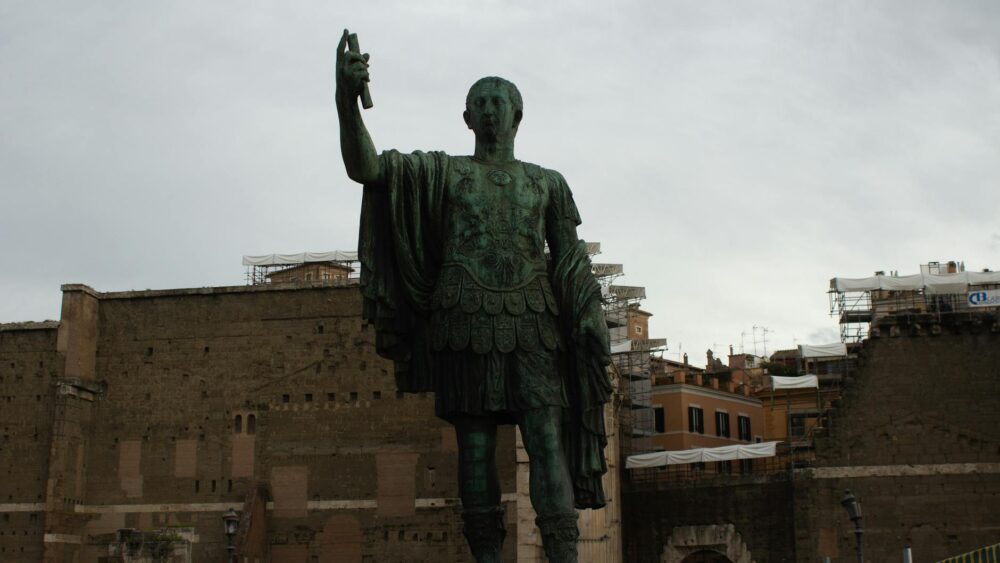
Roman emperor names are some of the most loaded words in Western history. Each one conjures a story: military genius, paranoid tyranny, accidental greatness, or a death so bizarre it still reads like fiction. From Augustus, who quietly remade the ancient world, to Romulus Augustulus, the teenager who watched it end, the names of Rome’s emperors are a living timeline of an empire that ran for roughly five centuries.
This list covers the rulers of the unified Roman Empire and the Western Roman Empire, moving roughly in chronological order and grouped by era and dynasty. These are real men with real names, and almost every story attached to them is stranger than anything invented.
The Julio-Claudian Dynasty (27 BC – 68 AD): Rome’s First Imperial Family
The dynasty that launched the imperial age. These five emperors set the template for everything that followed, including the ambition, the family murders, and the catastrophic succession crises.
Augustus
Born Gaius Octavius, he took the honorific title Augustus meaning “the venerable” or “the consecrated one” after defeating Mark Antony. He ruled for 40 years, transformed Rome from a republic into an empire, and died peacefully in his sleep at 75, which was practically a miracle in that company. The name became so associated with imperial dignity that it passed to dozens of successors.
Tiberius
The name comes from the Tiber River, Rome’s sacred waterway. Tiberius was a brilliant general who became an increasingly paranoid, reclusive emperor, eventually retreating to his island villa on Capri while Rome governed itself by rumor and terror. Ancient sources suggest he was either smothered or starved to death by the Praetorian prefect Macro, depending on who you believe.
Caligula
His real name was Gaius Julius Caesar Augustus Germanicus; Caligula was a childhood nickname meaning “little soldier’s boot,” given to him by legionaries who found a small child in camp uniform amusing. His reign began promisingly and collapsed into what ancient historians describe as cruelty and madness within two years. He was stabbed to death by his own Praetorian Guard in a corridor under the Palatine Hill.
Claudius
The name derives from the ancient Roman clan name Claudiuspossibly from a Latin root meaning “lame.” He was considered a fool by his family, survived multiple purges precisely because nobody took him seriously, and then accidentally became emperor when the Guard needed someone after Caligula’s murder. He turned out to be a competent, scholarly administrator. His wife Agrippina the Younger is widely believed to have poisoned him with mushrooms.
Nero
From the Sabine word meaning “strong” or “vigorous,” though his reign became synonymous with excess and persecution. He likely did not fiddle while Rome burned (the fiddle did not exist), but he did rebuild the city’s center as his own private palace. He fled Rome when the Senate declared him a public enemy and killed himself at 30, reportedly saying “What an artist dies in me.”
The Year of the Four Emperors (69 AD): When the Army Realized It Made the Rules
After Nero’s suicide, four men claimed the throne in a single year. It was the empire’s first real reckoning with the fact that an emperor’s power rested entirely on the loyalty of his legions.
Galba
An old, austere Spanish governor who seized power and immediately alienated the very troops who had supported him by refusing to pay the promised bonuses. He was murdered in the Roman Forum, and his head was paraded through the city on a pole. His reign lasted seven months.
Otho
A former friend of Nero’s who staged a coup against Galba and genuinely seemed to be developing into a capable ruler. When his forces lost the Battle of Bedriacum, he chose suicide over continued civil war, reportedly telling his men he would not let more Romans die for his sake. He had been emperor for three months.
Vitellius
A man whose historical reputation rests almost entirely on his appetite; ancient sources claim he held lavish banquets multiple times a day. When the Flavian legions marched on Rome, he was dragged through the streets, tortured, and thrown into the Tiber. His reign was eight months.
Vespasian
The survivor. Vespasian founded the Flavian dynasty, stabilized Rome’s finances after the chaos of 69, and began construction of the Colosseum. He reportedly made a joke on his deathbed: “Dear me, I think I’m becoming a god,” mocking the tradition of deifying emperors. He died of natural causes, one of relatively few emperors to manage it.
The Flavian Dynasty (69 – 96 AD): Builders and Tyrants
The Flavians gave Rome the Colosseum and two of its most discussed emperors: one beloved, one genuinely feared.
Titus
Vespasian’s older son, who commanded the siege of Jerusalem in 70 AD and later presided over the eruption of Vesuvius and a devastating fire in Rome. He was so popular and so effective in handling disasters that the Romans mourned him as a loss when he died of fever at 41 after just two years as emperor. The name is ancient Latin, possibly Sabine in origin, with an uncertain meaning.
Domitian
Vespasian’s younger son had a long reign of fifteen years that ancient senatorial sources painted as tyranny, though modern historians are more measured about his actual administrative record. He demanded to be addressed as “Lord and God.” He was assassinated in a palace conspiracy that included his own wife.
The Five Good Emperors (96 – 180 AD): Rome at Its Height
Edward Gibbon famously argued this was the happiest era in human history. Each of these emperors adopted his successor based on merit rather than blood, and the results speak for themselves.
Nerva
An elderly senator chosen by the conspirators who killed Domitian because he was old, childless, and inoffensive. He had the wisdom to adopt the popular general Trajan as his successor, setting the pattern for the next century. He died of natural causes after sixteen months, having arguably done more good for Rome by that single adoption than many emperors accomplished in decades.
Trajan
Born in Spain, the first emperor from outside Italy, and the man who expanded Rome to its greatest territorial extent through his Dacian wars. His name comes from the Roman family name Traianus. He died on campaign in Cilicia, and later Christian tradition would make him the one pagan emperor to receive a post-mortem place in heaven, supposedly through Pope Gregory’s prayers.
Hadrian
Trajan’s successor pulled back from some conquests and focused on consolidating and defending the empire’s borders, most famously by building his wall across northern Britain. He was a passionate traveler who visited almost every province in the empire, a devoted architect, and a man whose grief over his young companion Antinous, who drowned in the Nile, led him to declare the boy a god and name a city after him.
Antoninus Pius
His full name was Titus Aurelius Fulvus Boionius Arrius Antoninus, and his reign is notable largely for its extraordinary peacefulness. He ruled for 23 years, barely left Italy, and presided over a prosperous and stable empire. He died in bed at 74, reportedly falling asleep after eating Alpine cheese at dinner.
Marcus Aurelius
The philosopher-emperor who wrote the Meditations as private notes to himself and never intended them for publication. He spent much of his reign fighting Germanic invasions on the Danube frontier, conducting philosophy in a military tent. He died of illness during the Marcomannic Wars, and his decision to appoint his biological son Commodus as successor is widely considered one of history’s most consequential mistakes.
The Crisis and Its Prelude (180 – 235 AD): From Commodus to the Severans
After Marcus Aurelius, the empire lurched between capable administrators and men whose behavior still astonishes. The Severan dynasty held things together longer than it had any right to.
Commodus
The name comes from the Latin for “convenient” or “suitable,” which he was not. He renamed Rome after himself, declared himself the reincarnation of Hercules, and participated personally in the arena, which Romans found scandalous rather than impressive. He was strangled in his bath by a wrestler named Narcissus, on New Year’s Eve, 192 AD.
Pertinax
A disciplined former soldier who lasted 87 days as emperor before the Praetorian Guard murdered him for trying to restore financial discipline. His name comes from the Latin pertinax meaning “persistent” or “tenacious,” which describes his career but not his reign’s duration.
Didius Julianus
The man who bought the Roman Empire at auction. After murdering Pertinax, the Praetorian Guard literally auctioned the throne to the highest bidder, and Didius Julianus won. He ruled for nine weeks before a rival emperor arrived from the provinces and had him executed in his palace.
Septimius Severus
Born in North Africa, he marched on Rome, won a civil war, and founded a dynasty. He was ruthless, effective, and apparently exhausted: his reported last words to his sons were “Be harmonious, enrich the soldiers, and scorn all other men.” He died of illness at York in 211 AD while campaigning in Britain.
Caracalla
His real name was Lucius Septimius Bassianus, later renamed Marcus Aurelius Antoninus. Caracalla was a nickname from a type of Gallic cloak he popularized. He murdered his co-emperor brother Geta in their mother’s arms and then killed thousands of Geta’s supporters. He extended Roman citizenship to nearly all free inhabitants of the empire, which is either a sign of enlightenment or a tax measure, depending on your interpretation. He was stabbed by one of his own soldiers while urinating by the roadside.
Macrinus
The first emperor who was not a senator at the time of his accession and the first of North African origin (Septimius Severus was the first of African birth, but Macrinus was of Berber descent). He lasted fourteen months before being overthrown and executed.
Elagabalus
Possibly the most transgressive figure in the list of Roman emperor names. He was a Syrian teenager who served as high priest of the sun god Elagabal before being declared emperor by the Syrian legions. Ancient sources describe him wearing makeup, dressing in women’s clothing, and offering huge sums of money to any physician who could provide him with female anatomy. He was murdered by the Praetorian Guard at 18, and his body was thrown into the Tiber.
Severus Alexander
The last Severan, who came to power at 13 and ruled for 13 years under heavy influence from his mother Julia Mamaea. He was murdered by his own troops in 235 AD, who reportedly resented his mother’s interference and preferred their brutal general Maximinus. His death opened the door to the Crisis of the Third Century.
The Crisis of the Third Century (235 – 284 AD): Fifty Years of Chaos
Between 235 and 284, Rome cycled through roughly fifty emperors, depending on how you count claimants and usurpers. Most reigned for months. Most died violently. These are the ones whose names and stories stand out from the chaos.
Maximinus Thrax
Reportedly over seven feet tall, of Thracian and Gothic origin, and the first emperor to never visit Rome during his reign. He was murdered by his own troops, who were tired of his endless campaigns and decided peace with the Senate was preferable to continuing to follow him.
Gordian I
An elderly, wealthy senator who was declared emperor by African provincials during a tax revolt. He ruled for 36 days. When his son and co-emperor Gordian II was killed in battle, the elder Gordian hanged himself with his belt.
Gordian II
Died in battle against the governor of Numidia after about three weeks as co-emperor with his father. He reportedly had 22 concubines and 3 children, which is more than his reign time in days.
Gordian III
The grandson of Gordian I, he became emperor at 13 and was the third member of his family to hold the title in a single year. He ruled for six years, dying on campaign in Persia under circumstances that remain disputed: his own general Philip may have arranged his death.
Philip the Arab
His full name was Marcus Julius Philippus, and he presided over Rome’s thousandth birthday celebrations in 248 AD. He was killed at the Battle of Verona when his replacement, Decius, marched on Rome. His young son and co-emperor Philip II was murdered in the Praetorian camp on the same day.
Decius
A traditional Roman who launched the empire’s first empire-wide persecution of Christians and demanded universal sacrifice to the Roman gods. He was killed at the Battle of Abritus by the Goths in 251 AD, the first emperor to die in battle against a foreign enemy. His body was never recovered.
Valerian
Distinguished himself by becoming the only Roman emperor ever captured alive by a foreign enemy, taken prisoner by the Persian king Shapur I in 260 AD. Persian reliefs still show Shapur on horseback with Valerian kneeling before him. He died in Persian captivity, and ancient sources claim Shapur used him as a mounting step when climbing onto his horse.
Gallienus
Valerian’s son ruled alone after his father’s capture and managed to hold the empire together despite losing large territories and facing constant usurpers. He was murdered by his own officers during a siege, reportedly after they convinced him that a relief force was approaching and he ran outside to see it unprepared.
Claudius Gothicus
A tough Illyrian general who earned his cognomen by defeating a massive Gothic invasion. He died of plague in 270 AD, which made him unusual: death by disease rather than assassination. The Senate deified him, and later emperors including Constantine claimed descent from him to legitimize their own rule.
Aurelian
The man who genuinely saved Rome. He reunified the empire, defeated the breakaway Gallic Empire and the Palmyrene Empire, and built the Aurelian Walls around Rome that still partially stand today. He was assassinated by a group of officers who had been tricked into thinking he had condemned them to death, acting on a forged document.
Probus
Another Illyrian soldier-emperor who cleared the empire of Germanic invaders and put legionaries to work draining swamps and planting vineyards in peacetime, which they found humiliating. They murdered him in 282 AD, reportedly hiding in an iron watchtower to get close enough to do it.
Carus
A brief but militarily successful emperor who was reportedly killed by a lightning strike while on campaign in Persia, or possibly by his own men using the lightning as cover. The name is Latin for “dear” or “beloved.”
The Tetrarchy and Constantinian Dynasty (284 – 363 AD): Restructuring the Empire
Diocletian’s radical solution to fifty years of chaos was to split imperial authority among four rulers. It worked, briefly. What followed was Constantine, Christianity, and a permanently transformed empire.
Diocletian
The son of a freed slave who rose to become emperor, reorganized the entire Roman state, doubled the size of the army, restructured taxation, and then voluntarily retired to grow cabbages in his palace at Split, Croatia, which still stands. When colleagues begged him to return to power, he reportedly replied that if they could see the cabbages he had raised, they would not ask.
Maximian
Diocletian’s co-emperor in the West, a blunt soldier who made a capable partner. He retired alongside Diocletian, then came back for another attempt at power, then was forced to commit suicide by his son-in-law Constantine. His name derives from the Latin Maximusmeaning “greatest.”
Constantius I
Known as Constantius Chlorus (“the pale”), he was one of the four tetrarchs and Constantine the Great’s father. He died of illness at York in 306 AD, the same city where Septimius Severus had died 95 years earlier. His troops immediately proclaimed his son Constantine as emperor, jump-starting the next civil war.
Galerius
The eastern tetrarch who was the primary architect of Diocletian’s persecution of Christians, and who later issued an edict of toleration for Christians shortly before dying of what ancient sources describe in gruesome detail as an intestinal disease. Christian writers considered his illness divine punishment.
Constantine I
Constantine the Great converted to Christianity, made it the empire’s favored religion, founded Constantinople, and shaped Western civilization more than almost any other figure in this list. His name derives from the Latin constans meaning “constant” or “steadfast.” He died of illness in 337 AD, reportedly baptized on his deathbed, having waited until the last moment so his sins as emperor would all be washed away at once.
Constantius II
Constantine’s surviving son who reunified the empire after years of civil war with his brothers and cousins. He was a committed Arian Christian who spent much of his reign persecuting Nicene Christians, which earned him scathing commentary from historians including his own cousin Julian. He died of fever in 361 AD while marching to confront Julian’s usurpation.
Julian
Known as Julian the Apostate for his attempt to reverse Constantine’s Christianization and restore traditional Roman religion. He was a philosopher-emperor in the mold of Marcus Aurelius and a genuine intellectual. He died of a spear wound during a retreat from Persia in 363 AD, the circumstances suspicious enough that some ancient writers believed the spear came from his own side.
The Later Empire (364 – 476 AD): The Long Decline and Fall
The empire split permanently in 395 AD. The Eastern half would survive another thousand years as Byzantium. The Western half ground down through a series of emperors with increasingly little actual power until the last one was deposed and nobody bothered to replace him.
Valentinian I
A tough, capable soldier who defended the Rhine and Danube frontiers effectively for eleven years. He died in 375 AD from a burst blood vessel in his head, reportedly caused by the rage he flew into while berating a Quadian delegation for their impudence.
Valens
Valentinian’s brother and co-emperor in the East, who died at the Battle of Adrianople in 378 AD, killed by the Visigoths in what historians consider a turning point in the empire’s decline. His body was never found. The Visigoths had been welcomed inside the empire as refugees just two years earlier, then driven to revolt by Roman officials who exploited and starved them.
Gratian
Valentinian’s son, who appointed Theodosius to manage the East after Adrianople and then lost control of the West to a usurper. He was murdered at 24 in Lyon. His name derives from the Latin gratusmeaning “pleasing” or “thankful.”
Theodosius I
The last emperor to rule a unified Roman Empire, and the man who made Christianity not just favored but the empire’s mandatory state religion, outlawing pagan sacrifice. He died of illness in 395 AD, and his death permanently split the empire between his two young sons.
Honorius
The Western emperor who presided over the Visigothic sack of Rome in 410 AD, the first sack in 800 years. Ancient sources record that when told “Rome has perished,” he panicked, then relaxed when he realized they meant the city, not his pet rooster also named Roma. He ruled for 28 years and accomplished almost nothing deliberate.
Arcadius
Theodosius’s elder son and Eastern emperor, described by contemporaries as slow, easily manipulated, and generally absent as a political force. He died of illness in 408 AD after being dominated throughout his reign by a series of powerful ministers.
Valentinian III
Became Western emperor at six, ruled in name for 30 years while real power rested with his general Aetius, whom he eventually stabbed to death personally in a fit of rage. He was murdered six months later by two of Aetius’s former bodyguards while watching an athletic exercise in the Campus Martius.
Petronius Maximus
The senator who orchestrated Valentinian III’s murder and then declared himself emperor. He reigned for eleven weeks. When the Vandals arrived at Rome’s gates in 455 AD, he tried to flee and was torn apart by a Roman mob. His body was thrown into the Tiber.
Avitus
A Gallic aristocrat who lasted about a year before being deposed. He was either executed or forced to become a bishop, depending on the source. The name is an ancient Roman family name of uncertain origin.
Majorian
Arguably the last Western emperor who had a genuine chance of reversing the empire’s decline. He was an effective general, a thoughtful legislator, and was executed in 461 AD on the orders of his own general Ricimer, five days after being deposed. His name derives from the Latin maiormeaning “greater.”
Libius Severus
A puppet emperor installed by Ricimer with so little independent existence that his death in 465 AD may have been natural or may have been arranged. Almost nothing is recorded of his actual reign. His name, at least, is evocative: Libius is of unclear origin, while Severus means “stern.”
Anthemius
A Greek aristocrat sent from Constantinople to shore up the West. He and Ricimer despised each other, and Ricimer eventually besieged Rome itself to remove him. Anthemius was captured hiding in a church, dragged out, and killed by Ricimer personally near the Milvian Bridge in 472 AD.
Olybrius
Installed by Ricimer as Anthemius’s replacement, he then survived Ricimer by only a few weeks, dying of illness in 472 AD. He was emperor for approximately seven months and left almost no trace on history beyond his name.
Glycerius
Another emperor installed by a military strongman (Gundobad, Ricimer’s successor), deposed after about a year, blinded, and made a bishop in Dalmatia. The name is Greek in origin, from glykys meaning “sweet.”
Julius Nepos
The Eastern Empire’s preferred candidate for Western emperor, who expelled Glycerius and then fled to Dalmatia when Orestes raised a revolt. He continued to claim the title of Western emperor from exile until he was murdered by his own servants in 480 AD.
Romulus Augustulus
The last Western emperor, whose name was a cruel historical joke: Romulus, the name of Rome’s legendary founder, and Augustulus, a diminutive of Augustus meaning “little Augustus.” He was a teenager installed by his father Orestes, deposed by Odoacer in 476 AD, and mercifully spared because he was considered too young and pathetic to be a threat. He was pensioned off to a villa in Campania, and the Western Roman Empire ended not with a battle but with a bureaucratic dismissal.
How to Use Roman Emperor Names for Baby Names
Roman emperor names have been moving quietly back into fashion, and it is not hard to see why. Names like Hadrian, Julius, Maximus, and Aurelius have real weight and real history without feeling costume-y or theatrical. They carry their stories with them.
The best approach is to pick a name you can actually explain and genuinely love. Aurelius is having a moment right now, partly because of Marcus Aurelius’s cultural rehabilitation as the philosopher-emperor, and partly because it sounds both ancient and oddly modern. Hadrian has that same quality. Titus is crisp and strong and has been climbing the charts. Julian works beautifully in almost any context, with its Latin roots and centuries of use across European cultures.
Some names carry heavy historical baggage that is worth knowing before you use them. Caligula and Nero are effectively unusable for obvious reasons, though Nero is occasionally used in Scandinavian countries where the historical associations are less immediate. Commodus has a different problem. But names like Valerian, Carus, Gratian, and even Gallienus are so far outside common knowledge that they arrive as fresh discoveries, carrying Roman gravitas without the notoriety.
The middle name slot is where the more dramatic choices thrive. Valentinian, Diocletian, or Constantius as a middle name for a child named James or Clara? That is a combination that will raise exactly one eyebrow at every introduction for the rest of their life, which some parents consider a feature. Think about the rhythm: a short first name pairs beautifully with a long, rolling Roman name in the middle position, where its full weight can land without dominating the everyday.
Finally, do not overlook the meanings. Augustus means “venerable.” Maximus means “greatest.” Honorius means “honorable.” Gratian means “thankful.” These are not just historical names. they are names with genuine, aspirational meanings that have been carrying real people through recorded history for two thousand years.
Roman emperor names are the longest continuously used pool of given names in Western culture. Whatever you choose from this list, you are placing a child in a line of bearers that stretches back to the ancient world, which is either a beautiful thought or a slightly alarming one, depending on how closely you have read the entries above.